Showing posts with label MLS. Show all posts

Thursday, June 1, 2017

Giving Klinsmann His Due (If He's Owed It)

I know I've been incredibly wishy-washy about Jurgen Klinsmann over the years here.

Aside: You may ask: "Who cares about Klinsmann at this point? He's gone. Arena's got the men's team headed in the right direction. Enough is enough." But it's not, because ... well, because I've been searching in vain for something that interests me enough to post about, and this is where I landed. With the enigma that is Klinsmann.

I defended Klinsmann's decision to not include Landon Donovan in the 2014 World Cup roster, then admitted that it may have been a mistake. I took his side when critics accused him of being too European (or un-American), then took him to task for trying to assert ownership of the uniquely American traits of his team and players.

Ultimately, even though I liked the energy and inventiveness he brought to the position of National Team coach, I agreed that Coach Klinsmann needed to go based upon the U.S. team's miserable results in the first two matches of The Hex CONCACAF qualifying.

But I'm wondering now if his defense of his performance after he was let go, that his time with the team and its abrupt end was "an incomplete picture" was closer to the truth than we may have suspected at the time. At least as far as his second job, as technical director of all of the U.S. Men's teams, is concerned.


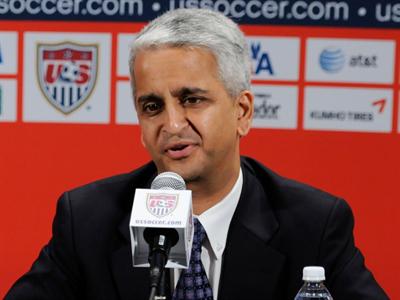
A bemused Klinsmann at a press conference
(photo from zimbio.com)

The recent showings by the U.S. Men's U-20 and U-17 teams have led me to think that Klinsmann was undervalued as a developer of young players, or at least of putting a system in place to help them succeed. While there are a variety of factors that no doubt play into the recent successes of our national teams with a "U" in front of them (MLS youth programs, more young players turning pro rather than going to college, more youth players signing with European clubs while young, etc.), I can't help but think that Klinsmann had something to do with the improvement, and indeed some of the other factors listed above.

Although his criticism of MLS was sometimes unwarranted and generally just not helpful, whether because of that criticism or just the organic growth of the league and its teams, much of the improvement in our national youth teams is due to the fact that most of the players at the U-17 level up are now professionals, a far cry from 10 years ago. It was Klinsmann who beat the drums for the professional development of young players (admittedly, at the expense of college soccer).

By the same token, the fact that more and more young Americans are going to Europe to play must play a role in the overall improvement of their national teams, not only from a technical aspect, but also simply from a comfort level of playing against the best in the world on a weekly basis. One has to look no farther than Christian Pulisic, who age-wise is eligible to be playing in the U-20 World Cup now being held in South Korea, but talent-wise has already graduated to the full men's team, to see the added value in playing professionally in one of the best leagues in the world (in his case, the German Bundesliga).  Again, it was Klinsmann who beat the drums for players to play professionally at the highest level (i.e., in Europe) although this again put him at odds with our American soccer establishment (such as it is) in the MLS.

The genesis of this post is the U-20 World Cup, in which, to this point, the Americans have never looked overmatched, have been inventive going forward, and have actually possessed the ball for long periods of time! After going down 2-0 in the first game against Ecuador, the U.S. fought back to tie at two, only for a gaffe/howler/_______ (insert English football phrase you deem most suitable) by American goalkeeper ... (wait for it ...) Jonathan Klinsmann, only to then score again in the fourth minute of extra time to earn a tie.

The Young Yanks then beat Senegal 1-0 and tied Saudi Arabia 1-1 after a series of incredibly bad refereeing decision that left them a man down for 55 minutes and three men down (due to yellow card accumulation) for the knockout stage match against New Zealand. And all of this was accomplished after the team's primary playmaker, Gedion Zelalem, was subbed off with an apparently serious knee injury only half of an hour into the Ecuador match.

While the group stage was encouraging, the New Zealand match was a revelation. Despite starting three players who had seen little playing time to that point, the Americans dismantled the Kiwis 6-0, as 17 year-old U.S. starlet (hauling out all the Brit football terms here) Josh Sargent scored his fourth goal of the tournament, and five others chipped in a tally as well.

As is always the case, Sargent's goal scoring has attracted much of the media attention (and interest from another Bundesliga club). But the work of those under coach Tab Ramos's guidance in the midfield and defense has been equally admirable.  Even operating without Zelalem, the team has looked confident on the ball and, except for the first half hour against Ecuador, preternaturally poised.

Similarly, the U-17 team (led by Sargent) had a good run in CONCACAF qualifying, winning a spot in that World Cup by tromping Cuba 6-2 before falling 5-4 in penalty kicks to Mexico in the Final.

Maybe it's the fact that Jurgen Klinsmann has been present for the U.S. U-20 World Cup matches, watching his son perform well (for the most part) in goal, that has led me to think of him a little more kindly and want to give him credit for our recent success at the youth levels. But I can't shake the feeling that, while Dad is present, his director ghost is too, and is more than a little pleased to see that his work is bearing fruit.

Monday, June 8, 2015

Insight and Eurocentricity

So much to catch up on in the world of soccer. FIFA scandal (or, more accurately, scandal finally exposed), Sepp Blatter, Hope Solo, the Women's World Cup, the Women's World Cup being played on an inferior surface.
 
But, for just a moment, a post about the game itself. Particularly, one player and how one coach can seemingly be completely insightful and completely wrong at the same time.
 
The player is Michael Bradley. While he didn't score (and frankly should have), he lead the U.S. Men's National Team to an improbable comeback win against The Netherlands last Friday in Amsterdam.
 
Bradley against Holland (photo courtesy of mlssoccer.com)
 
 
Before you say it, I know. Where do I stand on the "friendlies mean nothing" versus "friendlies tell us a lot" scale because I've been all over the place on it? But this isn't an evaluation of the entire men's team and its performance in Holland (which, frankly, was disastrous defensively) but of one player and his standout play and what it tells us about him and about Jurgen Klinsmann as a coach and as technical director of the Men's National Team.

First, the good news. Bradley was clearly the standout player on the pitch, for either team, and that includes Robin Van Persie, Klaas-Jan Huntelaar, and Memphis Depay (who was excellent going forward for the Dutch, but not so great in defense).Bradley pulled all the right strings for the U.S., including going on this mazy run that led to Bobby Wood's game winner at the death:

 
Bradley's excellence says much about him and his coach. Of Bradley, it tells us that he's willing to adjust his game, to bow to his coach's will for the good of the team (he is, after all, a coach's son). Since well before the 2014 World Cup Klinsmann has insisted that Bradley's role should be that of the attacking midfielder. And, for a long-time, many insisted that it wasn't working. With his great work rate and apparent defensive proclivity, Bradley continued to drop into the defensive mid role with which he seemed more comfortable.
 
The fruits of Klinsmann's insistence, and Bradley's compliance, were on display against Holland. Perhaps because Bradley knows that with Kyle Beckerman in the holding midfielder spot he can be more comfortable moving forward. perhaps out of desperation because, down 3-1 on the road there was no reason to play it safe. But whatever the reason, the hope is that Bradley is now comfortable with his new home.
 
Speaking of new homes, Bradley's performance again calls into question Klinsmann's mantra that the best American players need to play in Europe against the best competition to reach their competitive peaks. While admittedly the competition in the European professional leagues is still higher than that of MLS, Bradley's transformation has occurred not in Holland or Germany or Italy, which were all stops in his career, but in MLS playing for Toronto FC.
 
For every Bradley or Dempsey whose game has clearly benefited from playing in Europe, there are seemingly several Altidores and Sheas who sat on their benches in Europe and only played (and returned into the national team top tier) after returning to MLS. 
 
Is Europe still better? Yes. But only for players who play.
 
Hopefully Klinsmann the technical director will understand that message sometime soon.

Sunday, September 7, 2014

Trying to Keep College Soccer Relevant

While forces outside of the NCAA's control are compelling it to change the way that it administers its revenue-churning men's football and basketball competitions, at least one group is attempting to address issues from within. And in a "non-revenue" sport at that.

Led by WVU's Athletic Director, Oliver Luck (a former quarterback at the school and, perhaps more importantly for this subject, the former General Manager of MLS's Houston Dynamo) a group of college coaches, athletic directors, and administrators are trying to convince the NCAA and MLS that college soccer should move to all-season sport status, with the College Cup to take place in June, not November as it currently does.

The proposed changes would also allow more training time to college soccer teams and are aimed at improving training techniques and game preparation. Such a move would, hopefully, raise the level of play to that of lower division soccer in other countries. 

If the proposal is adopted, it would inject new life into college soccer in the U.S., which has been marginalized by MLS and its youth teams. Whether that diminution is a bad thing or not depends on who you ask. And when you ask them.

U.S. men's national team coach Jurgen Klinsmann has been particularly vocal about the need for the top-level U.S. players to play in Europe and its young national team players to train year-round with the best teams in the best training facilities, whether they be in Europe or with an MLS youth team in the States.

It's undeniable that the very best players in the World have, for generations, honed their craft in just that way - by playing constantly, with the highest level of coaching, against the best opponents. That is in fact how Klinsmann rose from an apprenticeship at his family's bakery to his fame as a World Cup hero and as feared striker for a number of prominent clubs in Europe.

But the problem with the European model is that for every Klinsmann or Messi or Rooney that it produces there are hundreds of faceless youngsters who became adults with no vocational ambitions to fulfill, tossed to the side because they're not quite big enough or fast enough. While some of the best youth programs offer education as well as soccer as a part of the curriculum, the primary reason that players are enrolled is to learn how to play soccer, not learn in the classroom.

Klinsmann, too, seems somewhat equivocal with regard to how he views American soccer, at both the developmental and professional levels. While he insists that the best players should play in Europe against the best of the world, he made Clint Dempsey the national team captain at the World Cup despite Dempsey's return to MLS last season. And, least we forget, Dempsey came of age as a player not after training in the depths of some professional team's youth ranks, but at Furman University.

Dempsey during his playing days at Furman,
(photo from furman.edu)

Perhaps most interestingly, among the players named to the U.S. squad for the recent friendly against the Czech Republic was Jordan Morris, the first collegiate player to appear on the roster since 1999. Morris apparently impressed Klinsmann while the national team trained at Stanford, where Morris is a sophomore, in scrimmages between the school's team and the U.S. men. While Morris was a player for the Seattle Sounders' youth team, he chose education over professional soccer in signing with Stanford instead of the Sounders.

Morris did not appear in the match, which the U.S. won 1-0 on an Alejandro Bedoya goal. But Morris' inclusion in the squad is hard to read as anything other than an indication that Klinsmann both recognizes his talent as a 19 year-old and validates the developmental training that he received in the Sounders' youth organization and at Stanford.

There are undoubtedly serious problems with the way the NCAA administers its revenue sports. Luck's proposal, however, presents an opportunity to the organization and its member institutions to make strides toward providing education for both sports and for life after sports, with the latter undoubtedly being the vocational destination for a vast majority of their players. 

The Soccer America article linked above suggests that Luck's proposal may well fail because, as a non-revenue sport, soccer simply isn't on the radar of may college athletic directors and presidents. They may either not want to set a precedent for other sports to seek a similar change, or simply not care enough about the development of college soccer to devote time to consideration of a change in how and when it is played.

Such a reaction (or non-reaction as the case may be) will simply be further confirmation of what the true "value" of college athletics to those that administer them is. And it would once again expose the NCAA's insistence to refer to those that play college sports as "student-athletes" for the sham that it is increasingly perceived to be.

Thursday, August 7, 2014

So Much for Goodwill

All the big European clubs are doing it.

Come to America, play a few friendly matches to tune up for the real "football" that starts in a few weeks. Sell some shirts, make some new fans from the burgeoning U.S. soccer culture. Goodwill tours can be very good business.

Except when there's no goodwill.

For ten years running, the MLS All-Star game has featured the best of the league (at some point anyway -- the fans seem to have a different idea of who the first 11 should be than me) against a European club. Fulham of the English Premier League was the first, followed by Chelsea, Celtic, West Ham, Man United twice, and others.

This year it was Bayern Munich, Champions League champ two years ago, finalist last year, winner of the most Bundesliga titles including the last two, chock-full of members of Germany's World Cup championship team, taking on the all-stars in Portland. Bayern is lead by Pep Guardiola, the former Barcelona coach whose style and temperament I previously admired.

The game was several steps above the usual all-star game fare in any sport. The players played hard, actually defended, and scored two great goals. Bayern went on top through a fabulous strike by Robert Lewandowski. That remained the best goal of the game for 43 minutes, until Bradley Wright-Phillips unleashed an unstoppable shot of his own in the 51st minute to tie the game.


Then things really got interesting. Osvaldo Alonso, the tough midfielder for Portland's rival, the Seattle Sounders, received a yellow card for a hard challenge on Bayern's Shaqiri. It was a foul deserving of a booking, but not horrendous. Six minutes later, Landon Donovan, who had come on three minutes after half time, was the recipient of a gorgeous ball from Portland's Diego Valeri and put the Americans ahead 2-1.

With a minute of regular time left, Portland's Will Johnson was carded for a foul against Bastien Schweinsteiger, who was last seen receiving a public beating administered by various Argentines in the World Cup Final. When the match ended, Guardiola refused to shake MLS coach Caleb Porter's hand, with two of his assistant coaches shoving between Pep and Porter like jackbooted Storm Troopers, ostensibly to protect Porter from Guardiola's wrath. 

It's hard to tell which of the above events set Guardiola off.  While the refusal to shake Porter's hand after the match was presumably justified in Guardiola's mind because the match had turned out somewhat less friendly than Guardiola had anticipated, it was just as likely because the result of the match was something other than what Guardiola had anticipated. Guardiola's failure to even admit post-match that he had snubbed Porter certainly didn't shed any light on the matter.

Pep wags his finger at Porter while the SS begins to intervene in the background. 

But either reason exposes Guardiola's lack of sportsmanship. As if it was somehow Porter's fault that Alonzo and Johnson had chosen to go into those tackles hard. Again I find myself agreeing with Alexi Lalas: "This is a game of soccer. If you don't want to risk anything, don't play the game. Don't come here, don't come here for the money, don't come here for the pre-season, don't come here for the game."

Whatever goodwill Bayern had built through its whirlwind tour was squashed under Pep's designer loafers, rejected by his wagging finger. Childish and petulant are adjectives that come to mind. Guardiola's players seemed embarrassed by his snub of Porter as several stayed on the field longer than usual after the match to exchange shirts, talk with the all-stars, and acknowledge the fans.

It didn't help. I know I'm not rushing out to buy a Bayern shirt any time soon. I doubt that many others in the stands in Portland or watching on tv had a different reaction. And it can't have been the denouement that the Bayern brass was hoping for.

Goodwill indeed. Get your arrogant butt back on the plane Pep, and play your European football all you want. We play soccer here, and we play to win.

Sunday, May 11, 2014

Soccer the Way It's Meant to Be

That was my tweet as I sat in the stands at Sporting Park in suburban Kansas City, soaking in the atmosphere before Sporting Kansas City's match against the Columbus Crew last Sunday. And I think I got it just right.

The crowd was fantastic throughout, singing, chanting, banging on drums and rooting their club on. And, I have to admit, that while I've supported the Crew since their inception, I certainly got caught up in the atmosphere and understood why the fans loved the team and that the feeling was clearly reciprocated by the players. Maybe that's why I wasn't the least disappointed that KC won the match 2-0.

Sporting KC's magnificent facility.

The contrast between the Kansas City crowd and those at Crew games was stark. While, admittedly, the Crew haven't given their fans a whole lot to cheer about in the past few years, the suspicion sneaked over you that there was something more fundamental at work - that the KC fans have embraced the sport and their club, while the Columbus fans have not, and probably never will.

More's the pity because the clubs are siblings of the same father - Lamar Hunt, one of the founding members of the MLS originally owned both franchises. But while, despite its professional football and baseball teams, the Kansas City area has become fervent about professional soccer, Columbus has not.

Rather than dwelling on the contrasts between the two franchises, however, I found more comfort in contrasting my experience at Sporting Kansas City Park with that of the first few MLS matches I ever saw in person. They were Crew games at what was then a decrepit Ohio State Stadium. Even putting aside my person distaste with regard to the facility and its regular tenant, it was a cold tomb in which the 10,000 or so in attendance on a good day were swallowed up by 80,000 empty seats.

From those humble beginnings, MLS has grown to scenes like those I witnessed last Sunday, on a beautiful day, with the sun streaming down on the natural grass pitch in a beautiful stadium dedicated to professional soccer. And similar scenes play out every weekend from one coast to the other, particularly in Seattle and Portland (although both have Field Turf pitches, which I can personally attest is beneficial where grass doesn't grow well, but is still not real grass) and Salt Lake City and Philadelphia and Houston.

Columbus corner kick in front of the "Cauldron".

We have become a soccer nation. And, at least some times, we play soccer the way it's meant to be.

Tuesday, March 25, 2014

The New Normal

First there was the call for the anonymous trailblazer, the modern day Jackie Robinson.

Then there was Robbie Rogers (although the "American" sports-centric press barely gives him passing mention).

And now Michael Sam. And Jason Collins (although Collins was really before Rogers or Sam, but wasn't playing professionally at the time).

This is the third year in a row that I've felt compelled to write about sexual orientation in sports, right around this time each year. And my how the dialogue has changed. From the (apparently) radical idea that athletes can hasten societal change, we are now at the point where the vast majority of the country recognizes that Rogers, Sam, and Collins are helping do exactly that. 

Sure, there has been the predictable backlash (primarily behind the anonymous curtain of social media), but there has been much more pubic praise for the fortitude that was displayed in coming out (Sam) and signing an NBA contract as its first publicly gay player (Collins). There's even the interesting symmetry between Collins' debut with his new team, the Brooklyn Nets, and Robinson's Brooklyn Dodgers.

Michael Sam (photo from theshadowleague.com)

To be clear: I am by no means claiming this as a victory for sports over society. Obviously, a conscious decision has been made by many in our country over the last few years to reexamine our attitudes toward sexuality, both individually and collectively. But, because they are such a part of our social consciousness, sports, more than perhaps anything else, cause us to examine issues that we may have casual or even subconscious predilections toward in a new way.

Interesting, too, is that "news" regarding female athletes coming out is no longer really news. While one might think that this is due in part to simple stereotyping (i.e., female athletes being regarded as "mannish"), I believe it's more likely attributable to the realization that female athletes were the real ground breakers regarding sexual orientation long before males made, or more precisely were required to make, their sexuality a public issue.

Billy Jean King, Martina Navratilova, and Sheryl Swoopes paved the way for Megan Rapinoe, Britney Griner, and Abby Wambach. To such an extent that, while Wambach's marriage to her long-time partner last year did make the headlines, it seemed that it was more because of who she was (one of the most visible female athletes in the country) not because she was marrying another woman. In other words, just another celebrity wedding in Hawaii.

Wambach said as much when she commented: "I can't speak for other people, but for me, I feel like gone are the days that you need to come out of a closet. I never felt like I was in a closet. I never did."

It certainly won't be tomorrow, and it may not be next year, but sooner or later, that day is coming for male athletes as well.

Wednesday, January 15, 2014

FIFA's Hypocrisy Knows No Bounds - Part II

Unless the European leagues all decide that they should change their seasons to a March to November schedule. Which is exactly what they appear to be considering.

The acting chairman of the European Club Association, Karl-Heinz Rummenigge (who is also the "top official" of Bayern Munich, almost indisputably the best soccer club in the world at the moment), just last week floated the idea that the European leagues should consider playing a Spring to late Fall season just like ... well, just like the MLS season that has drawn Sepp Blatter's wrath for years.

Rummenigge's reasoning makes so much sense, highlighting the issues (particularly bad weather) that Russian professional soccer has been endured since it switched its season to coincide with UEFA's, that FIFA will find very hard to ignore.

First, Rummenigge points out that, in Germany, France, or England "summer is the best period of the year. And that is the season we don't play. In deepest winter, when it is very cold and snowing, we play nearly all the time in conditions that are disagreeable for both players and spectators. It is not logical."

Not that logic has ever gotten in the way of Blatter's or FIFA's edicts in the past.

What may well appeal to both, however, is his second argument: that switching to a March to November season would ease the pressure on those who play for both club and country by clearly demarcating the club and international seasons. Many clubs now agonize over losing players in the middle of their seasons to train and play with their national teams, taking them away from their "paying jobs" and risking fatigue and injury.

And who knows? Maybe Rummenigge's idea was floated as part of a wider scheme by Blatter himself to justify what I wrote about in the first part of this post -- moving the 2022 Qatar World Cup to the winter of 2022-23. This may be the first step in allowing Blatter to retreat from his previous hard-line position on the seasons of the MLS and Russian professional leagues and appear as eminently reasonable in doing so.

The Russians listened when Blatter told them to move their
season. And for that these players say: "Thanks Sepp!"

Either way, if the European leagues move their seasons Don Garber, the MLS Commissioner, will breathe a huge sigh of relief. And all of Blatter's blathering about its non-competitiveness because of the position of its season will be revealed as just that.

Friday, January 10, 2014

FIFA's Hypocrisy Knows No Bounds - Part I

For years, FIFA Emir Sepp Blatter hounded MLS about changing its season to coincide with that of the European leagues. And, according to fairly recent reports, he may have been close to winning the argument. That should have changed, though, this past week with two separate developments regarding soccer and when it is played.

While the pretense of the advice was that the U.S. pro season should coincide with that of England, Spain, Germany, etc., it always struck me that Blatter's position on the issue was either incredibly naive (not caring that MLS can not now, and will not for years, if ever, be able to compete directly with the NFL) or, more likely, incredibly arrogant (Sepp thinks that if our pros play at the same time of year as Europe's they will be better players, so we should think that too).

Blatter didn't care that many MLS teams shared stadiums with NFL franchises or college football teams that made playing from August to May logistically impossible. Or that fans, forced to make the choice, would opt for football over soccer.  Or that the thought of playing soccer in Boston or New York City or Chicago or Denver or Toronto or Montreal in December and January and February is absurd (evidently, the NFL missed that memo too). Just his saying "play August to May" should have been all the reason we needed to make it so.

What soccer in March can look like in Denver.
(photo from USA Today)

Never mind that the Swedes aren't stupid enough to play in the Scandinavian winter, or that Brazilian clubs play May to December. Or that the Russians, who apparently caved in to Blatter's pressure, have experienced all sorts of issues in converting their season from March to December to August to May (hmm, maybe that's why they were awarded the 2018 World Cup? in a way, that would be a refreshing change from the usual monetary bribes).

The first development that should eliminate any consideration of kowtowing to the Blatter Rule on soccer seasons was a slip by FIFA Secretary General Jerome Valcke during an interview on a French radio station. Valcke admitted that it is likely that the 2022 World Cup (to be held in Qatar, remember?) will take place in December 2022 and January 2023.

Right smack dab in the middle of the domestic professional season Blatter has championed in most of Europe, forced on Russia, and has tried to foist off on the U.S. But in the Qatari winter, when temperatures will average a pleasant 25C rather than the brutal 50C weather in June and July, when the World Cup has been held in late May, June, and or July every time since its inception in 1930. Every time.

So much for tradition and concerns about domestic soccer. Not to mention the support of UEFA, which is thoroughly annoyed at the suggestion that the tournament will take place during both domestic competitions and its lucrative Champions and Europa League seasons, risking injury to its best players at the same time. Or of Fox and Telemundo which ponied up more than double the amount paid by ESPN to broadcast the South African and Brazilian World Cup to win the bid for the rights to the 2018 and 2022 Cups and now face the prospect of trying to convince advertisers that their money is better spent on soccer during the same months as the college football conference championship games, bowls, and playoffs and the NFL playoffs and Super Bowl.

While the ensuing denials, partial withdrawals, and outrage that followed Valcke's interview reveal FIFA at its Keystone Cops best, the real point is this: Blatter's demands that the U.S. change its domestic season were as baseless and dictatorial as most other decisions he has handed down during his reign.  

No matter how corrupt the selection of Qatar has proven to be (and it was astonishingly, brazenly corrupt, even for FIFA), no matter how stupid the idea of playing soccer in the Middle Eastern desert in June and July was, no matter how absurd the suggestion that the outdoor stadiums could be air conditioned for players' and fans' safety (yeah, that was b.s. too), the 2022 (well, and 2023) World Cup will be played there and then, the domestic season which he championed for years be damned. Which is pretty much what it will be.

Unless …


Monday, September 23, 2013

How Cool Is It That ...

How cool is it that ...

The son of a former major league baseball player is now an established veteran of Major League Soccer?

That MLS can now afford to bring one of the best American soccer players back to play in his prime?

That the undisputed home of the U.S. men's team is in Columbus, Ohio, a city dominated all day, every day except once every four years, by American football and is the residence of a fairly miserable MLS team in recent years?

That the "home" of MLS is the Pacific Northwest, where there was no MLS club six years ago?

That many MLS clubs now play, or at least attempt to play, dynamic, passing football rather than the long ball and hoof it game that dominated the game in the U.S. for most of its formative years?

I'll admit that I've been a fan of soccer teams other than MLS clubs for a long time. Blackburn Rovers, Celtic, Barcelona, and now I am grudgingly becoming somewhat of an Arsenal fan as I have convinced myself that it will be years, if ever, before Rovers make it back to the Premier League and I want a club to root for in the Premiership.

But I think many American soccer fans, later to come to the game than I, are doing the MLS and American soccer a disservice by ignoring MLS in favor of the EPL.

There is no dispute that the level of soccer in MLS is still not equal to that of the top European leagues. Or some of South America. Or even (not yet) the Mexican League. But it's gaining. And it's our league.

American soccer consumers have been duped, first by Fox, now by NBC, into thinking the Premier League is the be-all and end-all of professional soccer. And I'll admit, that I am among that number and continue to be, because I've followed the highest (and lesser) levels of soccer in that league for close to 20 years now.

But we confuse the hype with the play on the field. And confuse the Premier League with English soccer. Let's face it, England long ago stopped being the center of the World's game. Except for the huge infusion of cash by foreign owners of EPL clubs, which brought it back to prominence in the 1990's and the early part of this century.

Four of the last five UEFA Champions League winners have not been English clubs. In the past 20 years, Spanish clubs have won six titles, Italian and English four, German three, and French, Dutch, and Portuguese clubs one each. And while I don't have the time or inclination to examine the rosters of each club, my uneducated guess is that, with the exception of Manchester United's 1998 roster featuring Beckham, Giggs, Scholes, Keane, etc., the English clubs that won had more "foreign" players than those from the other countries had.

This post didn't start out with the intention of bashing the Premier League, its clubs, or its fans. Especially not its English fans, many of whom have followed the same club, through thick and thin, for generations. 

But American soccer fans have a certain obligation, I believe, to grow the game in this country. And the only way that can be done is with a strong domestic professional league.

I took this picture at a Sporting Kansas City match in 2012.
I wasn't supposed to end up right next to the field while trying
to find my seat, but took advantage of the situation.
Yes, MLS has its definite flaws. And the quality of play, while improving, is not up to that of the best leagues in the world. But it's getting better, and it's feeding more and better players to our national team.

So, go ahead and watch the Premier League on Saturday and Sunday mornings. But watch the MLS too. Or better yet, go see a game in Columbus or DC. It's a great experience. And it's real football.

Wednesday, May 22, 2013

Plenty Not to Like

Who put Bud Selig in charge of MLS?

There seem to be few explanations other than Selig-esque crass commercialism to justify the decision announced this week that the 20th MLS franchise has been awarded to New York City and its new owners, Manchester City and the New York Yankees. But apparently MLS Commissioner Don Garber is not only willing to take credit for the anointment of the newest club, he appears to actually thinks it's a good one.

Put together two of the most hated sports franchises in the universe and plop them down in a city that has shown a complete inability to support one, let alone two, professional soccer teams and you get what, exactly, that is appealing?

One wonders if the awkwardly named N.Y.C.F.C. was saddled with the moniker just to even things up with the New York Red Bulls and their uninspiring identification. "Go over-caffinated, sugary energy drinks!" doesn't lend itself to song or loyalty any more than the attempts by other MLS franchises to pander to Euro-snob U.S. fans by changing their names to sadly mimic storied franchises overseas ("FC Dallas", "Sporting Kansas City", "Real Salt Lake").


As smart as the decision was to add first Seattle, then Portland and Vancouver (with their devoted fan bases and true rivalries) to the fold in recent years, the selection of another New York City franchise appears even more ill-conceived than the attempt to create a rival for the L.A. Galaxy was by adding Chivas USA (whose attendance is abysmal so far in 2013).

Derbies aren't like sea-monkeys. They don't magically appear when you add water, or, in this case, a big pile of oil money and the Yankees' "mystique." That the Yankees were added as a minority owner in what appears to be an attempt to leverage Randy Levine's ability to strong-arm local politicians into handing over the use of public spaces to build nine figure playgrounds for rich owners makes the decision even more odious.

While the eight million or so denizens of The Big Apple will now have their choice of two soccer teams to ignore, those throughout much of the rest of the nation, many with soccer-rich traditions that pre-date both Garber and MLS, are left scratching their heads and wondering what they have to do to warrant consideration for franchises 21 and 22, which are apparently still in the works.

Prior to the NYC announcement, Garber had had identified Miami, Atlanta, Minneapolis, and Orlando as possibilities for additional expansion. Orlando actually makes some sense, based on the dearth of professional soccer at the highest level in the fourth most populous state in the country. Miami has already had its chance and it, like Atlanta, has consistently proven for decades its inability to sustain franchises other than pro football. Minneapolis? A nice place in July and August, but it will almost certainly need a turf field, which causes its own problems.

The wrong-headed approach to MLS expansion appears to be driven by identifying owner groups seeking a franchise and then either choosing somewhere to plop it, or to accede to their demands for a location, rather than on the fan-base of an area and its interest in soccer. St. Louis, with a long history of soccer enthusiasm and excellence in support of teams at the youth and college levels, is ignored not because it wouldn't support a franchise, but because the individual who has put himself at the forefront of its efforts to capture a club is likely not up to the task. And don't even get me started on poor Rochester, which carried the banner for soccer in New York State for years and isn't even close to being in the conversation anymore.

More and more, despite its bizarre and inscrutable rules regarding salaries, designated players, and player contracts, MLS is just another American professional sport. While the players are still expected to be grateful for whatever is thrown their way, when it comes to ownership and the location of franchises, money is the only thing that talks.

Friday, May 17, 2013

Gone for Good

That Landon Donovan was not named by coach Jurgen Klinsmann to the latest U.S. Men's World Cup qualifying squad for five upcoming matches -- two friendlies and three hex matches -- is not particularly surprising. Donovan, after taking a three months sabbatical from soccer, is trying to round back into shape in the L.A. Galaxy line-up, with varying degrees of success.

After making the decision, Klinsmann said the right things about Donovan -- noting that he understood and respected his decision to take time away from the game -- but also made it clear that this team is his, not Donovan's, and that it is developing its own identity, one that does not include Donovan as its centerpiece, if at all. Donovan also made the appropriate "team player" comments after his exclusion -- understanding and respecting Klinsmann's decision, saying that he will continue to work hard to get in game shape and win his way back into the squad.

While many have speculated that Donovan will return to the team for this summer's Gold Cup (and Klinsmann has noted that is a possibility) that doesn't necessarily mean there will be a place for Donovan in the matches that matter leading up to and hopefully including the World Cup in Brazil, since the coach has also said that he will likely call in an entire "second team" to play in the tournament. And while Klinsmann has not ruled Donovan out of future World Cup qualifiers, his comment regarding Donovan's chances of returning to the squad: "maybe later on we'll definitely expect him back in the team" hardly sounds like a ringing endorsement.

One of the obstacles that both Donovan and Klinsmann face to Donovan's return is where will he play? Clint Dempsey has essentially replaced Donovan in the number 10 shirt of the withdrawn forward or attacking midfielder (albeit with a somewhat different style -- Dempsey is more likely to try to advance the ball from midfield himself, taking on defenders, while Donovan relied on speed, passing, and diagonal runs).

Donovan after scoring the most exciting, if not most important,
goal in U.S. soccer history against Algeria in the 2010 World Cup.
Photo from The Second Ball blog.

The team is desperate for out-and-out wingers and Donovan has played on both the left and right in the past. But he was never a true winger, preferring to return to the center of midfield and rarely took the ball to the corner to send in a cross. And one wonders if age is robbing him of the speed that was a hallmark of his game, as well as an essential tool for a winger who can stretch an opposing defense.

Qualifying matches have revealed a weakness in the Americans' dead-ball skills, something for which Donovan is known. But he's already missed two penalty kicks in the MLS season, so even that  potential contribution is in doubt.

Regardless of whether Donovan regains a spot in the squad, it is clear that it will no longer be "his" team. That in itself indicates the passing of an era. Clearly one of Klinsmann's goals is to make the national team his, or (to give him the benefit of the doubt) the U.S. Soccer Federation's . It may be the most significant contribution he will make to moving the sport forward here.

Sunday, January 27, 2013

The Year of Ascendance or Disaster?

An important year awaits U.S. soccer, both on the men's and women's sides.

The women will face the year adjusting to a new coach as Tom Sermanni officially takes over from Pia Sundhage, now in charge of the national team in her native Sweden. While the team has understandably expressed excitement at the prospect of having a new coach with new ideas after five successful years under Sundhage (understandable because, well, if they're going to play, they're going to play for Sermanni), several key players are aging at positions that usually expose age (everywhere but keeper, really).

On the professional front of the women's game, the National Soccer League is set to begin play in April. The league announced this past week the allocation of National Team players from the U.S., Mexico, and Canada to the eight franchises, which include essentially are four teams from the former WPS (Boston, "Sky Blue", based in the New York City area, Western New York (Rochester), and Chicago) and four new clubs and cities (Seattle, Portland, Kansas City, and Washington D.C., which had a team for two years before it was moved to Florida).

The players were allocated with the help of a panel of experts, presumably to assure parity. Some effort appears to have been made to allocate American players close to home as well (for example, Hope Solo and Megan Rapinoe to Seattle, and Abby Wambach to Rochester).

While I don't profess to be familiar with any of the Mexican or many of the Canadian players, at first glance the Portland club, with Tobin Heath, Alex Morgan, and Christine Sinclair from Canada look to have the makings of a powerful offense.

Presumably, as much interest will be focused on the business model of the new league as it tries to succeed where two of its sisters recently failed. Smaller, and in some instances shifting, venues and subsidies from the U.S., Canadian, and Mexican national teams may at least provide a tourniquet for the financial bleeding that is bound to occur with any fledgling professional league.

Meanwhile, on the men's side the National Team faces the final round of qualifying ("The Hex") for the 2014 World's Cup. Who will be in the starting 11 against Honduras on February 6 is anyone's guess, including, more likely than not, head coach Jurgen Klinsmann's. Keeper Tim Howard is a lock. Michael Bradley and Clint Dempsey are certainties, barring injury. But even where they will play is not clear. Bradley could play holding midfield, or as an offensive mid. Dempsey could play out wide in a 4-3-3, as a withdrawn forward, or up front (although he does not seem to be preferred by club or country as an out-and-out striker).

Michael Bradley is one of the few certainties in the U.S. lineup.

The big questions are who will make up what was an inconsistent defense and who will play up front and in what configuration. Is it time to replace Steve Cherundolo and Carlos Bocanegra in back? Will Herculez Gomez, Jozy Altidore, Juan Agudelo, Eddie Johnson, or Chris Wondoloski play up front and alone or with a partner?

Whatever the line-up, the results have to be sufficient to qualify for the 2014 World Cup.  There is no doubt that soccer's popularity is on the rise in the U.S. But in the women's game, the interest has been limited, to this point, to the national team.

By the same token, the rise in popularity on the men's side has largely been concentrated on the European professional leagues, particularly the English Premier League. And while it's encouraging that there are more broadcasts of soccer than ever, and that results even occasionally creep into smaller newspapers, it doesn't do a lot to grow the professional game in the States.

In order for that to happen, soccer fans have to take more of an interest in MLS, either by attending or just by raising the t.v. ratings. And that's most likely to happen if the men's team, stocked primarily with MLS players, qualifies for its seventh consecutive World Cup. Failure to qualify will not only be a blow to the growth of the game here, but also to U.S. Soccer, which invested its future (not to mention a lot of cash) in the talismanic Klinsmann.

I may be a Pollyanna, but I think Klinsmann will figure it out and the U.S. will qualify either first or second in the group. And the star of the team will not be Dempsey or Altidore or Landon Donovan. It will be the former coach's son - Bradley.

Sunday, November 25, 2012

Third Time's a Charm?

Amidst the orgy of turkey, Black Friday, and college football this past week you may have missed the announcement that, for the third time in the past 12 years, a women's professional soccer league will begin play in the U.S. this coming spring.

The WUSA was formed in the wake of the U.S. Women's National Team's triumph in the 1999 World Cup here in the U.S. Much as the formation of MLS following the men's World Cup in the States in 1994, the notion was that it was the perfect time to start a women's league with all the momentum that the sport had gained after the climatic final game, won by Brandi Chastain's famous pk.

That league folded after just three years though, drowning in debt caused, at least in part, by the signing of big name players from abroad and (based on the attendance and limited television exposure and dollars) high salaries for the players. The WUSA tried to hang on through the next year, holding a few "exhibition" matches which were essentially all-star games, but finally gave up the ghost.

Women's Professional Soccer jumped into the void for another three years, but it seemed even more doomed from the start. Feuding (and seemingly imbalanced), owners, lackluster crowds, and frankly dull play led to another three seasons, but even the most hard core fan would be hard-pressed to name more than one team, let alone more than one champion. The WPS played in 2009-2011, but in January of this year announced a hiatus and eventually disbanded.

The success of the U.S. Women's National Team this summer in London, however, led to renewed talk of another women's professional league. While the WPS had tried to associate with MLS and thus reduce facilities costs, the effort never seemed to take hold outside of, perhaps, Philadelphia. The announcement of the new league, however, came not from potential owners but from Sunil Gulati, the President of the U.S. Soccer Federation. 

Gulati, whose day job is a senior lecturer in economics at Columbia, believes he has finally developed a  "sustainable" economic model for the women's professional game in the States. The as-yet-unnamed league will work in cooperation with the U.S., Canadian, and Mexican Soccer Federations in paying the salaries of many of the players in the league. U.S. Soccer will also finance the administrative costs of the league, presumably while trying to ensure that costs are held in some close approximation to the revenues generated by attendance, television rights, and collateral income.

Gulati, at the press conference announcing
the formation of the new women's league.

The new league will also likely follow more closely the MLS model by limiting, at least initially, the number of foreign players allocated to each club ("foreign" meaning in this context non-American, Canadian, or Mexican) and to begin play in smaller venues to enhance fan participation and camaraderie.

While it remains to be seen whether a women's professional league is sustainable in the U.S., Gulati's plan seems to have the kernels of the model that could work. But what else would you expect from an Economics professor who has been called "the single most important person in the development of soccer in this country"? 

Monday, July 9, 2012

Let's Call it Courage

There are a lot of critics and pundits and journalists who object to the use of terms like courage and bravery and honor when it comes to sports. Sometimes even athletes join in, noting in interviews that the "real heroes" are those who serve in the armed forces or try to raise families on minimum wage incomes, or fight fires or walk a beat.

I too am sometimes off-put or even offended when sportscasters breathlessly whisper about an athlete's courage in playing in a game despite an injury or after the death of a loved one. This discomfort is heightened when athletes and coaches use military terms to refer to the games in which they participate.  No matter how difficult or grueling or against all odds a contest may be, when you go on to a field of play you are never going into battle.

But there are moments in sports, unlike almost any other endeavor other than war, in which courage is truly shown. One such instance occurred Sunday, when a soccer player made an appearance in the last five minutes of a match between the Seattle Sounders and the Colorado Rapids.

Steve Zakuani had been severely injured in in a match against the same opponent 15 months earlier. In April of 2011, Brian Mullan, a midfielder for the Rapids, tackled Zakuani hard near the touchline. Zakuani's foot caught beneath him and he fractured his right fibula and tibia. Zakuani was told by doctors he would never play soccer again. Mullan was suspended for 10 matches.

Through a long and painful rehab, Zakuani maintained a positive outlook, which he continued to demonstrate during the match (he was only on for about six minutes, but there was at least one slide tackle challenge -- not from Mullan -- that had me holding my breath) and afterward when he and Mullan embraced and exchanged shirts.

Zakuani and Mullan embrace, before trading shirts.

To make it through that grinding recovery, then step on to the pitch with the player who had maimed him (Zakuani had long before forgiven Mullan and Mullan, to his credit, showed genuine remorse from the start) can only be called courageous. Zakuani may or may not, ultimately, fully recover from his injury. But I can't imagine that anyone is not rooting for him to do so. And I can't think of any word that more aptly describes his comeback, and his actions, than courageous.

And as for the Sounders' fans, if you need any affirmation that the United States is becoming a soccer nation, just take a listen. Eddie Johnson, the Sounders' forward who has played in the English Premier League and Championship, Greece, and Mexico, in addition to MLS, said of the fans: "Man, that's the loudest I've ever heard it. that's the loudest I've ever heard a stadium." 


The whole video's almost nine minutes long, but stick around for the first minute and a half, when the Sounders' fans chant "Steve!" "Zak-u-ani!" back-and-forth. If that don't raise the hair on the back of your neck, nothing will.