Showing posts with label FIFA. Show all posts

Wednesday, July 12, 2017

Cups All Around (and not a Drop to Drink)

Some observations after watching most of the Confederations Cup and attending the U.S. Men's National team Gold Cup game against Panama in Nashville:

1.  The Confederations Cup Is No Longer a Test for Anyone but the Host Country.  Sure, you can say that the Germans don't have a B Squad, or that even their second team is better than most other countries, but whatever the excuse or the analysis, the simple fact is that they breezed through the Confed Cup starting exactly zero players who started the 2014 World Cup Final against Argentina. 

While roster turnover is a fact of international soccer, and it would be a shock if Philipp Lahm or Miroslav Klose featured in the 2018 German World Cup team (since both have retired from international football), there are several players from that team (Neuer, Ozil, Muller, Boateng) who seem naturals for the next edition as well. But they were nowhere to be found on the squad as Joachim Low chose a team without a wealth of international experience. The Germans won four games and tied one, "avenging" the tie by beating Chile 1-0 in the Final.

2.  Russia Met its Lowly Expectations. Apparently the "test" for Russia hosting these games, as far as FIFA was concerned, was to prove that it could be at least superficially friendly to traveling supporters of the participating teams and avoid any overt racism, homophobia, or hooliganism. While new FIFA Capo Gianni Infantino said that the tournament was a great success, it remains to be seen whether Russia can duplicate the feat on a much larger scale, with many of the stadiums not used for the Confederations Cup still not complete. Not to mention the pesky North Korean labor abuses upon which those stadia are apparently being built.

3.  Russia's Men's Soccer Team Met its Lowly Expectations. Which is to say, it sucks. Although one player, Yuri Zhirkov, was fun to watch.

4.  Mexico is Still Mexico. Which is to say, it folds on the big stage. The best Mexico has to offer was a poor, poor second to Germany in the semis, losing 4-1, and couldn't beat a Ronaldo-less Portugal in the third place match.
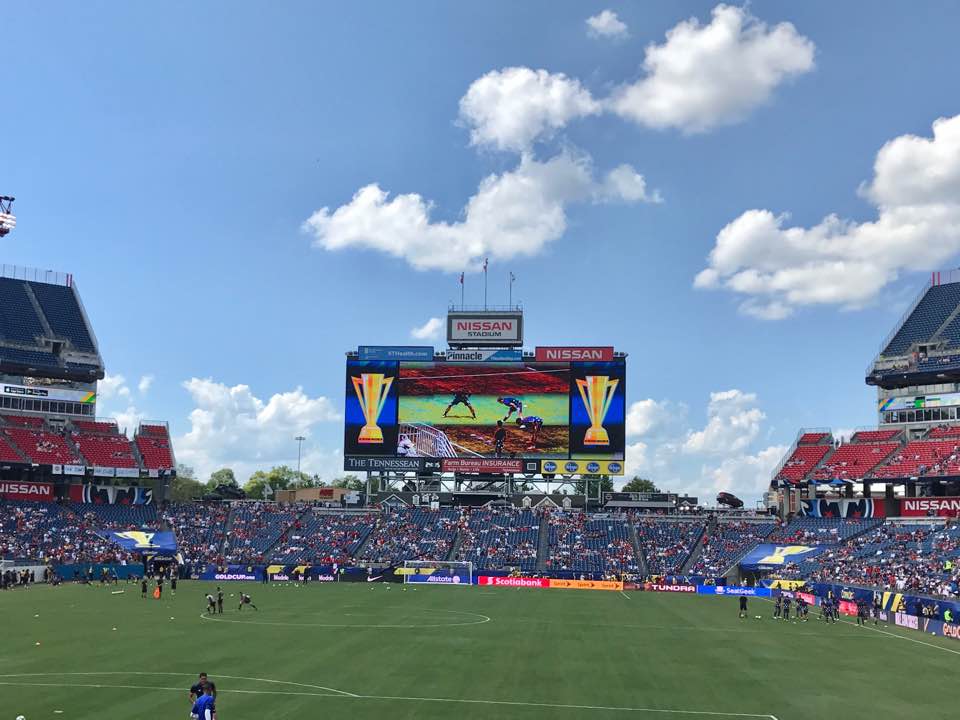
The view of Nissan Stadium in Nashville from the American
Outlaws' section prior to the U.S. v. Panama match. (photo by me)

5.  The U.S. Men's B Team is Not Germany's B Team. Or C Team. No surprise there, of course, but the performance against Panama was dross. Fortunately, the players know it and Bruce Arena knows it. While Arena chose to use the Gold Cup as a testing ground for players who are on the fringe of the potential 2018 World Cup roster, they were out-of-sorts defensively and particularly in the midfield. Which leads to the final observation ...

6.  Shut Up About Michael Bradley Already. After every U.S. match of any significance, the trolls crawl from their parents' basements to complain about how Bradley gives away the ball too much, doesn't play high enough, doesn't play back enough, blah, blah, blah. If the match against Mexico at the Azteca and a Bradley-less midfield against Panama don't convince you of Bradley's quality and the absolute necessity that he be a starting midfielder for the U.S. as long as he wants to strap on his boots and don the shirt, nothing will.

While Kellyn Acosta was good in the warm-up match against Ghana and threw himself around a bit against Panama, the other two center mids against Panama, Dax McCarty and Joe Corona, were abysmal. Here's hoping Arena gives someone (anyone) else a shot against Martinique. But only with the caveat that they will back-up, or at best play alongside, Bradley.

Wednesday, June 15, 2016

A Plateful of Soccer (Best Served Cold)

We've got the Euros all day long and the Copa America in the evenings. I'm already spoiled enough that I am perturbed that there are no Copa 100 games Wednesday before the quarterfinals start tomorrow.

As a result, writing choices abound ...

There were the U.S. men's spirited displays against Costa Rica and Paraguay (and we have to credit Jurgen Klinsmann some for that, don't we?) in not only overcoming a desultory 2-0 loss to Columbia in the first game of group play, but in ending up winning their group.

There is the game tomorrow against Ecuador, and perhaps a deserved backtrack from a certain comment about them being "minnows" in CONMEBOL when they currently lead its qualifying, are ranked 13 in the world, and have qualified for three of the last four World Cups.

But there was something even more compelling that happened on the other side of the pond.

Iceland is playing in its first major tournament ever, thanks at least in part to the expansion this year of the field at the Euros from 16 to 24 teams. But make no mistake, "Our Boys" (or "StrĂ¡karnir okkar" in Icelandic if you prefer) earned their way to the Finals by finishing second in their group in qualifying, beating The Netherlands at home and away in the process.

To put things in population perspective (as I'm want to do), Iceland's population is roughly 330,000 people, or a few thousand less than that of, yes, Kalamazoo, Michigan. As far as countries go, Iceland is wedged between Belize and The Bahamas (or 179 out of 209) in population of  FIFA member nations. But in the FIFA world rankings, Iceland is #34, between the Republic of Ireland and Sweden, and just three spots below the U.S.

The most recognizable Iceland player to international soccer fans is probably Eidur Gudjohnsen, who played, and played well, for Barcelona and Chelsea back in the day but is now 37 years old and did not start or appear off the bench for their first major competition match, against Portugal and Cristiano Ronaldo.

Interesting side note: Eidur Gudjohnsen and his father, Arnor, hold the unique distinction of being the only father and son to appear on behalf of their country in the same international match.  Arnor started the game, against Estonia in 1996, and Eidur, 17 at the time, came on in the second half as a substitute for his dad.  

In the Portugal match, Iceland, a true soccer minnow, tied mighty Portugal and Ronaldo 1-1. Iceland fought and scrapped and was a little bit lucky, but survived. Afterward they celebrated like, well, like a country that had just tied its first ever match in an international tournament against the eighth best team in the world and a player about whom my friend Mike would say "Ronaldo loves him some Ronaldo."

Portugal took the lead in the match, but Iceland, with one of the precious few chances it had, tied it 50 minutes in on a goal by Birkir Bjarnason, then held on for the next 40 minutes for the tie, surviving two Ronaldo free kicks deep into stoppage time.

Bjarnason celebrates his goal (photo from theguardian.com)

Was it particularly attractive soccer? No. But it was a demonstration of why soccer is great and why, sometimes, a team underskilled and undermanned (although, as is apparent from the picture, not undercoifed, even against pretty boy Ronaldo) can, for 90 minutes, make up for all of those deficiencies by playing gritty, desperate, team soccer.

“Iceland didn’t try anything,” whined the Portuguese captain. “They were just defend, defend, defend and playing on the counterattack. It was a lucky night for them. We should have three points but we are OK. I thought they’d won the Euros the way they celebrated at the end. It was unbelievable. When they don’t try to play and just defend, defend, defend, this in my opinion shows a small mentality and they are not going to do anything in the competition.”
To which Karo Arnason, an Iceland center-mid, responded: "tough shit."

I could add more about Ronaldo, but the Telegraph article is too well written to even try to challenge. So I leave you with these observations about Ronaldo while I hope you revel in the smorgasbord of soccer from which we are feasting, whilst Iceland parties like it's 999, and while I fervently hope someone is forced to eat a little crow:
But Ronaldo would not be Ronaldo if he did not view every single game as a stage for him alone to confirm his greatness, rather than an opportunity for any Tom, Dick or Heimar to seize their own 15 minutes of fame.
He is the ultimate back-garden bully, the kind of barbecue guest who would spend the afternoon doing step-overs past seven year-olds and nutmegging the neighbours’ arthritic collie. It is that mind-set which has made him great. You don’t score 487 career goals, including 50-plus a season for the last six seasons by routinely squaring to better-placed team-mates.
... you get the impression that even now, at the age of 31, it does not matter how luxurious the hotel suite – if Ronaldo has no goal to replay in his mind before lights-out, he does not get a good night’s sleep.

Saturday, April 9, 2016

Killing The Goose?

"We are the best in the world" said Hope Solo in announcing her support for the EEOC complaint filed by her and four other members of the U.S. Women's National Soccer Team this past week against the U.S. Soccer Federation.

Setting aside concerns that Solo provided bulletin board material for 15 other national teams (and that she would have the temerity to bite the hand that not only fed her but provided support when she faced a domestic violence charge  (yes, I just linked to a People Magazine article) that could have ended her World Cup hopes, if not her career, last year), while Solo's statement is completely defensible given that the team is the reigning World Cup and Olympic champion, it does not conclusively prove the players' case.

Too easy, I know (photo from businessinsider.com)

By now my support of women's sports in general and soccer in particular should be well-established. I believe in level playing fields (and similarly surfaced playing fields) for men and women.

But equal opportunity does not necessarily mean equal pay.

While I am all for the women receiving pay commensurate with their work and the money that they generate for U.S. Soccer (and with their male counterparts if they are entitled to it) I'm not sure that this lawsuit is the best way to try to accomplish that. In fact, a victory for them could actually be detrimental to many of their professional soccer playing peers who are good, but not good enough to play for the national team.

The men's team and the women's team are governed by separate collective bargaining agreements, under which the men are paid substantially more for performances in international matches. Important, lawyer-type note: just because you're subject to a collective bargaining agreement does not mean that you are prohibited from bringing an equal pay claim. According to one article, when playing in an international friendly, the men can earn as much as $17,635 in bonus money for a win, $8,125 for a tie, and $5000 for a loss.  The women, meanwhile, receive a $1,350 bonus for winning a friendly, nothing if they tie or lose.

But the ways in which the men's team and the women's team members are compensated are hardly apples to apples. The men are paid strictly on a bonus system while the women are paid salaries and receive benefits more akin to those of traditional employees - severance pay and "various types of insurance" - that the men are not.  And they are also paid salaries as National Women's Soccer League players, which is where the crux of the problem, and the danger in the players' suit, lies.

U.S. Soccer, with some help from the Canadian and Mexican federations, helped start and is presumably helping keep the NWSL financially afloat. It doesn't take a photographic memory to recall the fate of the two U.S. women's professional leagues that preceded the NWSL (but it may to name them), both of which succumbed to a combination of poor management and, frankly, lack of interest in non-World Cup and Olympic seasons. It appears that the players' suit does not take into account the money that U.S. Soccer has spent to start and sustain the NWSL. [In my original post, I surmised here that the federations pay the salaries of non-federation players in the NWSL. After further investigation, I don't believe that to be the case. While information regarding NWSL individual players' salaries is not disseminated, it appears that the league pays non-federation players, while the federations only pay those of "allocated players" from one of the three participating federations. Nonetheless, the suggestion that U.S. Soccer pays the salaries of the highest-paid players in the league appears to be correct.]

The league has benefited those players, who would not otherwise have an opportunity to play professional soccer, by both giving them that chance and proving that they are worthy of consideration for the national team. Crystal Dunn, for example, was the last player cut from last year's World Cup team, but proved her mettle by being the leading scorer in the league last season. Restored to the roster, she scored five goals against Puerto Rico in the Olympic qualifying tournament and appears to be poised to play a significant role for the team in Rio.

Setting aside U.S. Soccer's apparently well-taken position that the players and their attorneys cooked the books by focusing on income from last year (when the women won the World Cup in Canada and embarked on an extended victory tour), its claim that the men's team's games over which it has control (i.e., non-World Cup games) have audiences double those of the women, and that U.S. Soccer has been at the forefront, world-wide, of commitment both to the women's game and to cajoling or compelling FIFA to support women's soccer and women in positions of power within FIFA, there's a more fundamental concern that I have with the players' complaint and the future of women's soccer in the U.S.

Where is the money to come from to pay the players if they succeed?

Unless U.S. Soccer adopts FIFA's more ... creative ways of generating income, the funds to pay a large increase in player compensation may well result in a reduction of its financial commitment  to the NWSL. And while the national team players may or may not care, that would be detrimental to the long-term health of women's professional soccer in the U.S., and perhaps to the national team as well. 

This may all be much ado about next-to-nothing. The Soccer America article suggests that the true motive for the EEOC complaint may be simply to gain leverage in the players' on-going negotiations with U.S. Soccer over a new collective bargaining agreement, particularly in light of U.S. Soccer's filing of its own complaint in February, in which it seeks court confirmation that the current collective bargaining agreement runs through the end of 2016 (fearing, presumably, a work stoppage by the players shortly before or during the Olympics).

But if it is not, if the players pursue their complaint beyond the Olympics or the (hopeful) signing of a new collective bargaining agreement, then I fear for the future of women's professional soccer in the U.S. That may or may not be of concern to Solo and her fellow litigants. But it should be to the rest of us.

Sunday, January 25, 2015

Good is Dumb

"So Lone Starr, you see that evil will always triumph, because good is dumb."

So says Dark Helmet to Lone Starr in the movie Spaceballs after he's tricked him for the umpteenth time.

But it could just as easily be FIFA czar Sepp Blatter speaking to Abby Wambach or Megan Rapinoe or Marta.  Because this week came the news that evil had indeed triumphed once again over good as the 84 women soccer players who had filed a complaint with the Human Rights Tribunal of Ontario over FIFA's insistence that this year's Women's World Cup be played exclusively on artificial turf had abandoned their lawsuit.

Basically, FIFA broke all the rules when it comes to conducting litigation, yet, in the end, it won. Again.

It refused to mediate with the players after being ordered to by the Tribunal. It refused to even meet with the players' counsel. It was accused of, and may well have, coerced the national teams of the players who filed the complaint into discriminating against those who participated in the lawsuit.

But in the end its tactics of stalling, blackmailing, and just bald-faced lying about turf and soccer and inequality among the sexes wore down the women and won the day for evil.

"I am hopeful that the players' willingness to contest the unequal playing fields -
and the tremendous pubic support we received during the effort - marks the start
of even greater activism to ensure fair treatment when it comes to women's sports."
Abby Wambach (photo from foxsports.com)

So much for the thought that the rule of law would prevail where reason, negotiation, investigation, and public ridicule had failed. The players' lawsuit, however well-founded, however compelling, again failed to bring FIFA to a public accounting. We were dumb to think that this time the result would be different.

Usually, when I write a post like this one, I try to include links to other articles and posts to demonstrate that I'm not just making this stuff up. But when it comes to FIFA, I've decided that's pointless. It makes stuff up all the time, doesn't play by the rules, and still wins. Every time.

Ultimately, the players say that they abandoned their complaint because they, unlike FIFA, were "putting soccer first" and realized that the lawsuit, at this late date, could have no positive effect. And they were correct. It became obvious that FIFA would have abandoned the tournament altogether rather than admit that a court of law has authority over it, and rather than making the simple accommodation that it had made before for men's World Cups by installing temporary grass fields.

No, it is clear that only one thing motivates FIFA, that it will bow to only one master not ensconced in its palaces in Geneva.

Money.

Lots of it.

Perhaps, completely apart from the plight of its women players, the tide may be turning. Not for the women in 2015, but for the men in 2018 or 2022.

This week came news that three "second-tier" sponsors of the 2014 Men's World Cup were not renewing their sponsorships for the next two World Cups. Presumably because of the rampant corruption that marked the bidding processes that allowed Russia and Qatar to steal the right to host the next two World Cups.

FIFA insists that this is business as usual and that there are other suitors lined up to replace Castrol, Johnson & Johnson, and Continental. Perhaps.

But we can only hope that this is the dawn of a new era. Clearly FIFA will continue to operate above the law as long as the bottom line is satisfied. But maybe, just maybe, there won't be new shills ponying up millions to replace those that have finally had enough.

A fat lot of good that will do the women who play on fake grass this summer in Canada, knowing that their male counterparts will not be required to do the same in Russia in 2018 or Qatar in 2022.

Monday, October 27, 2014

Plastic Grass and Level Playing Fields

While the U.S. Women's National team has qualified for the 2015 World Cup (and, if you remember, that was not a given four years ago), the question remains: on what surface will its members be playing?

You may have heard that FIFA, in its imperial wisdom, has sanctioned next summer's Women's World Cup in Canada to be held at six venues, all of which have artificial turf. Unlike in 1994, when U.S. Soccer was required to lay natural turf fields over the artificial surfaces of the Pontiac Silverdome and The Meadowlands (which, admittedly, were vastly inferior AstroTurf as opposed to today's FieldTurf), FIFA has not required the Canadian Soccer Association to alter the turf of the host stadia for the 2015 tournament to comply with what has been a consistent FIFA requirement: that World Cup matches take place only on natural grass.

In responding to concerns over requiring women to play on plastic grass next summer, FIFA czar Sepp Blatter has declared that "artificial pitches are the future." Well, for women anyway. While many clubs in the Russian professional leagues have fake grass due to the extreme winters, there hasn't been even the faintest whisper that any of the venues for the 2018 men's World Cup will be played on artificial turf. The same for Qatar and its 110F summers, which are seemingly not conducive to growing grass (it's a desert!) and the pitches for the 2022 tournament.

Blatter has also responded by cranking up the FIFA propaganda machine, with its Head of Women's Competitions Tatjana Haenni declaring that "we play on artificial turf and there is no Plan B" for the Canadian games and by directing that a Roger Goodell-esque "interview" be performed with "independent consultant Prof Eric Harrison" in which the virtues of plastic pitches are touted and the merits of installing temporary real grass fields are poo-pooed. 

The reaction of women players to FIFA' double-standard has been emphatic and increasingly militant. It appears that, left out of the inscrutable process that is decision-making in FIFA, they've decided that they've got nothing to lose by actually fighting back. Megan Rapinoe, never one to mince words, summed up her reaction to FIFA's inaction in response to unofficial entreaties from women asking to play on real grass like their male counterparts, this way: "Maybe you're not having a thousand times more injuries [on turf], but there's an aspect to the purity of the game and the quality of the game that is played on grass that is different on turf. They can say what they want, but it's all bullshit to me."

Tell it like it is Megan (photo from espn.com)

Instead of just engaging in what would likely be a losing war of words, the women decided to take action. Earlier this month they filed an application before the Human Rights Tribunal of Ontario seeking a ruling that FIFA and the CSA be ordered to provide "proper, lawful playing surfaces [i.e., grass turf] for FIFA Women's World Cup Canada 2015."

The complaint contains a damning laundry list of past discrimination against women by FIFA and the CSA as well as an extensive analysis of the dangers and game-altering properties of fake grass. Amusingly, the players' counsel turns FIFA's words on itself, quoting from an article in the March 14, 2014 FIFA magazine "The Weekly" in which an English journalist examined the use of plastic pitches by four MLS teams and stated that "non-grass pitches are widely regarded as deeply problematic."

While in their complaint the players do refer to numerous studies that establish a possible link to increased lower extremity injuries to turf fields and the certainty that minor injuries (contusions and abrasions) occur with greater frequency on fake grass, the primary emphasis in the complaint is simply that FIFA and the CSA are clearly comfortable with requiring women to play on inferior surfaces as opposed to their male counterparts. This strikes me as a smart strategy -- arguing fundamental fairness is much less complicated than quibbling over whether or how much the risk of substantial injury is increased when playing on turf instead of grass.

In support of their assertion that there is a clear mandate that men's games be played on real grass, the players quote CSA officials who have declared in the past that play on turf for male World Cup qualifying matches is a "dealbreaker" and that the surface that that men's team plays on "has to be grass." They also cite FIFA's past and on-going requirement that World Cup matches take place on real grass, mentioning the Silverdome, The Meadowlands, and the future World Cups to be held in Russia and Qatar (seriously, Qatar). 

The players also note that FIFA "invited" female players to express whether they had a preference to play on grass or turf (the vast majority responded in favor of the former) and then promptly ignored their input. Finally, the players seek an expedited ruling on their application to allow FIFA and the CSA sufficient time to comply with the Tribunal's anticipated ruling before the games begin next June.

Having had Canadian courts described recently to me as "California on steroids" as far as their proclivity to find for litigants asserting discrimination, I find it difficult to believe that the Tribunal will find against the players. This seems rather clear-cut gender discrimination.

While undoubtedly FIFA and the CSA will oppose the players' application, it's difficult to conjure up many good arguments that they will have in response. The usual recourse followed by FIFA, to ignore or obfuscate issues, is not going to work this time around. The response that "there's no Plan B" won't either. And certainly, if it reads the same handwriting on the wall, it is not in either organization's interests to attempt to delay the proceedings since it will only make identifying alternative stadia or planning to overlay existing turf fields well in advance of the competition more problematic. 

My guess is that there are two different sets of conversations taking place in bowels of FIFA and the CSA right now: one in which FIFA, the CSA, and their lawyers are trying to figure out how to respond to the application without looking like bigger misogynists than it already depicts them to be; and the second between FIFA and the CSA to figure out who is going to foot the bill for the temporary surfaces. 

If we've learned anything about Blatter, it's that his only true concern is FIFA's bottom line. It would be completely consistent for him to be less concerned at this point with defending the "pitch of the future" and more worried about how he can strong-arm the CSA into paying for the renovations while holding on to every penny of proceeds that he can from the tournament.

Will the women play on grass next summer? There's a very good chance they will. Will it be FIFA that pays for the same playing surface that it demands for its male players? There's a better chance that the 2022 World Cup will be held in the middle of a desert in July.
Footnote: The only World Cup match I have seen in person was at the Silverdome in 1994. The U.S. men played Switzerland to a 1-1 draw thanks to a fantastic free kick by Eric Wynalda. What I remember most about the game was it was the most miserably hot I have ever been for an extended period of time (well, until I spent three days in a field in Southern Tennessee in July). The Silverdome wasn't air conditioned and since it was a true domed stadium, they had to keep it ridiculously humid to try to keep the grass alive, without sun, for as long as possible. The first step into the arena was like walking into a sauna.

Tuesday, July 15, 2014

Truly the World's Cup

I watched the U.S. vs. Belgium match in a pub in Canmore, Alberta with C and a bunch of U.S. vacationers. 

I marveled, with my countrymen, at Tim Howard.

I wondered how many would say "I told you so" when Wondo missed the sitter.

No caption necessary (photo from grantland.com).

I groaned when Belgium scored, and scored again. I said to C after the first goal "Klinsmann has to sub Green for Bedoya" (honest, I really did). He listened after the second, and we cheered Green's fantastic goal, then groaned again as chances went wanting at the death.

I listened to Columbia vs. Brazil on XM radio driving from Lake Louise to Jasper, glad I was watching the Canadian Rockies out the car window instead of the match as I heard the cynical play of the former purveyors of the beautiful game and the exasperating refereeing described, convinced that FIFA had stacked the deck in Brazil's favor in every conceivable but subtle way.

I saw two German tourists, faces painted with the German flag, on a sunny Tuesday morning in Banff. Little did they, or I, know what lay in store a few hours later. 

I passed a bar in the Calgary airport those few hours later, saw the game was on, and did a double, then a triple, take. The graphic read: "0 Brazil 4 Germany". In the 27th minute. I asked the guy standing next to me, still incredulous, "is that score right?" He assured me it was with a wry smile. I rushed back to the gate to tell C (she's of 100% German ancestry) of the score and that I was going to watch the rest of the first half, at least.

I rubbed my eyes when, not five minutes later, back at the bar, the graphic said: "0 Brazil 5 Germany." This time I just looked at the same guy, and he just nodded. Not a word was exchanged or needed.

I watched the French CBC station coverage at half time, deciding that even that lovely language couldn't put a pretty face on being down 0-5 in your own World Cup.

I decided that, at least this once, I was wrong about FIFA.

I followed The Netherlands game against Argentina, getting home from work to watch la Albicelestes win on PKs, a result that seemed neither deserved nor undeserved. Then I saw the Dutch destroy a slightly less desultory Brazil in the Third Place match.

I ambiguously watched the Final, half rooting for Germany because of that familial connection, half rooting for Argentina because I believe Messi to be the best player of this, and perhaps any, generation and that this was probably his best chance to add "world champion" to his resume. 

I was pleased that it was not another boring, tentative final, at least not in the first half, and that it was settled not by PKs but by two moments of brilliance (Schurrle's cross and Gotze's finish).

I was glad that a record number of my countrymen watched with me.

Welcome to the World's Cup and the World's game, American. Stick around for a while.

Thursday, June 26, 2014

Through

I'm spent.

I've written before about my ambivalence about my love of sports. Particularly soccer. Particularly a soccer tournament run by an organization as corrupt as FIFA.

But I've also resolved to embrace my obsession. And so I watched the U.S. game against Germany with E, didn't sit the whole first half, didn't even sit at half time while eating and pacing. E didn't either, although I'm not sure out of superstition or just nervousness. I hadn't been so nervous since my last Regional championship game. Or my last trial. Or the Ghana match.

I in my Klinsmannesque blue USA polo, E in his brand new away jersey that he had just opened, a present on his 23rd birthday. Moaning, muttering, yelling at the ref (which will either amuse or confirm the suspicions of my referee friends - and, no, I do not count the zebra in the photo to the right giving me a card among them).

This one (photo from ussoccerplayers.com)
Only after Muller scored (and what a fabulous strike) did I decide that particular talisman was broken and sat and watched, as much what was happening in the Portugal-Ghana game as ours, and fretted and groaned and, in the end, exalted. At a loss.

Some of my friends and family, new to soccer, still have problems with the nuances. What is up with added time? Why do players dive with impunity? How can losing a battle mean winning a war?

It's all part of the magic, my friends. There's often the chance of a last gasp. There's always the hesitation for the whistle, the pointing of the arm, the brandishing of the card. And there's also the ability to rely, in the group stage anyway, on good work already done and grinding out a result, and hoping that someone else keeps playing hard on the biggest sporting stage in the World. 

Thanks Portugal. Thanks Ronaldo (never thought I'd say that).

We're through. And that's really all that matters right now. The shirt can stay. 

I'm sitting for the Belgium game, though.

Some random thoughts:

Klinsmann got it right again. I thought Geoff Cameron needed to go after Portugal, and evidently Klinsmann did too. But he stuck to his guns that Omar Gonzalez was his right central defender on the bench and started Gonzalez against Germany. And Gonzalez was very, very good.

Tim Howard was fantastic. Jermaine Jones again was huge, but about as spent as me when the game ended. Bradley not great but better. Dempsey also exhausted (time to get someone else up front -- Altidore or Johannsson -- and let Dempsey play withdrawn?).

If you like soccer, or humor, or even better both, check out the Men in Blazers podcast from Grantland. Spider bites with questionable consequences, tiny bananas, Tiricoism, and, best of all, #wetherrara. These guys are fantastic.

Ian Darke was driving me crazy during the match. E and I kept yelling at him to quit restating the obvious and jinxing us. Michael Ballack, on the other hand, has gotten much better as a studio analyst.

And speaking of improved performances, I begrudgingly give credit to FIFA for lowering the boom on Suarez.

Belgium? I'll take our chances. And Argentina after that? That would be something not to miss.

Thursday, February 27, 2014

Sports Hypocrisy All Our Own

The hypocrisy of organized sporting institutions (particularly those that were founded as "amateur" associations) is not limited to FIFA, nor to European-based fiefdoms. But one of the elements that enables FIFA's and the Olympic Organizing Committee's, continuing high-handed corruption is the lack of a governing body to, well, govern them.

Not so in the United States, where the NCAA is facing attacks in several judicial bodies by the individuals who have made it and its member schools billions of dollars, the same folks that the NCAA insists on calling scholar-athletes.

The Through the Looking Glass logic of the NCAA is hard to deny, particularly after the recommendation of its football rules committee this month that offensive teams be charged with a delay of game penalty for snapping the ball within the first ten seconds of the play clock. You read that right: delay of game for playing too quickly. The proposed rule has been dubbed the "Saban Rule" after Alabama head coach Nick Saban, who supports the rule apparently because "run and shoot" offences provide opponents with the opportunity to actually compete with a school that routinely has the best recruiting class in the nation. Whether the fact that only one of every five college coaches support the change matters more to the NCAA than what Saban desires remains to be seen.

While court action is unlikely with regard to the Saban Rule, the NCAA does face serious challenges in several other areas which may well force its hand with how it administers college sports. First came former UCLA basketball player Ed O'Bannon's law suit against the NCAA and its corporate partners EA Sports and the Collegiate Licensing Company seeking compensation for players who either appeared in video games or in televised broadcasts while in college.

O'Bannon's case has slogged its way through the legal system and reached a tipping point in late December 2013 when U.S. District Court Judge Claudia Wilken certified a class of former college players (comprised of O'Bannon and other named plaintiffs including Bill Russell) that sought licensing fees from EA Sports and CLC, but ruled that they could not proceed as a class on their claims against the NCAA for the use of their likenesses in televised broadcasts.

The ruling may appear a victory for the NCAA, but it still faces the claims made by the individual plaintiffs in the case, and it could have to face the daunting prospect of trying to resolve not one but hundreds of individual cases brought in all 50 states instead. Just as importantly, because the certification of the class against EA Sport and CLC would give the former athletes the rights to their own images while in college, the NCAA sought the stay of a ruling regarding a similar class in another class action which was denied by the United States Supreme Court.

In the back-and-forth between lawyers after Judge Wilken's ruling was issued, the NCAA repeated its mantra regarding "student-athletes" and the many benefits to which they are entitled in yet another attempt to justify the fact that it and its member schools make billions of dollars from the labor of their football and basketball players (and pay their coaches millions of dollars at the same time). 

Meanwhile, Northwestern University football players have taken steps to organize and join a union. The critical issue in that case, is, of course, whether football players are employees of the university or are merely (wait for it ...) student-athletes. The NLRB held hearings last week in Chicago in the case, in which Northwestern introduced a number of witnesses to testify that its athletes (who, with their 97% graduation rate, are probably more "students" than at most U.S. universities) receive academic support and are limited in the amount of time that they are allowed to practice or otherwise participate in their sport.

Former Northwestern quarterback Kain Colter, who is leading
the effort of its football players to organize (photo from Deadspin).

If past cases are any indication, the players may have a tough go of it. An effort by graduate assistants at Brown University to organize last decade was denied by the NLRB, which found that the assistants were primarily students, not employees, and reversed a prior decision of the Board to the contrary. But left unanswered is the question of why one cannot be both. "I don't know that there's anything inconsistent with being a student and an employee," noted Craig Becker, the AFL-CIO's general counsel.

The ultimate decision in the NLRB case may rest on the next Presidential election, as it's unlikely that it will be submitted to the consideration of the entire Board until 2016. Just as in Brown case's George W. Bush's Board reversed precedent regarding the organizing efforts of graduate assistants at private institutions, so too the next Board is likely to be comprised of a majority of pro-union or pro-employer members depending on whether a Republican or Democrat next sits in the White House.

Regardless of the outcome in that case, however, the O'Bannon case is likely to have a more immediate impact, both because it appears to be nearing it apex (trial is scheduled for this June) and because it will likely hit the NCAA where it hurts the most - its pocketbook and that of its member institutions. It's hard to see the NCAA's position regarding compensation of players for the use of their likenesses as anything other than archaic, last ditch attempt to cling to the same arguments that Major League Baseball made and ultimately lost long ago regarding its reserve clause, which essentially made players indentured servants to their mother clubs.

While the NCAA has a valid point that players do receive at least the opportunity to receive a higher education through their scholarships, the value of that education so pales in comparison to the billions of dollars flowing to the NCAA and its members that it is difficult to perceive that as adequate or just compensation in the 21st Century. While O'Bannon's case against the NCAA may or may not ultimately succeed, one suspects that the recent movement toward paying football and basketball players some amounts in addition to their tuition and room and board may be an avenue to at least limit whatever future financial bleeding may result from his case and thousands of others that will follow if it is successful.

Wednesday, January 15, 2014

FIFA's Hypocrisy Knows No Bounds - Part II

Unless the European leagues all decide that they should change their seasons to a March to November schedule. Which is exactly what they appear to be considering.

The acting chairman of the European Club Association, Karl-Heinz Rummenigge (who is also the "top official" of Bayern Munich, almost indisputably the best soccer club in the world at the moment), just last week floated the idea that the European leagues should consider playing a Spring to late Fall season just like ... well, just like the MLS season that has drawn Sepp Blatter's wrath for years.

Rummenigge's reasoning makes so much sense, highlighting the issues (particularly bad weather) that Russian professional soccer has been endured since it switched its season to coincide with UEFA's, that FIFA will find very hard to ignore.

First, Rummenigge points out that, in Germany, France, or England "summer is the best period of the year. And that is the season we don't play. In deepest winter, when it is very cold and snowing, we play nearly all the time in conditions that are disagreeable for both players and spectators. It is not logical."

Not that logic has ever gotten in the way of Blatter's or FIFA's edicts in the past.

What may well appeal to both, however, is his second argument: that switching to a March to November season would ease the pressure on those who play for both club and country by clearly demarcating the club and international seasons. Many clubs now agonize over losing players in the middle of their seasons to train and play with their national teams, taking them away from their "paying jobs" and risking fatigue and injury.

And who knows? Maybe Rummenigge's idea was floated as part of a wider scheme by Blatter himself to justify what I wrote about in the first part of this post -- moving the 2022 Qatar World Cup to the winter of 2022-23. This may be the first step in allowing Blatter to retreat from his previous hard-line position on the seasons of the MLS and Russian professional leagues and appear as eminently reasonable in doing so.

The Russians listened when Blatter told them to move their
season. And for that these players say: "Thanks Sepp!"

Either way, if the European leagues move their seasons Don Garber, the MLS Commissioner, will breathe a huge sigh of relief. And all of Blatter's blathering about its non-competitiveness because of the position of its season will be revealed as just that.

Friday, January 10, 2014

FIFA's Hypocrisy Knows No Bounds - Part I

For years, FIFA Emir Sepp Blatter hounded MLS about changing its season to coincide with that of the European leagues. And, according to fairly recent reports, he may have been close to winning the argument. That should have changed, though, this past week with two separate developments regarding soccer and when it is played.

While the pretense of the advice was that the U.S. pro season should coincide with that of England, Spain, Germany, etc., it always struck me that Blatter's position on the issue was either incredibly naive (not caring that MLS can not now, and will not for years, if ever, be able to compete directly with the NFL) or, more likely, incredibly arrogant (Sepp thinks that if our pros play at the same time of year as Europe's they will be better players, so we should think that too).

Blatter didn't care that many MLS teams shared stadiums with NFL franchises or college football teams that made playing from August to May logistically impossible. Or that fans, forced to make the choice, would opt for football over soccer.  Or that the thought of playing soccer in Boston or New York City or Chicago or Denver or Toronto or Montreal in December and January and February is absurd (evidently, the NFL missed that memo too). Just his saying "play August to May" should have been all the reason we needed to make it so.

What soccer in March can look like in Denver.
(photo from USA Today)

Never mind that the Swedes aren't stupid enough to play in the Scandinavian winter, or that Brazilian clubs play May to December. Or that the Russians, who apparently caved in to Blatter's pressure, have experienced all sorts of issues in converting their season from March to December to August to May (hmm, maybe that's why they were awarded the 2018 World Cup? in a way, that would be a refreshing change from the usual monetary bribes).

The first development that should eliminate any consideration of kowtowing to the Blatter Rule on soccer seasons was a slip by FIFA Secretary General Jerome Valcke during an interview on a French radio station. Valcke admitted that it is likely that the 2022 World Cup (to be held in Qatar, remember?) will take place in December 2022 and January 2023.

Right smack dab in the middle of the domestic professional season Blatter has championed in most of Europe, forced on Russia, and has tried to foist off on the U.S. But in the Qatari winter, when temperatures will average a pleasant 25C rather than the brutal 50C weather in June and July, when the World Cup has been held in late May, June, and or July every time since its inception in 1930. Every time.

So much for tradition and concerns about domestic soccer. Not to mention the support of UEFA, which is thoroughly annoyed at the suggestion that the tournament will take place during both domestic competitions and its lucrative Champions and Europa League seasons, risking injury to its best players at the same time. Or of Fox and Telemundo which ponied up more than double the amount paid by ESPN to broadcast the South African and Brazilian World Cup to win the bid for the rights to the 2018 and 2022 Cups and now face the prospect of trying to convince advertisers that their money is better spent on soccer during the same months as the college football conference championship games, bowls, and playoffs and the NFL playoffs and Super Bowl.

While the ensuing denials, partial withdrawals, and outrage that followed Valcke's interview reveal FIFA at its Keystone Cops best, the real point is this: Blatter's demands that the U.S. change its domestic season were as baseless and dictatorial as most other decisions he has handed down during his reign.  

No matter how corrupt the selection of Qatar has proven to be (and it was astonishingly, brazenly corrupt, even for FIFA), no matter how stupid the idea of playing soccer in the Middle Eastern desert in June and July was, no matter how absurd the suggestion that the outdoor stadiums could be air conditioned for players' and fans' safety (yeah, that was b.s. too), the 2022 (well, and 2023) World Cup will be played there and then, the domestic season which he championed for years be damned. Which is pretty much what it will be.

Unless …


Friday, October 18, 2013

Ascendancy It Is

I kept telling myself "it was only a friendly. It was only a friendly."

On two occasions this summer, after the U.S. Men's soccer team's big win over Germany and its shocking come-from-behind triumph over Bosnia-Herzegovina, I reminded myself of just that. After all, in the midst of UEFA qualifying, those countries may have treated the games as warm-ups, an opportunity to allow their reserve squad players a taste of international action.

But the mere fact that the Americans won both matches, in which they likely would have collapsed two years ago, or even earlier this year (remember the game against Belgium a week before the one against Germany?) made me think that something big was brewing with the national team.

Back in January, I wrote about how this was a cross-roads year for both the U.S. Men's and Women's National teams, as well as women's professional soccer in the U.S. Feast or famine; make or break. A year of ascendancy or disaster? is the way I put it.

While the Woman's national team has done just fine under new coach Tom Sermanni, and the jury is still very much out with regard to the new women's league, the answer for the Men's team is clear: ascendancy it is.

The improvement shown against two of the best squads in Europe in the friendlies was borne out in the remaining matches of CONCACAF qualifying as the Americans, after a serious misstep in Costa Rica (which was clearly the second best team in this Hex), steamrolled Mexico and Jamaica and then stunned poor Panama, on the cusp of kicking Mexico to the qualifying curb, with two extra time goals in the final qualifying match.

Graham Zusi celebrates his game tying goal in Panama, the dagger
to the heart of its qualifying hopes. (photo from sbnation.com)

While some pundits wondered post-match about the wisdom of pursuing an in-game strategy that kept Mexican hopes alive in the World Cup (with their loss to Costa Rica in the final match and what seemed like a imminent win by Panama over the U.S. Panama would have traveled to New Zealand and back for a playoff and Mexico would have been sent home to lick its considerable psychological and monetary wounds), I'm glad that the team and Coach Jurgen Klinsmann saw fit to play hard and go for a win in their last competitive match before next summer's World Cup.

And least we forget, while Klinsmann is now being hailed as a savant and savior, it wasn't too long ago that his leadership and tactics were being seriously questioned. But first with those friendlies, then with the wins over Mexico and Panama, Klinsmann has show a deft touch with substitutions and the ability to get the most out of his players, especially those that he does not put in the starting 11.

Klinsmann's leadership strengths discredit the idea that the U.S. should have "thrown" the Panama game. That thought is completely contrary to the way that Klinsmann is going about the job of building a different soccer psyche in this country, and that is not the lesson that he would have wanted his players in Panama City to take away from that match.


Instead, the Americans flew back to the U.S. full of confidence, convinced that they can win any match, at any time, with any 11 players on the pitch.  Whether that will bear out depends a lot on what countries it draws into its group in the World Cup (and it might get ugly)(you could waste hours keeping track of all the possible permutations using the draw simulator here). Nonetheless, that confidence will be there when they step on the pitch, somewhere in Brazil against an unknown opponent in June 2014. I can't wait. And I don't think they can either.


Tuesday, May 7, 2013

"I'm Kind of a Big Deal"


"Ron: I don't know how to put this, but I'm kind of a big deal.
Veronica:  Really.
Ron: People know me.
Veronica: Well, I'm very happy for you.
Ron: Um, I'm very important. I have many leather-bound books,
and my apartment smells of rich mahogany."


Far be it from me to suggest that Sunil Gulati would use the same terms to identify himself, and every indication is that he wouldn't, but the fact is he's kind of a big deal. That was emphasized late last month when he was elected by representatives of CONCACAF to serve on FIFA's Executive Committee.

Call me naive if you will, but I truly believe that Gulati has worked for the New England Revolution, MLS, the U.S. Soccer Federation, and now FIFA because he wants to advance the game in America. The unfortunate reality, however, is that he may be alone among the 25 members of the ExCom to put the game's interests above his own.

I admit, you can almost hear:
"I have many leather-bound books."
(photo from the "San Diego's #10" blog)

The tales of the excesses and arrogance of the men who run FIFA are legendary. Kickbacks, bribes, and private jets appear to be the rule, not the exception, when it comes to business as usual for the FIFA poo bahs. Some have suggested that the first question from most of Gulati's less-than-luminous predecessors upon their election was "just how many World Cup tickets do I get?"

I suspect that Gulati has bigger fish to fry. After the failed U.S. attempt to win the bid for the 2022 World Cup, Gulati didn't cry foul, as he was surely tempted to do, after many years of effort in the bid went down in flames (in particular, those from the gas wells in Qatar). Instead he shrugged his shoulders and vowed to carry on the fight for soccer in the States.

If Gulati sees his election as an attempt to remake FIFA from a fiefdom of stuffy old men in fancy suits into the actual international organizing body of the most popular sport in the world, he may have a few allies. Michel Platini, the President of UEFA (Europe's CONCACAF equivalent), is another influential member of the international soccer community who actually appears to have the best interests of the game at heart.

Can one or two or a few men change the mindset of what is essentially a huge multi-national corporation based on graft and backscratching? Time will tell. But that seems to be precisely what Gulati has in mind.

Tuesday, March 27, 2012

The Magical Athlete

Every generation of fans believes, and is entitled to believe, that it has watched the all-time great of a sport during its time.

Cobb-to-Ruth-to-Gehrig-to-Williams-to-Mays-to-Ripken-to-Bonds-to-Pujols in baseball. Thorpe-to-Harmon-to-Unitas-to-Brown-to-Sanders-to-Favre-to-Manning-to-Rodgers in football. Mathews-to-Di Stefano-to-Puskas-to-Pele-to-Cruyff-to-Maradona-to-Zidane-to-_______ in soccer.

It is impossible, of course, to compare athletes from one generation to the next because the rules of the game, the playing conditions, and the size and conditioning of the athletes varies so much, as does the level of competition. But every generation gives athletes and fans a new opportunity to say they were, or at least saw, the best that ever was.

In the soccer world, that opportunity, and that blank above, is filled by Lionel Messi. At the age of 24, middle age and in his prime in soccer years, Messi this past week set the all-time record for goals scored for his club, Barcelona. To put things in perspective, the record stood for 57 years and was set by a player (Cesar Rodriguez) who played 16 seasons for the club. This is Messi's eighth season as a professional.

235 celebrations and counting.

He has won the Golden Ball award (or the Ballon d'Or -- yes, FIFA's awards are in French too), given to the outstanding soccer player in Europe, three years in a row and should win a fourth at the end of this season.  This past weekend he set the record for goals in all competitions in one season by a Spanish player (55) and he still has two months to play. A goal against AC Milan in the Champions League Wednesday will give him the record for goals in a single Champions League season, which he already earned a share of last season.

And he has done it all with humility and as the ultimate team player, who would just as soon make a pass to set up a goal as score it (he finished fourth in La Liga in assists last season). Unlike the all-time great footballer to whom comparisons are most easily made, Maradona, Messi shuns the limelight.

Messi and Maradona are both Argentines. Both came from humble origins (Messi's father was a steelworker and his mother a part-time cleaner; Maradona was born in a shantytown on the outskirts of Buenos Aires). Both are short of stature (Messi is 5'7"; Maradona 5'5"), which lends them to both being "one with the ball." 

Incredibly, Messi would likely have not reached that height, and perhaps would not have reached the heights that he has in soccer, if not for his club, Barcelona. While many players owe much to clubs, and the clubs demand much in return, Messi truly owes his career to Barca. At the age of 13 Messi was a frail, 4'6" youngster with enormous talent, but with a huge stumbling block to success -- a growth hormone deficiency. Argentine clubs were unable to pay for the expensive treatments, as was Messi's family. After a tryout with a Barca scout, Messi was signed to a contract on the back of a paper napkin and he and his father moved to Spain, where Messi grew in stature and as a player.

How can you not root for a guy with that personal history? How can that not be a lesson to everyone, athlete or not, that obstacles are made to be overcome, and the more spectacularly the better?

Assuming he avoids major injuries in the next decade, Messi will set records that may never be broken. Even if Argentina does not win a World Cup during his time with its national team (which some will insist must happen before he can be considered the best player of all time alongside Pele and Maradona), his accomplishments may demand that he be placed at the top of the list.

Regardless, if you get the chance, watch Messi and his mates take on Milan this Wednesday. Then, someday, you'll be able to tell your grand kids: "I saw the best there ever was. I saw Messi in his prime."

As a hint of what you might see, here are the highlights from Messi's five goal performance against Bayer Leverkusen earlier this year in the Champions League. And, if you've never played -- those two  chips that he had over the keeper? They're way, way more difficult than just blasting the ball into the back of the net.


Friday, March 16, 2012

Your Game Wasn't Stolen, It Was GIven Away

The World has their game and the British want it back. Or so says Dave Richards, Chairman of the English Premier League.

Speaking at a conference on sports and security this week, Richards went on what can only be described as an ill-advised and misinformed rant about soccer and its governance, saying:
England gave the world football. It gave the best legacy anyone could give. We gave them the game. For 50 years, we owned the game . . . We were the governance of the game. We wrote the rules, designed the pitches and everything else. Then, 50 years later, some guy came along and said you're liars and they actually stole it. It was called FIFA. Fifty years later, another gang came along called UEFA and stole a bit more.
One can easily perceive Richards' diatribe as a misguided call for some order in soccer's governing bodies, where decisions regarding the location of the next multi-billion dollar extravaganza are seemingly based on which suitor has the willingness or ability to line the decision-makers' pockets. It's a point that has merit, and when made usually falls on deaf (or lucre-stuffed) ears. But he didn't specifically identify the problem and didn't really address the solution, other than presumably a return to the "good old days" when the English controlled all aspects of the sport.

But setting aside for a minute the absurdity of the notion that in this day any nation has exclusive rights to a sport, his history is completely wrong. I don't mean about soccer being an English game (Chinese claims to the contrary, Richards is correct that the English invented the game in close to its current form), but about others stealing it from them. In fact, in their arrogance, the English gave it away.

Soccer is the World's game because the English exported it to their vast imperial outposts in the late 19th and early 20th Centuries. Europe, Africa, the Middle East, South America -- almost anywhere that soccer became the sport was because the locals learned it from British teachers, engineers, entrepreneurs, and, more often than not, soldiers and sailors.

But the English refused to allow the World to share in the governance of the sport. As David Goldblatt explains in his seminal history of soccer "The Ball is Round" the British founded the International Association Football Board (IAFB) to serve as soccer's law-making body. The IAFB was solely comprised of representatives of the four "Home Nations" (England, Scotland, Wales, and, at the time, Ireland). Twenty-two years later, the rest of the world created the Federation Internationale de Football Association (FIFA) without any British involvement.


England's initial refusal to recognize FIFA, and its reluctance to even allow the rest of the world a role in the IAFB, ultimately led to the irrelevance of the IAFB and the dominance of FIFA as the governing body of the sport. I'm sure that the irony isn't lost on Richards, or the English, that the ruling body in soccer has a French, not an English, name.

Now we are stuck with FIFA and its Gallic soul, to paraphrase Goldblatt. But make no mistake, we are stuck with it not because it stole soccer from Great Britain, but because the English gave it away.

Thursday, January 26, 2012

It's Time to Come Out

Two recent events have drawn my attention to the issues of sexual orientation, soccer, and the need for a modern day Jackie Robinson, not only in soccer but in all of men's sports.

I tend to think of soccer's culture, as it has grown in this country in the past two decades, as residing primarily among the white and upper middle class. While soccer was at one time largely the bastion of immigrants here, its recent explosion is no doubt due to suburban parents and players. From my interaction with coaches, players, parents, and fans, I regard soccer followers as tolerant folk.

In doing so I forget soccer's roots as the World's game, played by the lower and lower middle class, as a means of entertainment and escape (from reality and, occasionally, from their circumstances). While I've declined in other posts to expound on the nature of sport as a substitute for combat or the hunt, it is undeniable that, in many other parts of the world, sport in general and soccer in particular are still viewed as somewhat gladiatorial.

This attitude is reflected by the attitudes towards, or restrictions placed on, women's soccer teams in many parts of the world, particularly in predominantly Islamic countries. While these restrictions are purportedly based on Sharia law, they are certainly reflective, I believe, of the attitudes of those nations and cultures with regard to women and their place not only in sport but in society. And certainly the same issues are being fought out in broader society in non-Islamic nations as well.

Lest we consider the "West" more enlightened, however, recent developments in Germany and England and less recently in Brazil all indicate differently, at least where sexual orientation is concerned.

Last week, as a parting plea upon his departure as president of the German Football Association ("DFB"), Theo Zwanziger called for gay players "to have the courage to declare themselves." Zwanziger cited German politician Klaus Wowereit, the Mayor of Berlin, as an example of how a public figure acknowledging his or her own homosexuality can contribute towards making public acceptance of various sexual orientations more likely.

In response, Philipp Lahm, the captain of the German national team, described Zwanziger's plea as unrealistic. "Football is like being the gladiators in the old times," Lahm was quoted as saying. "The politicians can come out these days, for sure, but they don't have to play in front of 60,000 people every week."

Zwanziger, describing Lahm as a tolerant person, said that he wouldn't criticize Lahm for his views. But while they may be realistic, they certainly aren't brave.

Also last week, news came that Blackburn Rovers were contemplating a bid for a Brazilian midfielder named Richarlyson. A midfielder and defender who has had a successful club career and won two caps for his national team, Richarlyson would seem to be the type of player in whom the big clubs of Europe would have an interest.

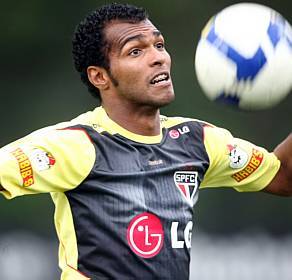
Richarlyson

But for the fact that he was publicly identified as gay, he might well have been. Richarlyson's outing (if it can be called that -- he has apparently neither admitted nor denied publicly that he is gay) occurred when the coach of a rival team "accidentally" identified Richarlyson as the player in Brazil's top division who was rumored to be gay.

It got worse for Richarlyson when, after suing the coach for defamation, the presiding judge dismissed the lawsuit, reportedly on the grounds that soccer is a "virile masculine sport and not a homosexual one." The judge went so far as to suggest that because of his assumed sexual orientation "Richarlyson should be forever banished by FIFA and never be allowed to play football again".

The decision was appealed and Richarlyson's lawyers were quoted as saying that they would sue the judge as well but, although these incidents occurred in 2007, there is nothing on the internet (at least in English) to indicate that the judge was disciplined or a civil lawsuit was instituted against him. Not surprisingly, Richarlyson's professional career has not benefited from the controversy -- he transferred in 2010 from one of the biggest clubs in Brazil, Sao Paulo, and after two appearance with the national team in 2008 has not had another cap.

While I understand Lahm's position that a professional player would risk derision from fans and players if he were to come out, I can't help but think of the parallels between gay athletes today and those who fifty years ago broke the color barrier in professional sports in this country. The notion that the first "big name" professional athlete to declare his homosexuality would face more vitriol than Jackie Robinson or Emlen Tunnell is, I believe, false.

It will no doubt take a player with the courage of his convictions, a thick skin, and athletic talent to be the first to break the orientation barrier, just as it did for football and baseball here. But once that barrier is broken, the benefits to other gay players, and ultimately to society, are immense.

Sports allow, even require, fans in particular and citizens in general to reevaluate their attitudes and prejudices towards certain groups. While the differences between the races are hardly resolved here, the fact that we have had in the past two years a national championship football team from the Deep South with a black quarterback and, in the past four, a black president, have to be accounted for, at least in part, by pioneer athletes who endured the threats and chants of those who were opposed to them solely because of the color of their skin a half century ago.

In the same way I believe that the first internationally recognized soccer player who steps up the the microphone and declares his sexuality will lead to the second, then the third, then many more. And he will no doubt have to endure years, perhaps a lifetime, of bigoted songs from the terraces (perhaps even those of his own club), physical threats, and the cold shoulder from some teammates. But the volume and ferocity of those chants and threats will lessen over time, and lessen with each additional player who comes out.

And when they do, when some day an admittedly gay player captains a World Cup squad or a Champions' League finalist, then everyone will have to acknowledge, on one level or another, that homosexual soccer players (or baseball players, or football players) can be just as skilled, just as committed, just as much a member of the team, as any heterosexual player.

Soccer needs its Jackie Robinson. He's out there somewhere. It's time for him to step forward.

We're waiting.