Showing posts with label Blackburn Rovers. Show all posts

Wednesday, May 30, 2012

Another Year, Another Review

As I enter my third year of posting, and with the recent migration of this blog to a new host (thanks Bulldog Creative and Chris Michael!) it seems a good time to look back at the evolution of the issues and events that I addressed over the past year.

With the exception of the occasional post about music, this blog has evolved primarily into one that examines stories in the sports headlines from the perspective of a coach, parent, fan, citizen, and lawyer. I don't intend any posts to be particularly controversial, although apparently sometimes they are. 

Neither do I intend to offend. Quite to the contrary -- I detest columnists and bloggers who transparently set out to stir the pot. But I would do you, or at the least myself, a disservice if I didn't bring my perspective to the issues that I examine. You can read about the latest employment law case or the most recent views of a particular coach's or player's deeds, or misdeeds in a variety of places; you don't need to come here for that and, frankly, it would bore me to tears to post about it. 

My perspective, more often than not, is shaped by my belief (to quote the character Mike Schwartz in the excellent book "The Art of Fielding" who, in a pre-game pep talk, quotes his teammates Schiller) that "Man only plays when in the full meaning of the word he is a man. And he is only completely a man when he plays." And that applies equally to women as well.

Here are the updates:

After I declared the U.S. Men's and Women's National teams not dead but at least ailing, the women reached the finals of the World Cup, only to lose in excruciating fashion to Japan and apparently deprive Abby Wambach of her last chance at a world championship. The good news for the women is that they qualified for the Olympics and that Wambach will be there, along with Alex Morgan, Megan Rapinoe, and Sydney Leroux, among others.

The American men failed to qualify for the Olympics, bombing out of the U-23 qualifying tournament by first losing to Canada then allowing a last-second goal from 25 yards out that tied its match with El Salvador 3-3 and sent El Salvador to the semi-finals. The U.S. effort in the tournament was marked by bad defending and atrocious goal tending, which is usually a strength of U.S. teams.

No description needed. El Salvador was wearing blue.

After getting off to an indifferent start under Jurgen Klinsmann, however, the U.S. full team is undefeated in 2012, including a 5-1 thrashing of Scotland last week, highlighted by a hat-trick by Landon Donovan and a stunning strike by midfielder Michael Bradley. The U.S. is playing five matches over the next two weeks to begin preparations for World Cup qualifying. The match Wednesday against Brazil will tell us more about how that preparation is coming, and whether Klinsmann is starting to get to team to a level where it can compete consistently against the best in the world. Highlights of the Scotland match are below.


Lionel Messi capped a record-breaking personal season with a goal in Spain's Copa Del Rey ("King's Cup") bringing his total on the season to an unimaginable 73. The victory was the fourth trophy this season for Barcelona (adding to the Club World Cup, European Super Cup, and Spanish Super Cup already won), but the two biggest prizes, the Champions League and La Liga titles, eluded Barca in its final season under Pep Guardiola, who had already announced his retirement at the tender age of 41. Fortunately, Real Madrid and Christiano Reynoldo also crashed out of the Champions League in the semi-finals.

Meanwhile, in American football Bobby Petrino lost his job as Arkansas coach, to be replaced by John Smith, who never coached a game for his alma mater Weber State, which had just hired him over the winter. Stan Van Gundy is gone as well, apparently at Dwight Howard's behest, although the "NBA insiders" now believe it almost a certainty that Howard will not return to the Orlando Magic after he plays out his next and last season under his current contract. At least in the NFL the foxes are not yet running the hen house as Roger Goodell laid heavy fines and suspensions on the New Orleans Saints, their players and coaches, and former defensive coordinator Greg Williams. But an arbitrator has yet to rule on the players' suspensions, and we know how that could turn out.

In State College, Joe Paterno's son announced 11 days after my post about his reign at Penn State that his father had lung cancer. Two months a day later, Paterno died. While his sudden decline was tragic, it is made all the more so by his tarnished legacy, caused by hubris, inattention, or implausible deniability.

Finally, and sadly, back to soccer where my Blackburn Rovers were relegated from the Premier League, going out with a whimper and two last dismal performances. The club is in greater disarray now than before, with a decision regarding the future of manager Steve Kean (who would be long gone from any professional organization) still up in the air. News of Rovers will be much harder to come by next season on this side of the Atlantic, but that may not be a bad thing.

Thursday, January 26, 2012

It's Time to Come Out

Two recent events have drawn my attention to the issues of sexual orientation, soccer, and the need for a modern day Jackie Robinson, not only in soccer but in all of men's sports.

I tend to think of soccer's culture, as it has grown in this country in the past two decades, as residing primarily among the white and upper middle class. While soccer was at one time largely the bastion of immigrants here, its recent explosion is no doubt due to suburban parents and players. From my interaction with coaches, players, parents, and fans, I regard soccer followers as tolerant folk.

In doing so I forget soccer's roots as the World's game, played by the lower and lower middle class, as a means of entertainment and escape (from reality and, occasionally, from their circumstances). While I've declined in other posts to expound on the nature of sport as a substitute for combat or the hunt, it is undeniable that, in many other parts of the world, sport in general and soccer in particular are still viewed as somewhat gladiatorial.

This attitude is reflected by the attitudes towards, or restrictions placed on, women's soccer teams in many parts of the world, particularly in predominantly Islamic countries. While these restrictions are purportedly based on Sharia law, they are certainly reflective, I believe, of the attitudes of those nations and cultures with regard to women and their place not only in sport but in society. And certainly the same issues are being fought out in broader society in non-Islamic nations as well.

Lest we consider the "West" more enlightened, however, recent developments in Germany and England and less recently in Brazil all indicate differently, at least where sexual orientation is concerned.

Last week, as a parting plea upon his departure as president of the German Football Association ("DFB"), Theo Zwanziger called for gay players "to have the courage to declare themselves." Zwanziger cited German politician Klaus Wowereit, the Mayor of Berlin, as an example of how a public figure acknowledging his or her own homosexuality can contribute towards making public acceptance of various sexual orientations more likely.

In response, Philipp Lahm, the captain of the German national team, described Zwanziger's plea as unrealistic. "Football is like being the gladiators in the old times," Lahm was quoted as saying. "The politicians can come out these days, for sure, but they don't have to play in front of 60,000 people every week."

Zwanziger, describing Lahm as a tolerant person, said that he wouldn't criticize Lahm for his views. But while they may be realistic, they certainly aren't brave.

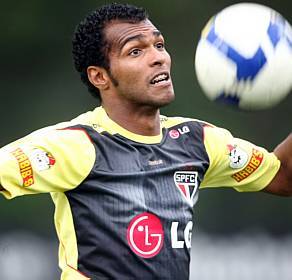
Also last week, news came that Blackburn Rovers were contemplating a bid for a Brazilian midfielder named Richarlyson. A midfielder and defender who has had a successful club career and won two caps for his national team, Richarlyson would seem to be the type of player in whom the big clubs of Europe would have an interest.

Richarlyson

But for the fact that he was publicly identified as gay, he might well have been. Richarlyson's outing (if it can be called that -- he has apparently neither admitted nor denied publicly that he is gay) occurred when the coach of a rival team "accidentally" identified Richarlyson as the player in Brazil's top division who was rumored to be gay.

It got worse for Richarlyson when, after suing the coach for defamation, the presiding judge dismissed the lawsuit, reportedly on the grounds that soccer is a "virile masculine sport and not a homosexual one." The judge went so far as to suggest that because of his assumed sexual orientation "Richarlyson should be forever banished by FIFA and never be allowed to play football again".

The decision was appealed and Richarlyson's lawyers were quoted as saying that they would sue the judge as well but, although these incidents occurred in 2007, there is nothing on the internet (at least in English) to indicate that the judge was disciplined or a civil lawsuit was instituted against him. Not surprisingly, Richarlyson's professional career has not benefited from the controversy -- he transferred in 2010 from one of the biggest clubs in Brazil, Sao Paulo, and after two appearance with the national team in 2008 has not had another cap.

While I understand Lahm's position that a professional player would risk derision from fans and players if he were to come out, I can't help but think of the parallels between gay athletes today and those who fifty years ago broke the color barrier in professional sports in this country. The notion that the first "big name" professional athlete to declare his homosexuality would face more vitriol than Jackie Robinson or Emlen Tunnell is, I believe, false.

It will no doubt take a player with the courage of his convictions, a thick skin, and athletic talent to be the first to break the orientation barrier, just as it did for football and baseball here. But once that barrier is broken, the benefits to other gay players, and ultimately to society, are immense.

Sports allow, even require, fans in particular and citizens in general to reevaluate their attitudes and prejudices towards certain groups. While the differences between the races are hardly resolved here, the fact that we have had in the past two years a national championship football team from the Deep South with a black quarterback and, in the past four, a black president, have to be accounted for, at least in part, by pioneer athletes who endured the threats and chants of those who were opposed to them solely because of the color of their skin a half century ago.

In the same way I believe that the first internationally recognized soccer player who steps up the the microphone and declares his sexuality will lead to the second, then the third, then many more. And he will no doubt have to endure years, perhaps a lifetime, of bigoted songs from the terraces (perhaps even those of his own club), physical threats, and the cold shoulder from some teammates. But the volume and ferocity of those chants and threats will lessen over time, and lessen with each additional player who comes out.

And when they do, when some day an admittedly gay player captains a World Cup squad or a Champions' League finalist, then everyone will have to acknowledge, on one level or another, that homosexual soccer players (or baseball players, or football players) can be just as skilled, just as committed, just as much a member of the team, as any heterosexual player.

Soccer needs its Jackie Robinson. He's out there somewhere. It's time for him to step forward.

We're waiting.


Monday, January 9, 2012

When Enough Is Enough

Now that my coaching days are over, I've spent more time over the past two months being a fan - of music, of American football, but most of all of soccer and Blackburn Rovers.

These are not good times if you're a Rovers fan. In fact, they may well be the worst of times. For while I and many of my fellow supporters with whom I commiserate (or, to put it more accurately, whose commiserations I read on our list-serve without comment these days) have lived through the dark days of relegation and far too many inept players and managers in the past, we always had hope. Now, we have none.

That hope was provided by two means: first, strong, ambitious ownership provided by local-boy-made good steel magnate Jack Walker; and, second, dedicated, knowledgeable decision-making from the front office, led by long-time Rovers' employee John Williams.


A statute of Jack Walker outside Ewood Park in Blackburn.

Walker's love for Rovers was clear from the millions of pounds that he spent turning the club from a Second Division afterthought into the Premier League Champions. It was not a love shared by his family, however. After Walker died in 2000, his holdings, including the Rovers, were put in a family trust. For a time the trust operated Rovers with parsimonious oversight but not neglect, allowing Williams, who began working for the club in the 1990s and rose to the rank of Chairman, to spend enough money to keep Rovers afloat.

Eventually Walker's heirs tired of the drain on their fortune that Rovers created and sought a new owner for the club. After several false starts and many rumored interests, finally a buyer was found: Venky's. I knew nothing of the company at the time but learned that it is based in India, began as a poultry company, and is privately held, owned by a family named Rao. Several fans expressed concerns about Venky's true intentions for the club from the start (sell off all the "assets"? treat it as their play toy like some Indian version of the Beverly Hillbillies?) but I put it down to the "glass half-empty" nature of most Rovers fans, or, to be honest, perhaps a touch of bigotry.

There is no doubt, however, that Venky's ownership of Rovers has been an unmitigated public relations disaster. Soon after taking over they fired manager Sam Allardyce, claiming that he lacked the ambition that Venky's had for the club. While many Rovers' fans (me included) were dissatisfied with Allardyce's boring tactics we were comfortable Big Sam's ability to keep Rovers in the Premier League.

In his place Venky's appointed Steve Kean, the club's first team coach, as the new manager. Kean expressed what was apparently the requisite ambition for Rovers -- attractive soccer, a top five finish, and challenging for the championship. But he had no real managerial experience before taking the job and his ambitions seemed completely out of touch with small town football in the toughest league in the World. Kean's reign has been marked by last minute collapses, poor tactical decisions, and, perhaps most galling, toadying to Venky's (including frequent command performances in India at a time when he should be devoting his energies to his club).

Kean's summons to India are indicative of Venky's management style, which appears to be to trust the counsel of those who tell them what they want to hear and ignore those who don't. Particularly troubling is the relationship of Venky's to player agent Jerome Anderson, who, despite his fervent denials, seems to have considerable influence with the owners in player and managerial decisions (he represents Kean and his son is on the Rovers' roster).

Even more troubling than Allardyce's dismissal was Williams' departure soon after. While managers always come and go, especially at smaller clubs like Rovers who tend to either lose the successful ones to bigger clubs or fire the unsuccessful ones when at the brink of relegation, the chairman is hopefully the constant -- the one person in whom power lies who can be expected to do what is in the best interests of the club, not him or her self. Williams was certainly that person for Rovers.

Matters off the pitch reached a fever pitch this past week as Kean accused a growingly vocal majority of Rovers' supports calling for his (and Venky's) ouster of essentially not being "true" fans. This apparent effort by two Johnny-come-latelies to take it upon themselves to define who is or is not a "fan" follows on the heels of previous attempts to censor fan's statements about the club (under the disingenuous guise of safety concerns) by prohibiting anti-Kean banners at Ewood Park.

The beliefs of many supporters regarding Venky's ineptitude was confirmed earlier this week with the belated release of a letter that was sent by Williams and two other then-Board members noted that they were being by-passed and ignored regarding the most fundamental decisions made at the club: "We now find ... that the board are not even being consulted on some of the most fundamental decisions this or any other football club ever makes. This includes the termination of the manager's employment and the appointment of a new manager."

Venky's and Kean's actions and statements have sparked a discussion among Rovers' fans regarding what it means to be a fan and, when matters of The Club and Our Club collide, how a true fan should act.

This is, admittedly, an easier call for me to make than that of those who were born in Blackburn, or near there. Many figuratively bleed Blue and White and some, literally, will be buried in the Blue and White halves. The Club has been "theirs" for thirty, forty, fifty, or more years. They are season ticket holders who have invested their lives in the club.

But, simply put, it is no longer their club. It is Venky's, and they have made that very clear with everything they have done since they bought the club.

While fans are relatively powerless these days in the face of billionaire owners, multi-millionaire players, and millionaire agents, they do have one chit left. And that is the ultimate one. To not willingly pay one penny (pence?) to further the interests of those owners, players, and agents.

If they have already purchased their season tickets for 2011-12 I encourage them to attend the matches, root for the Rovers, cheer every goal, boo or whistle at every appearance by Kean, and hope for the best. But don't buy a pie or a pint or a shirt on the grounds. Do not give Venky's one more penny.

As for me, I laugh at the emails that I get from Rovers telling me about the latest sale at the club's on-line shop and scoff at the invitations to sign up for internet access to match commentary and video highlights. For now, I'll just have to console myself with my Tugay Rovers' shirt and my tape of the 2002 League Cup triumph over Spurs.

For me, enough is enough.

Tuesday, May 24, 2011

Has It Been a Year Already?

This blog had its first birthday a week ago last Saturday. I hope you've enjoyed reading and found at least some posts of interest along the way.

Sometimes I feel I'm still trying to find my "voice" here, other times I've hit on something that is exactly what I hoped to do  (particularly the posts about Dick Winters and Jim Tracy). And I think my love of coaching and soccer came through in the two posts linked in this sentence. Please, let me know what you like and don't like, what you'd like to see more of or less of, as we head into our second season.

Here are some follow-up bits (in no particular order) to a few of this last year's posts that you might find interesting:

Rovers survived the drop, winning on the final day of the season to cement their place in the Premier League for another year. You can read about the final match here. Oh, and both West Ham and Birmingham were relegated (pity).


The Red Rose of Lancaster on Rovers' badge

FIFA President Sepp Blatter, facing opposition in his reelection bid, has promised to have an "investigation" of or "discussion" with a former employee of Qatar's successful World Cup 2022 bid who has claimed to know of at least two FIFA executive committee members who were paid $1.5 million bribes for their pro-Qatar votes. Say it ain't so Sepp! Apparently Blatter does not perceive a distinction between a discussion and an investigation . . .

The New York Times ran an fascinating article on the genius of Lionel Messi this past Sunday. Check out the piece, then watch Messi and his Barca pals take on Manchester United this Saturday in the UEFA Champions' League Final at Wembley.


Messi airborne against Real Madrid

Bob Bradley announced the U.S. roster for the Gold Cup this summer. Jermaine Jones was named in the squad, but not Teal Bunbury.

Finally, Champion (a sporting goods company) cancelled Rashard Mendenhall's endorsement contract with them because of his Bin Laden tweet. In a statement announcing the decision, Champion concluded that it did not believe that Mendenhall could "appropriately represent Champion" due to some of the comments in the tweet. The free speech advocate in me has no problem with Champion deciding it doesn't want to pay Mendenhall endorse its products. The lawyer in me, though, wonders what the contract language was that Champion relied on in making the decision and whether it was a "morals" clause or if Champion just had the unilateral right to cancel for any reason it deemed appropriate.

Wednesday, March 30, 2011

The Drop

Every year around this time throughout Europe sportswriters and commentators and fans start talking about The Drop.  Relegation and promotion (or, I guess, promotion and relegation if your glass is half full) are features of almost every professional soccer league in the world not in the U.S. or Australia.

Rather ironic, since relegation is the most democratic, or Darwinian, of all sporting concepts. Each year in one or two or three of the clubs that finish in the bottom of the standings of a league will be relegated to the next division down, and the same number of clubs will be promoted, either by virtue of their finish in their league during the regular season or by a playoff, to the next higher division. So while clubs in, say, China will (theoretically) rise or fall each year on their own merits, those in the U.S. are among the few that are always safely ensconced in the highest professional division of the sport.

Because of the way professional sports teams developed in the United States, with a small number of clubs owned usually by one individual or entity, promotion and relegation never took hold here. In Europe, however, with its thousands of soccer teams and stronger local and regional ties, it was a natural development.

In recent years, the relegation battle, at least in England, is much more interesting than the fight for the championship of the Premier League. While the same two or three teams fight it out for the crown every year, several more are sucked into the abyss that is the desperate attempt to avoid the drop.

This year the races to the championship and to relegation are both shaping up to be interesting, thanks to the lack of a dominating club at the top and many middling to miserable ones at the other end of the spectrum. But while one of the usual suspects (either Man United or Arsenal) are likely to win the crown, nine or ten clubs, within six points of each other, are capable of playing badly enough over the last eight or nine matches of the season to warrant relegation.

Unfortunately for me and other Blackburn fans, one of those clubs that could face The Drop is the Rovers.  In the top ten and looking good just a few weeks ago, Rovers have managed to snatch defeat from the jaws of victory, or at least a draw, on several occasions recently, including two weeks ago when they conceded a penalty in the last minute to lose 3-2 to Fulham, and last week when they had to come from two goals down at home to register a draw with Blackpool. Speculation has gone from wondering whether the club will be able to challenge for a Europa League spot to whether they will be playing in the Premier League next season.

I have to admit, though, that whether it's the glass-half-empty Rover fan, the masochist, or the republican (yes, little "r" republican) in me, I relish the fight to dodge The Drop. Nothing more energizes a fan base than supporting your club to survive to fight another day. And, I have to admit, I always relish the opportunity to chirp when a "Big Club" (like Newcastle two seasons ago) goes down.

How cool would it be to get to see an American pro team (insert team name here -- mine would be the Cowboys or the Yankees) struggle to maintain top flight status? Can you imagine the glee if Jerry Jones was faced with the prospect of a half-filled billion dollar stadium while his Cowboys play some semi-pro team from Waco?

I'll be there on Saturday morning, biting my nails and hoping the Rovers can pick up three or even one point against Arsenal (yeah, right) that would go a long way to avoiding The Drop. But I'll be pulling just as hard for West Ham and Birmingham (two self-proclaimed "Big Clubs") to lose and sink a little farther toward oblivion. What could be more American?

Wednesday, February 2, 2011

What Gets You Excited?

These are exciting times for two of my favorite soccer teams, at least as far as I'm concerned.

The U.S. Men's soccer team played its first match of the season last week and four of the starters and seven players altogether earned their first caps (a "cap" is the term used for a full national team appearance, for all you soccer-challenged readers). One of them, Zach Loyd,  a 23 year-old outside back, was named Man of the Match. Another, Teal Bunbury, a 20 year-old forward, scored the only goal for the Yanks in a 1-1 draw with Chile.

Teal Bunbury.

By my unofficial count, 12 players on the U.S. squad who saw action in the match were 23 years old or younger. Landon Donovan, Tim Howard, Clint Dempsey, and many other National Team veterans were nowhere to be found.

Meanwhile, in Lancashire, Blackburn Rovers have just concluded the January transfer window by adding four players, one of whom is a former team member (forward Roque Santa Cruz, a Paraguayan international), an American defensive midfielder (Jermaine Jones) and two young offensive players (Mauro Formica, 22, from Newell's Old Boys -- is that a great club name or what? and Ruben Rochina, 19, from one of my other favorite clubs, Barcelona).

Ruben Rochina.

Rovers' new owners, Venky's, an Indian poultry company, made noises about trying to sign David Beckham or Ronaldinho to "strengthen" the team but whether they were truly interested in either, or whether they were just trying to realize some media profit for their recent investment, fortunately neither will wear the blue and white halves.

No doubt there are casual fans of both the U.S. team and Rovers who would have welcomed the veterans back to or into their squads. But not me.

It's probably the coach in me, but nothing is more exciting to me than the introduction of young and (hopefully) talented players to a team. The opportunity to mold a group of individuals into a winning, entertaining team is much more interesting than watching some "big name" past his prime earn a last few paychecks.

The same is true with our national team.  I'm sure Howard, Donovan, Dempsey et al. will still play a big part in the near future, but it's way more exciting to get a glimpse of what 2014 and beyond may look like than trotting them out for another friendly.

The introduction of young talent to an established team isn't something that happens all that often in the business world. After all, the goal there is to keep valuable employees for a working lifetime, which is normally considerably longer than an athlete's viable economic life.

That doesn't mean, however, that management and the employees themselves can't try to inject a breath of the unusual or extraordinary into the workplace. Team meetings, lunches, social events, or bonus or other incentive plans based on unique criteria are all ways that you can try to give your workplace a jolt of newness, even when the roster doesn't change as dramatically as it did recently for two of my favorite teams.

Monday, December 20, 2010

The Damned Rovers?

Cindy and I watched the movie "The Damned United" this weekend and I couldn't help but draw an analogy between the topic of the movie -- Brian Clough's brief, unsuccessful reign as manager of Leeds United in 1974 -- and the current situation that my Blackburn Rovers find themselves in.

To make a long story short, Clough was a young, brash, self-confident manger in England who led lowly Derby (that's pronounced "Darby" for all you American readers) County from the depths of the second division to the championship of Division One in England (what is now called the Premier League) in two short years. Along the way he first admired and then came to loathe the manager of Leeds United, Don Revie, who was an "old school" manger (read: his players played hard, arguably dirty, soccer).

Clough had a habit of buying the rights to players without the approval of the Chairman of Derby and, at least according the to admittedly fictionalized movie account depicted in The Damned United, became more arrogant in his dealings with the Chairman after his initial success. Ultimately, he submitted his resignation to the Board in an attempted power play to leverage his running of the club without the Chairman's involvement. Unfortunately for him, the resignation was accepted.

After a brief stint at a lower division club in Brighton, Clough was offered the manager's position at Leeds. Revie had accepted the job as England's manager and the club targeted Clough as his replacement.
Clough's reign at Leeds lasted exactly 44 days, but during that time he managed to alienate its board, the media, Revie, and most importantly his players. Whether Clough was right or not (and the movie suggests that he was) it was hardly the way to start a relationship when he supposedly told his players (who had won the first division championship in 1973-74, the year before Clough led Derby to the title, and the FA Cup the year before that) that they could "all throw [their] medals in the bin because they were not fairly won."

Brian Clough leading Leeds onto the pitch before the 1974 FA Charity Shield match. 

Predictably, the players did not play hard for Clough and he was ousted after less than a month and a half in charge.

The comparison to Blackburn is that this week its new owners sacked their manager, Sam Allardyce. While many Rovers fans were not admirers of Allardyce, they were almost unanimously surprised by his firing since Rovers were mid-table at the time -- a standing about as good as most fans expect given the club's limited resources. There was talk of a protest by fans before the match this past Saturday against West Ham and many have speculated that the firing, the reasons given for it (essentially, lack of ambition and an unattractive style of play), and the expectations that the club's new owners have all demonstrate that they are naive at best and will endanger the club's Premier League life at worst.

I suspect that just as Clough failed to appreciate how his words and attitude would affects his new players at Leeds and their desire to play well for him, so too Allardyce may have overestimated the weight his belief in his own managerial style and abilities would have with Rovers' new owners when compared to how his message was delivered.

Sam Allardyce, cutting a somewhat less dashing figure than Clough.

Allardyce, although admittedly somewhat successful in a previous managerial stint at Bolton and in keeping Rovers afloat, seems (inordinately) impressed with his own managerial ability, which to the casual observer is exclusively comprised of one-note football built around long balls and set pieces. To his credit, his players did seem to genuinely like playing for him. But the players weren't footing the bill.

This is pure, unsupported conjecture on my part, but one can easily imagine Allardyce communicating with his new bosses in a manner that was both self-congratulatory and condescending in informing them of his previous work, what their priorities should be (almost exclusively Premier League survival), and how they should go about achieving them (leaving him alone and letting him manage the club the way he wanted to).

Like Clough, Allardyce entered a new situation in his job and probably thought that the way he had handled such a relationship in the past would be good enough -- particularly since it was his way. You should always consider before speaking to any audience not only the message but how it ought to be conveyed. Particularly if your job is on the line. And if you're a manager, it always is, isn't it?

Wednesday, November 10, 2010

Arte et Labore

So, we've just won our third straight State championship by a score of 3-0, finished a season undefeated, and virtually guaranteed a National ranking at the end of the year. And most of the quotes in a newspaper article about the Final game are me moaning about how we didn't play particularly well.

No mention of the fact that we just went through a season in which we played and beat all four AAA state semi-finalists as well as an Ohio state finalist. No nod to our undefeated season, to the fact that the last time we lost a game was in August 2009, to our 46-game unbeaten streak. No reference to the first "three-peat" in West Virginia soccer in a decade.

I've been wondering the last few days if I can defend my comments based on some argument that aesthetics are important to me and I care not only about whether we win but how we look while we're doing it, or we really didn't play that well and I wanted us to go out on a high note. Or maybe that I wanted to impress on our returning players that there was still unfinished business that needs to be taken care of next season.

Or maybe I'm just a grouch.

I don't think I'm usually an over-demanding coach. Not a lot of yelling. I generally try to be positive, before, during, and after games (although admittedly once this year the whole team was mad at me because of my obvious, and repeatedly expressed, disappointment at their play). So what's up with the Steve Spurrier imitation?

I think I just wanted to be our last game together to be perfect and I was disappointed when it wasn't. We had played so well all season and set such high standards for ourselves that I wanted that final to be a celebration of what we were capable of -- attractive, maybe even beautiful, attacking soccer. But I should have recognized it as a celebration of a different sort. Not of art, but of the value of plain old hard work and determination.

The crest of my favorite professional soccer team, Blackburn Rovers, has the Latin phrase "Arte et Labore" -- by skill and hard work -- on it.


I recognize now (too late for the reporters) that our Finals win was a testament not to the "Arte" of our team but rather to the "Labore" -- the hours of practice, of long distance running and sprints and drills and scrimmaging that 20 players and two coaches endured since the first week of August. It was that work that put us in a position to withstand the elements, as well as overcome the emotions that went with the realization that it was our final weekend as this team, to finish the deal. And that's exactly what we did.

We played in difficult conditions both days -- cold and rain and snow and sleet and sloppy goal boxes and bumpy fields. While it's true that the conditions were the same for both teams, let's face it: weather and field conditions can be an equalizer for the less-skilled team. Add in the fact that we played the second half of the Final with three players sitting on the bench with injuries, including arguably the best player (and in my opinion certainly the best forward) in the state who was sidelined with a hamstring pull, one could certainly believe that we overcame some significant obstacles to win and win convincingly at that.

If I had it to do over again, I would make sure to mention that good teams can win in different ways, that we had discovered all of those different ways in the course of the season, and that "winning ugly" can have its own value. But I'd still probably say that I wouldn't have minded seeing a few more passes to the players with the same colored shirts. Hard work only gets you so far when you're an aesthetic person. Or a grouch.

Monday, August 2, 2010

An Inexplicable Obsession

I am a Blackburn Rovers fan.

Whenever I meet someone from England who is not a Blackburn fan, I usually get the same reaction when I tell them that I support the Rovers: "Blackburn? Why?"

The Rovers are not a fashionable club to follow, at least not these days. Admittedly, I started rooting for the Blue and White in their second heyday, following their first (and, truth be told, likely only) Premier League championship in 1995. But I wasn't a bandwagon jumper, actually not throwing my support behind the club until it was on the decline, in 1997. Only two years later they were relegated and I stuck with them, proof of my stubbornness or stupidity.

It was not a decision that was made lightly. I began following the Premier League around 1996, a time coinciding with my beginning to coach my son's rec soccer team and with ESPN2's broadcasts of some Premier League games. I decided to follow one team, and set a few rules in choosing which one it would be. I wanted to root for a team that had enjoyed some success but was not one of the mega-teams. And I wanted to feel a connection with not just the team but its supporters.

Options for viewing soccer, and following foreign leagues, were much more antiquated 15 years ago than they are now, so the tools at my disposal to help figure out what team I would call my own were limited. I relied on the occasional match on ESPN2 and message boards and email lists on the Internet to help make my choice. For a time, I joined email lists of fans of Newcastle, Liverpool, and Blackburn.

All three were moderately successful in the '90's and had some promise of future success. Liverpool had enjoyed a long spell as the best club in England in the '70's and '80's and Newcastle had a strong fan base and fanatical following. Rovers had been the best team in England in the late 1800's and had enjoyed a revival under steel magnate and local boy made good Jack Walker, who had purchased the club in the early '90's and quickly steered it (or bought its way, depending on how you looked at it) from the Second Division to the Premier League and then champions in a remarkably short period of time.

I quickly struck Newcastle off of the list, finding their fans to be boorish and unintelligent. The Liverpool supporters were smarter but had an air of entitlement that I found off-putting. The Rovers fans, however, were smart, funny, and had a certain "us against the world" attitude that fit with my predisposition to root for the underdog (a trait I believe I share with many West Virginians).


My support for Rovers was cemented by two other factors: their fantastic blue and white halves, a kit that I think is the best looking soccer shirt in the world, and a 7-2 thrashing of Sheffield Wednesday on a Monday afternoon that still may be the most dazzling soccer game I've ever watched.

That was 13 years ago and it is still the most goals I've ever seen the Rovers score in a match. There have been some very low points along the way, including relegation in 1999 and two seasons in what was then called the First Division. As hard as it was to follow a club in the Premier League then, it was nothing compared to the wasteland that was news, let alone match highlights or live games, regarding First Division teams.

Rovers tried a number of miserably unsuitable managers while stumbling into and then through the wilderness before a savior arrived: Graham Souness. Although his departure from the club, inevitable for almost any professional team, was unpleasant, there is no doubt in my mind that Souness was the right man at the right time to lead Blackburn back to the Premier League, which he did in a season and a half.

During the first year back, Rovers reached their high point since I've followed them, winning the  2002 League Cup final 2-1 over Tottenham Hotspur at the Millennium Stadium in Cardiff. I still have the video tape (yes, video tape) of that win, and pull it out and watch every so often.

Since then, Rovers have mostly struggled in the Premier League, although they did enjoy a spell in the top half of the league for a time under manager Mark Hughes, one of the heroes of the League Cup win. Hughes, however, bolted for the filthy lucre offered by Manchester City (he's since been fired there and was recently hired by Fulham, which employs Americans Clint Dempsey and Eddie Johnson) and were very nearly demoted again after a disastrous start to the next season under Paul Ince.

The past two years have been marked by mediocrity and dull play, due in part to the current manager, Sam Allardyce, a coach whose tactics and demeanor would be difficult for the most ardent supporter to warm to, and in part to the financial cost of "facing the drop" to the First Division (now called the "Championship") which makes survival in the Premiership the main goal for all but a handful of clubs.

Things are better from the standpoint of getting to watch Rovers live on FSC and ESPN2 these days when they play one of the "big clubs". But I can't say that I often enjoy the experience. That's part of being a true fan, particularly a fan of a perpetual underdog. And, unlike in baseball (I'm a lifelong Tigers and Cubs fan) or football (ahem, Lions?) at least professional soccer offers several different avenues, through cup competitions, for a team to shine even when the season isn't going all that well (Portsmouth were in the FA Cup final last year while slogging through a miserable league campaign that saw them practically relegated by Christmas).

The preseason hasn't gone well at all for Rovers this year, and I fear that survival may be an accomplishment rather than just a goal in 2010-11. But I'll be watching. Through thick and (mostly) thin, I'm a Rovers fan.