Showing posts with label Brandi Chastain. Show all posts

Sunday, December 9, 2012

Learning to Live with It

If you follow women's soccer, or the tabloids, you've probably heard about Hope Solo's drunken bachelorette/bachelor party/melee, followed by her appearance at a hearing on domestic battery charges that she brought against her fiancee (now husband), a former NFL player with an impressive history of run-ins with the law including DUI, possession with intent to distribute, and, most disturbingly, sexual assault.

Various folks have weighed in on what should or should not be off limits with regard to Solo and what appear to be some questionable life choices (not that that should be particularly shocking given her public declarations in the past). But my take is a little different. It's about the choices that coaches and teams are sometimes forced to make.

Coaches are fond of saying that they have one set of rules that applies to all players. But they know, and the players know, that that's not always the case.

At any level, coaches have to make adjustments and even exceptions for exceptional players. And they have to depend on the players to understand that it's for the good of the team that they do so, even if  the players that exceptions are made for aren't "team players."

After watching the U.S. Women's team in the Olympics, reading Solo's controversial comments regarding Brandi Chastain's commentary and the lack of public support that she received for those comments from her teammates and coaches, and then watch the last two friendlies that the team played against the Republic of Ireland, I wonder how much tongue biting and eye rolling goes on inside the team when Solo opens her mouth. Because two things are clear: first, Solo, true to her name, is not a team player; and, second, the team really, really needs her.

Um, that look pretty much says it all.

Admittedly, it may not be fair to evaluate based on two halves of two friendlies, but Solo's backup, Nicole Barnhart, looked very shaky in her two appearances. While her decision-making would undoubtedly benefit from more game time, she looked indecisive on crosses and balls in the box.

Keepers are like left-handed pitchers in baseball -- they're often viewed as the odd-balls, marching to the beat of a different drummer (no doubt in part because they are the only players allowed to use their hands). But that doesn't mean they can't or don't have to be good teammates.

It will be interesting to see how the new head coach of the National Team, Tom Sermanni, deals with Solo. Perhaps, like Pia Sundhage before him, he will decide that regardless of the distractions, it's best for the team that he tolerate them as best as he and the team can. But we should also probably hope (pun intended) that somewhere in the program a replacement is being groomed.


Sunday, November 25, 2012

Third Time's a Charm?

Amidst the orgy of turkey, Black Friday, and college football this past week you may have missed the announcement that, for the third time in the past 12 years, a women's professional soccer league will begin play in the U.S. this coming spring.

The WUSA was formed in the wake of the U.S. Women's National Team's triumph in the 1999 World Cup here in the U.S. Much as the formation of MLS following the men's World Cup in the States in 1994, the notion was that it was the perfect time to start a women's league with all the momentum that the sport had gained after the climatic final game, won by Brandi Chastain's famous pk.

That league folded after just three years though, drowning in debt caused, at least in part, by the signing of big name players from abroad and (based on the attendance and limited television exposure and dollars) high salaries for the players. The WUSA tried to hang on through the next year, holding a few "exhibition" matches which were essentially all-star games, but finally gave up the ghost.

Women's Professional Soccer jumped into the void for another three years, but it seemed even more doomed from the start. Feuding (and seemingly imbalanced), owners, lackluster crowds, and frankly dull play led to another three seasons, but even the most hard core fan would be hard-pressed to name more than one team, let alone more than one champion. The WPS played in 2009-2011, but in January of this year announced a hiatus and eventually disbanded.

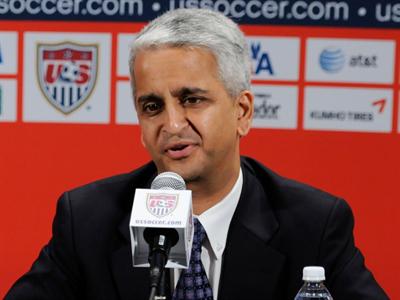
The success of the U.S. Women's National Team this summer in London, however, led to renewed talk of another women's professional league. While the WPS had tried to associate with MLS and thus reduce facilities costs, the effort never seemed to take hold outside of, perhaps, Philadelphia. The announcement of the new league, however, came not from potential owners but from Sunil Gulati, the President of the U.S. Soccer Federation. 

Gulati, whose day job is a senior lecturer in economics at Columbia, believes he has finally developed a  "sustainable" economic model for the women's professional game in the States. The as-yet-unnamed league will work in cooperation with the U.S., Canadian, and Mexican Soccer Federations in paying the salaries of many of the players in the league. U.S. Soccer will also finance the administrative costs of the league, presumably while trying to ensure that costs are held in some close approximation to the revenues generated by attendance, television rights, and collateral income.

Gulati, at the press conference announcing
the formation of the new women's league.

The new league will also likely follow more closely the MLS model by limiting, at least initially, the number of foreign players allocated to each club ("foreign" meaning in this context non-American, Canadian, or Mexican) and to begin play in smaller venues to enhance fan participation and camaraderie.

While it remains to be seen whether a women's professional league is sustainable in the U.S., Gulati's plan seems to have the kernels of the model that could work. But what else would you expect from an Economics professor who has been called "the single most important person in the development of soccer in this country"? 

Wednesday, June 22, 2011

What Exactly Is The State of U.S. Soccer?

With the United States men's national team in the midst of the Gold Cup and the women's team preparing for their World Cup which begins in Germany later this month, I've been thinking about where were are as a soccer nation and whether things are improving or not.

The men have not looked particularly good so far despite making it to the final after beating Panama 1-0 in the semis. The best news is probably that the U.S. was not in the same bracket as Mexico and will only have to play Los Tricolores once, in the final. Panama had beaten the U.S. 2-1 in group play in this tournament so the semi-final win was a measure of redemption or revenge for a team that had never before lost in group play in the Gold Cup.

The way that Mexico is playing, however, second may be the best that the U.S. can hope for in this Gold Cup. Given the way the Americans both won the Gold Cup in 2007 and finished first in CONCACAF qualifying leading to the 2010 World Cup, that concession is disturbing.

Clint Dempsey celebrates his goal against Jamaica.
Mexico looks like the younger, more innovative squad right now as the Yanks struggle to assimilate new players into the established backbone of Landon Donovan, Clint Dempsey, Jozy Altidore, Michael Bradley, Steve Cherundolo, and Tim Howard. Heck, even Freddie Adu (remember him?) played a role in the only goal against Panama in the semis. 

While the men have time to sort things out before the rigors of World Cup qualifying, the U.S. women enter their World Cup next week far from the role of clear favorites that they once enjoyed. Although the women's team is currently ranked first in the world, and won the gold medal at the Beijing Olympics, they have endured a string of inconsistent results in the past year.

After dominating World Cup qualifying for the past decade, the U.S. women lost to Mexico in the CONCACAF tournament semifinal  and had to beat Italy in a two-legged play-in to even reach the World Cup. They followed that up with a series of matches earlier this year, again with some inconsistent results.

Germany seems the odds-on favorite to win the WWC, as the host and after winning the last two (the U.S. finished third in both). Brazil and the U.S. lead the second tier of contenders, with Canada, Japan, and Sweden possibilities as well.

While the U.S. women are led by an experienced group including Abby Wambach and captain Christie Rampone, there are a number of younger players on the roster that could see significant playing time and perhaps tilt the scales in the Yanks' favor. Forwards Amy Rodriguez and Alex Morgan in particular may help inject some speed and youth into an attack that has seemed relatively predictable against well-organized defenses.

There certainly isn't the hype and anticipation for this team that surrounded the 1999 edition, even before Brandi Chastain took off her shirt.

The most famous picture in women's soccer history.

There was a time, even after the men's World Cup was held in the U.S. in 1994 and MLS started in 1996, when there seemed to be as much interest, or more, in the women's national team than the men. Whether because of the retirement of magnetic personalities and players like Mia Hamm, Julie Foudy, and Christine Lilly, or the disappointing finishes in recent tournaments that seem attributable in part to too many coaching changes or questionable coaching decisions on the national team, the women no longer enjoy much of the spotlight here.

The hope is that Wambach and company can restore a little of that luster this summer in Germany. After all, there's only one national team from the U.S. (and North America, for that matter) that has won a World Cup.