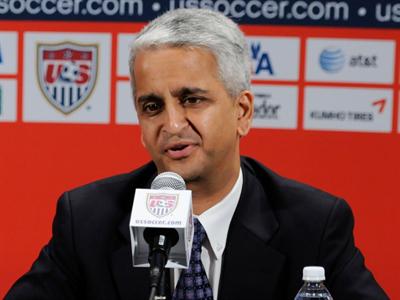
"We are the best in the world" said Hope Solo in announcing her support for the EEOC complaint filed by her and four other members of the U.S. Women's National Soccer Team this past week against the U.S. Soccer Federation.
Setting aside concerns that Solo provided bulletin board material for 15 other national teams (and that she would have the temerity to bite the hand that not only fed her but provided support when she faced a domestic violence charge (yes, I just linked to a People Magazine article) that could have ended her World Cup hopes, if not her career, last year), while Solo's statement is completely defensible given that the team is the reigning World Cup and Olympic champion, it does not conclusively prove the players' case.
 |
| Too easy, I know (photo from businessinsider.com) |
By now my support of women's sports in general and soccer in particular should be well-established. I believe in level playing fields (and similarly surfaced playing fields) for men and women.
But equal opportunity does not necessarily mean equal pay.
While I am all for the women receiving pay commensurate with their work and the money that they generate for U.S. Soccer (and with their male counterparts if they are entitled to it) I'm not sure that this lawsuit is the best way to try to accomplish that. In fact, a victory for them could actually be detrimental to many of their professional soccer playing peers who are good, but not good enough to play for the national team.
The men's team and the women's team are governed by separate collective bargaining agreements, under which the men are paid substantially more for performances in international matches. Important, lawyer-type note: just because you're subject to a collective bargaining agreement does not mean that you are prohibited from bringing an equal pay claim. According to one article, when playing in an international friendly, the men can earn as much as $17,635 in bonus money for a win, $8,125 for a tie, and $5000 for a loss. The women, meanwhile, receive a $1,350 bonus for winning a friendly, nothing if they tie or lose.
But the ways in which the men's team and the women's team members are compensated are hardly apples to apples. The men are paid strictly on a bonus system while the women are paid salaries and receive benefits more akin to those of traditional employees - severance pay and "various types of insurance" - that the men are not. And they are also paid salaries as National Women's Soccer League players, which is where the crux of the problem, and the danger in the players' suit, lies.
U.S. Soccer, with some help from the Canadian and Mexican federations, helped start and is presumably helping keep the NWSL financially afloat. It doesn't take a photographic memory to recall the fate of the two U.S. women's professional leagues that preceded the NWSL (but it may to name them), both of which succumbed to a combination of poor management and, frankly, lack of interest in non-World Cup and Olympic seasons. It appears that the players' suit does not take into account the money that U.S. Soccer has spent to start and sustain the NWSL. [In my original post, I surmised here that the federations pay the salaries of non-federation players in the NWSL. After further investigation, I don't believe that to be the case. While information regarding NWSL individual players' salaries is not disseminated, it appears that the league pays non-federation players, while the federations only pay those of "allocated players" from one of the three participating federations. Nonetheless, the suggestion that U.S. Soccer pays the salaries of the highest-paid players in the league appears to be correct.]
The league has benefited those players, who would not otherwise have an opportunity to play professional soccer, by both giving them that chance and proving that they are worthy of consideration for the national team. Crystal Dunn, for example, was the last player cut from last year's World Cup team, but proved her mettle by being the leading scorer in the league last season. Restored to the roster, she scored five goals against Puerto Rico in the Olympic qualifying tournament and appears to be poised to play a significant role for the team in Rio.
Setting aside U.S. Soccer's apparently well-taken position that the players and their attorneys cooked the books by focusing on income from last year (when the women won the World Cup in Canada and embarked on an extended victory tour), its claim that the men's team's games over which it has control (i.e., non-World Cup games) have audiences double those of the women, and that U.S. Soccer has been at the forefront, world-wide, of commitment both to the women's game and to cajoling or compelling FIFA to support women's soccer and women in positions of power within FIFA, there's a more fundamental concern that I have with the players' complaint and the future of women's soccer in the U.S.
Where is the money to come from to pay the players if they succeed?
Unless U.S. Soccer adopts FIFA's more ... creative ways of generating income, the funds to pay a large increase in player compensation may well result in a reduction of its financial commitment to the NWSL. And while the national team players may or may not care, that would be detrimental to the long-term health of women's professional soccer in the U.S., and perhaps to the national team as well.
This may all be much ado about next-to-nothing. The Soccer America article suggests that the true motive for the EEOC complaint may be simply to gain leverage in the players' on-going negotiations with U.S. Soccer over a new collective bargaining agreement, particularly in light of U.S. Soccer's filing of its own complaint in February, in which it seeks court confirmation that the current collective bargaining agreement runs through the end of 2016 (fearing, presumably, a work stoppage by the players shortly before or during the Olympics).
But if it is not, if the players pursue their complaint beyond the Olympics or the (hopeful) signing of a new collective bargaining agreement, then I fear for the future of women's professional soccer in the U.S. That may or may not be of concern to Solo and her fellow litigants. But it should be to the rest of us.