Showing posts with label Mexican National team. Show all posts

Wednesday, July 12, 2017

Cups All Around (and not a Drop to Drink)

Some observations after watching most of the Confederations Cup and attending the U.S. Men's National team Gold Cup game against Panama in Nashville:

1.  The Confederations Cup Is No Longer a Test for Anyone but the Host Country.  Sure, you can say that the Germans don't have a B Squad, or that even their second team is better than most other countries, but whatever the excuse or the analysis, the simple fact is that they breezed through the Confed Cup starting exactly zero players who started the 2014 World Cup Final against Argentina. 

While roster turnover is a fact of international soccer, and it would be a shock if Philipp Lahm or Miroslav Klose featured in the 2018 German World Cup team (since both have retired from international football), there are several players from that team (Neuer, Ozil, Muller, Boateng) who seem naturals for the next edition as well. But they were nowhere to be found on the squad as Joachim Low chose a team without a wealth of international experience. The Germans won four games and tied one, "avenging" the tie by beating Chile 1-0 in the Final.

2.  Russia Met its Lowly Expectations. Apparently the "test" for Russia hosting these games, as far as FIFA was concerned, was to prove that it could be at least superficially friendly to traveling supporters of the participating teams and avoid any overt racism, homophobia, or hooliganism. While new FIFA Capo Gianni Infantino said that the tournament was a great success, it remains to be seen whether Russia can duplicate the feat on a much larger scale, with many of the stadiums not used for the Confederations Cup still not complete. Not to mention the pesky North Korean labor abuses upon which those stadia are apparently being built.

3.  Russia's Men's Soccer Team Met its Lowly Expectations. Which is to say, it sucks. Although one player, Yuri Zhirkov, was fun to watch.

4.  Mexico is Still Mexico. Which is to say, it folds on the big stage. The best Mexico has to offer was a poor, poor second to Germany in the semis, losing 4-1, and couldn't beat a Ronaldo-less Portugal in the third place match.
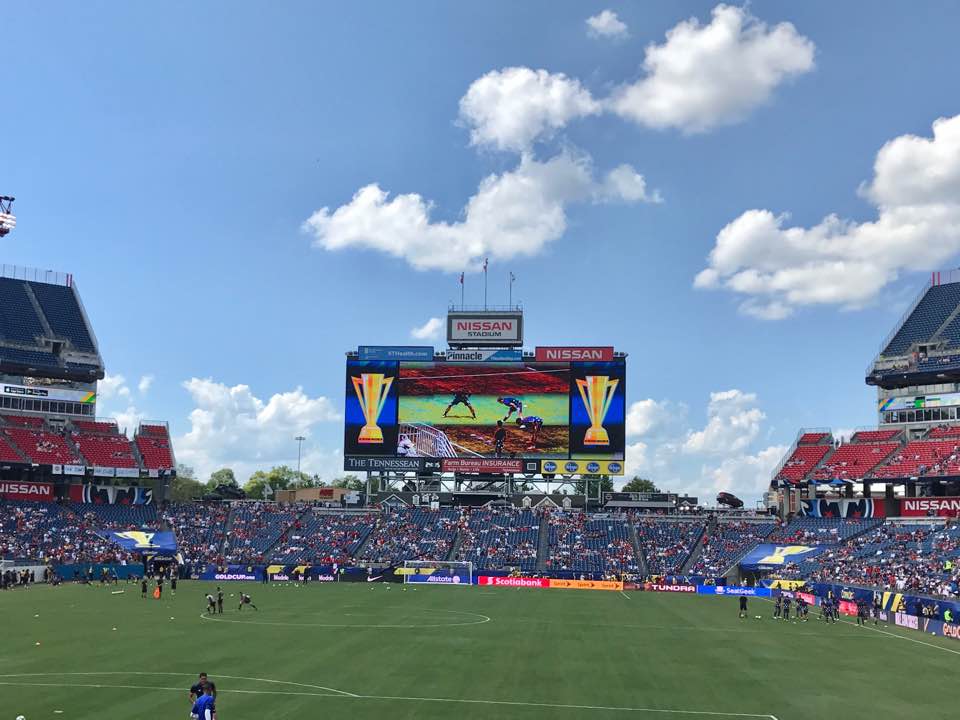
The view of Nissan Stadium in Nashville from the American
Outlaws' section prior to the U.S. v. Panama match. (photo by me)

5.  The U.S. Men's B Team is Not Germany's B Team. Or C Team. No surprise there, of course, but the performance against Panama was dross. Fortunately, the players know it and Bruce Arena knows it. While Arena chose to use the Gold Cup as a testing ground for players who are on the fringe of the potential 2018 World Cup roster, they were out-of-sorts defensively and particularly in the midfield. Which leads to the final observation ...

6.  Shut Up About Michael Bradley Already. After every U.S. match of any significance, the trolls crawl from their parents' basements to complain about how Bradley gives away the ball too much, doesn't play high enough, doesn't play back enough, blah, blah, blah. If the match against Mexico at the Azteca and a Bradley-less midfield against Panama don't convince you of Bradley's quality and the absolute necessity that he be a starting midfielder for the U.S. as long as he wants to strap on his boots and don the shirt, nothing will.

While Kellyn Acosta was good in the warm-up match against Ghana and threw himself around a bit against Panama, the other two center mids against Panama, Dax McCarty and Joe Corona, were abysmal. Here's hoping Arena gives someone (anyone) else a shot against Martinique. But only with the caveat that they will back-up, or at best play alongside, Bradley.

Saturday, November 12, 2016

Disappointment, Desperation, and Despondency (All Solely Related to Soccer)

Jose, from Washington State, introduced himself to me and E as he took his seat in the row in front of us in the American Outlaws section of MAPFRE Stadium. Cowboy hat, cowboy boots, and a welcoming grin from ear-to-ear. He took off his coat, revealing his AO jersey. He sang and chanted at the top of his lungs the entire game.

We all rode the wave of emotion that is unique to being present while your team, your country is on the field, seemingly within arms' reach. Disappointment at the first Mexican goal. Desperation when Tim Howard was subbed out, unable to continue (please tell me why they watered the field right before the start). Relief when not one, but two, Mexican shots banged off of the crossbar and the post. Frustration at chances missed in the first half, largely against the run of play; and in the second, when we should have put the game out of reach. Jubilation when Bobby Wood scored the tying goal.

Howard lies injured.
(photo from sbnation.com via pinterest)

And, then, disbelief when Rafa Marquez, he who could teach Putin a thing or two about true anti-American villainy, scored the winning goal at the death. Right in front of us.

No emotions invested or wasted due to anything off of the pitch. No "Build the Wall" chants. No anti-Trump protests. Just devotion directed by us to our team, and them to theirs. And, of course, some derision sent in the direction of the opposing players. But not their fans, and not their countries.

At game's end, Jose was disconsolate, repeatedly banging his AO Washington-Tri-Cities scarf on the seat in front of him. He'd come all this way to witness that? E and I silently filed out, leaving Jose and his two friends to their despondency.

As we left, I caught the eye of a woman in the row behind us, wrapped in the flag of Mexico. I gave her a wink, hoping that she took it as a "congrats," not flirtation.

Yes, the U.S. Men's Team lost. But America won.

This is still is our America.

One Nation. One Team.

Thursday, November 10, 2016

When the Yanks ...

It's been 15 years since I've seen the U.S. Men's National Soccer team play a World Cup qualifier, in Columbus, against Mexico.

This was that game:


What I remember the most, other than the fact that we won 2-0 (and that it may have been the coldest I have ever been in my entire life), from "La Guerra Fria" was Tony Sanneh coming out for final pre-game warm-ups in shirt sleeves, while the Mexican team huddled in its dressing room until, literally, seconds remained before the whistle blew to start the match.

A lot has changed since then.  Three more dos a cero wins in World Cup qualifiers in Columbus. And an election, just this week, that has given me pause to reflect on what being a supporter of the United States -- in the broadest sense, and in the context of its soccer teams -- means.

This is what I've decided:

I am still an American, as are the millions who voted, as was their right, for the candidate I did not support. As are the millions who did not vote (although maybe a little less love for them as far as I'm concerned). 

I still am proud to be an American.

I will still loudly and full-heartedly cheer and sing and probably yell at the officials in support of my team and my country.

Most importantly, I will cheer for a team that is comprised of African Americans, German African Americans, Hispanic Americans, Jewish Americans, Icelandic Americans, Asian Americans, Croatian Americans, and, yes, some Anglo Americans too.

I will respect our brothers from Mexico for their right to cheer on their team, although I will desperately hope that their team fails.

This is what my America looks like:

photo from mlssoccer.com
I'm still all in.

Friday, October 18, 2013

Ascendancy It Is

I kept telling myself "it was only a friendly. It was only a friendly."

On two occasions this summer, after the U.S. Men's soccer team's big win over Germany and its shocking come-from-behind triumph over Bosnia-Herzegovina, I reminded myself of just that. After all, in the midst of UEFA qualifying, those countries may have treated the games as warm-ups, an opportunity to allow their reserve squad players a taste of international action.

But the mere fact that the Americans won both matches, in which they likely would have collapsed two years ago, or even earlier this year (remember the game against Belgium a week before the one against Germany?) made me think that something big was brewing with the national team.

Back in January, I wrote about how this was a cross-roads year for both the U.S. Men's and Women's National teams, as well as women's professional soccer in the U.S. Feast or famine; make or break. A year of ascendancy or disaster? is the way I put it.

While the Woman's national team has done just fine under new coach Tom Sermanni, and the jury is still very much out with regard to the new women's league, the answer for the Men's team is clear: ascendancy it is.

The improvement shown against two of the best squads in Europe in the friendlies was borne out in the remaining matches of CONCACAF qualifying as the Americans, after a serious misstep in Costa Rica (which was clearly the second best team in this Hex), steamrolled Mexico and Jamaica and then stunned poor Panama, on the cusp of kicking Mexico to the qualifying curb, with two extra time goals in the final qualifying match.

Graham Zusi celebrates his game tying goal in Panama, the dagger
to the heart of its qualifying hopes. (photo from sbnation.com)

While some pundits wondered post-match about the wisdom of pursuing an in-game strategy that kept Mexican hopes alive in the World Cup (with their loss to Costa Rica in the final match and what seemed like a imminent win by Panama over the U.S. Panama would have traveled to New Zealand and back for a playoff and Mexico would have been sent home to lick its considerable psychological and monetary wounds), I'm glad that the team and Coach Jurgen Klinsmann saw fit to play hard and go for a win in their last competitive match before next summer's World Cup.

And least we forget, while Klinsmann is now being hailed as a savant and savior, it wasn't too long ago that his leadership and tactics were being seriously questioned. But first with those friendlies, then with the wins over Mexico and Panama, Klinsmann has show a deft touch with substitutions and the ability to get the most out of his players, especially those that he does not put in the starting 11.

Klinsmann's leadership strengths discredit the idea that the U.S. should have "thrown" the Panama game. That thought is completely contrary to the way that Klinsmann is going about the job of building a different soccer psyche in this country, and that is not the lesson that he would have wanted his players in Panama City to take away from that match.


Instead, the Americans flew back to the U.S. full of confidence, convinced that they can win any match, at any time, with any 11 players on the pitch.  Whether that will bear out depends a lot on what countries it draws into its group in the World Cup (and it might get ugly)(you could waste hours keeping track of all the possible permutations using the draw simulator here). Nonetheless, that confidence will be there when they step on the pitch, somewhere in Brazil against an unknown opponent in June 2014. I can't wait. And I don't think they can either.


Wednesday, July 6, 2011

Can You Demand Support?

The recent National Team matches between the U.S. Men's soccer team and Mexico and the Women's team and Sweden have had me pondering the nature of support of national teams.
Ask anyone who is a fan raised in a football culture and they will tell you club comes before country. In America, however, it's a little different. Unless you're 15 years old or younger, you were born at a time when there was no major professional league in the country. So for my generation, and the one that preceded me, the national team was the team of first allegiance. Maybe that's why I have trouble understanding Americans who root for other countries against "their" nation in any competition.
My Grandfather emigrated from Sweden in his early adulthood and I am extremely proud of my Scandinavian heritage, as well as his accomplishments and assimilation into American life. But I would never think of rooting for Sweden to beat the U.S. Sweden is what I claim as my nation of origin, my heritage. The United States is my country.
The Swedish national team badge.
So while the Swedes made the American women look very ordinary in their World Cup match Wednesday, I felt no elation. Frustration, yes. But the team I was rooting for wore white and the badge of U.S. soccer and they were and are my team.


As noted in my previous post, that is not the case with Hispanic fans who root on Mexico against their adopted homeland, America. While I am far from those who insist on making English the official language of the United States, and have established a track record of non-jingoism, I am troubled by the fact that the American men are the "away" team when they play Mexico almost anywhere within the contiguous 48 states.
The rationalization of one Mexican national team supporter at the Gold Cup final was this: "I love this country, it has given me everything that I have, and I'm proud to be part of it," said Victor Sanchez, a 37-year-old Monrovia resident wearing a Mexico jersey. "But yet, I didn't have a choice to come here, I was born in Mexico, and that is where my heart will always be."
I'm sorry Victor, but, unless you were forced across the border at gun point, yes, in fact, you did have a choice. You chose to come to the land of opportunity over your native land, much as my Grandfather did. And now you turn your back on it.
There are several solutions to this situation. The most obvious is to cultivate a large enough following of the U.S. national team that supporters that they will purchase tickets instead of the Mexican fans. 
The second is to hold to matches in areas that are not traditional "strongholds" of Mexican national team support (i.e., Los Angeles). The most memorable soccer match I have ever attended was in Columbus, Ohio. In February. 


U.S. Soccer finally decided to turn the tables on our neighbors to the South, who generally make us play in the smog-filled thin air of Mexico City for our national team matches against them, and set our first qualifying match for the 2002 World Cup in Columbus. Mother Nature, with a wink and a nod, complied with the plan and served up weather that was 29F at kick-off, with the wind chill in the teens.


The Mexican team never had a chance, emerging shivering from its locker room only minutes before kick-off only to find the Americans already on the field, most memorably for me Tony Sanneh in shirt sleeves. Even with Brian McBride, local Columbus Crew hero and the Americans' top striker, forced out early with a golf ball sized knot on his face, the Yanks dominated and won 2-0.


The third solution is the one that the democrat (little "d") in me whispers in my ear while I curse the pro-Mexican crowds is to make those fans feel a little more American. Maybe, it says, it was easier for your Grandpa and his son and his son's son because they had fair hair and blue eyes. Maybe, if we spent a little less time building walls (real and metaphorical) to keep immigrants out they would feel a little more American.


Pia Sundhage, the U.S. women's national team coach, is Swedish. I seriously doubt that anyone will accuse her of throwing the game against Sweden (although why Megan Rapinoe played for 72 minutes is completely beyond me). Would the same be true if Bob Bradley was of Mexican heritage?


Regardless of why, or what the short-term solution may be, the bottom line is that you can't dictate allegiance. It has to be earned. So, at least for the short run, Victor and his many companions will continue to support their country of origin over their country of opportunity. And I (and Tim Howard) will just have to learn to deal with it. After all Tim, that match in Columbus? It's forever known in Mexico as La Guerra Fria ("The Cold War"). Sounds way cooler in Spanish.