Showing posts with label Michael Bradley. Show all posts

Wednesday, July 12, 2017

Cups All Around (and not a Drop to Drink)

Some observations after watching most of the Confederations Cup and attending the U.S. Men's National team Gold Cup game against Panama in Nashville:

1.  The Confederations Cup Is No Longer a Test for Anyone but the Host Country.  Sure, you can say that the Germans don't have a B Squad, or that even their second team is better than most other countries, but whatever the excuse or the analysis, the simple fact is that they breezed through the Confed Cup starting exactly zero players who started the 2014 World Cup Final against Argentina. 

While roster turnover is a fact of international soccer, and it would be a shock if Philipp Lahm or Miroslav Klose featured in the 2018 German World Cup team (since both have retired from international football), there are several players from that team (Neuer, Ozil, Muller, Boateng) who seem naturals for the next edition as well. But they were nowhere to be found on the squad as Joachim Low chose a team without a wealth of international experience. The Germans won four games and tied one, "avenging" the tie by beating Chile 1-0 in the Final.

2.  Russia Met its Lowly Expectations. Apparently the "test" for Russia hosting these games, as far as FIFA was concerned, was to prove that it could be at least superficially friendly to traveling supporters of the participating teams and avoid any overt racism, homophobia, or hooliganism. While new FIFA Capo Gianni Infantino said that the tournament was a great success, it remains to be seen whether Russia can duplicate the feat on a much larger scale, with many of the stadiums not used for the Confederations Cup still not complete. Not to mention the pesky North Korean labor abuses upon which those stadia are apparently being built.

3.  Russia's Men's Soccer Team Met its Lowly Expectations. Which is to say, it sucks. Although one player, Yuri Zhirkov, was fun to watch.

4.  Mexico is Still Mexico. Which is to say, it folds on the big stage. The best Mexico has to offer was a poor, poor second to Germany in the semis, losing 4-1, and couldn't beat a Ronaldo-less Portugal in the third place match.
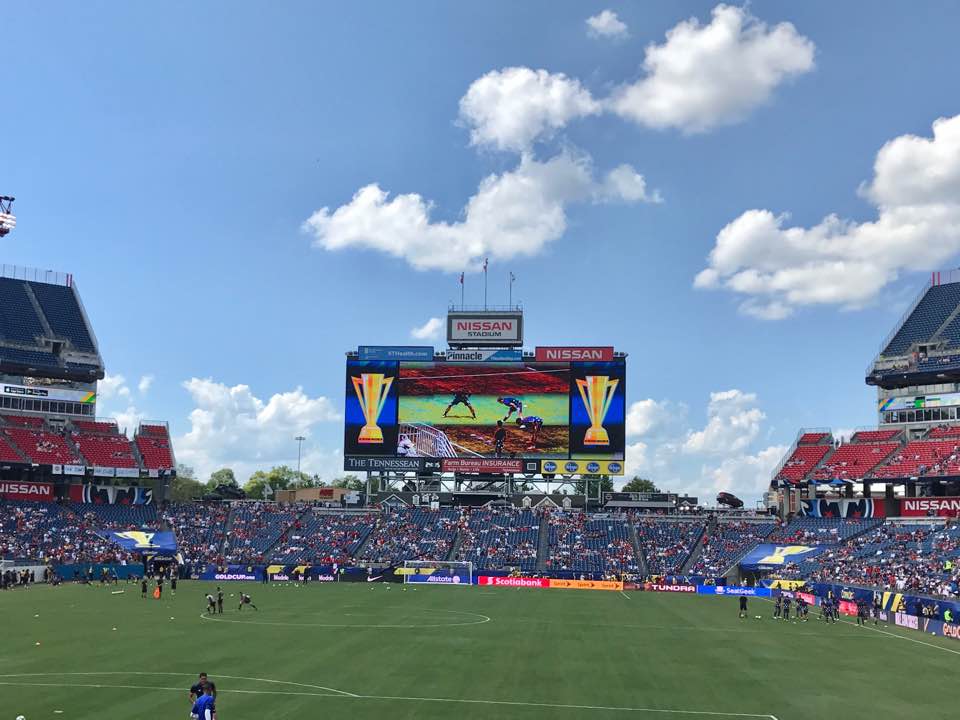
The view of Nissan Stadium in Nashville from the American
Outlaws' section prior to the U.S. v. Panama match. (photo by me)

5.  The U.S. Men's B Team is Not Germany's B Team. Or C Team. No surprise there, of course, but the performance against Panama was dross. Fortunately, the players know it and Bruce Arena knows it. While Arena chose to use the Gold Cup as a testing ground for players who are on the fringe of the potential 2018 World Cup roster, they were out-of-sorts defensively and particularly in the midfield. Which leads to the final observation ...

6.  Shut Up About Michael Bradley Already. After every U.S. match of any significance, the trolls crawl from their parents' basements to complain about how Bradley gives away the ball too much, doesn't play high enough, doesn't play back enough, blah, blah, blah. If the match against Mexico at the Azteca and a Bradley-less midfield against Panama don't convince you of Bradley's quality and the absolute necessity that he be a starting midfielder for the U.S. as long as he wants to strap on his boots and don the shirt, nothing will.

While Kellyn Acosta was good in the warm-up match against Ghana and threw himself around a bit against Panama, the other two center mids against Panama, Dax McCarty and Joe Corona, were abysmal. Here's hoping Arena gives someone (anyone) else a shot against Martinique. But only with the caveat that they will back-up, or at best play alongside, Bradley.

Wednesday, June 1, 2016

Glimmers of Hope

So what are we to think about the U.S. Men's National soccer team headed into the Copa America (or Copa Centenario, if you prefer)?

Consecutive wins against South American opponents in the past week? Good.

Those wins coming against traditional CONMEBOL minnows Ecuador and Bolivia? Not so good.

Four straight wins and a 6-1 record so far in 2016? Good.

The loss being in World Cup qualifying to Guatemala in a dismal 2-0 performance? Not good at all.

The introduction of new, exciting players like Darlington Nagbe, Christian Pulisic, and Steve Burnbaum? Good.

Continuing to rely on old, and old guard, players like Jermaine Jones and Kyle Beckerman, particularly in the demanding role of center midfielder? Not very good.

Obviously the upcoming Copa America will give us more information on where the national team is, and where it might be going, in World Cup qualifying and, hopefully, the 2018 World Cup itself. The recent wins have certainly quelled, for now, the anti-Klinsmann drumbeat that reached a crescendo after losses to Jamaica in the Gold Cup and Mexico in the play-in for the Confederations Cup last year.

While they are far from a guarantee for success in the upcoming Copa America, which will be against stiffer competition in a more meaningful setting, the Americans' luck appears to be turning after a dismal 2015. And not just on the field.

The U.S.'s opportunity to participate in the Copa, and indeed the entire tournament, was cast into doubt by the indictment or arrest of many top CONMEBOL and CONCACAF officials last summer and additional indictments for Traffic Sports, a major player in organizing (and skimming graft from) both the Gold Cup and Copa America. The importance of the tournament as preparation for the next World Cup cannot be understated, particularly after the ignominious denial of the chance to play in the Confederations Cup, participation in which was long touted by Klinsmann as essential to success in Russia, until it wasn't.

But whether through sheer will to actually celebrate the 100th anniversary of the competition, or the unappealing prospect of losing millions of dollars of revenue from the target-rich U.S. soccer market, the tournament will go on (although perhaps without Argentina).

While Klinsmann has talked about bringing new or younger players along slowly (hence not starting Nagbe or Pulisic against either Ecuador or Bolivia), this tournament seems the ideal opportunity to start determining whether they will be able to withstand the pressure of top flight competition in CONCACAF World Cup qualifying, particularly once it moves to the final stage (known as The Hex because of its six teams, the top three of which will qualify for the World Cup, and the fourth place team of which will advance to a playoff against the fifth place team from Asia).

The back line seems set with John Brooks and Geoff Cameron (assuming he's healthy) in the center of defense and Fabian Johnson and DeAndre Yedlin on the wings. Bobby Wood, Gyasi Zardes, and Clint Dempsey appear ready to play up front in some combination (particularly with the surprise exclusion of Jordan Morris from the squad) with Pulisic likely to come off the bench and Chris Wondolowski available to poach a last minute goal in a pinch. 


Pulisic celebrates his goal against Bolivia, which made him the
youngest goalscorer for the U.S. Men in the modern era.
(photo from www.dailymail.co.uk)

That leaves three players to man the midfield (although Zardes could play wing or Dempsey as a withdrawn forward or attacking midfielder at the top of a diamond). Michael Bradley is a shoo-in, of course. Alejandro Bedoya was, for my money, perhaps the Yanks' best player against Bolivia and seems unlikely to be left out of the starting 11 (as long as Klinsmann doesn't insist that he play in the back).

There has to be some bite, which Jones normally provides. Klinsmann could go with two defensive mids with Jones and Beckerman, but that seems unlikely, particularly given Beckerman's lack of mobility. Equally unlikely is abandoning the defense altogether and playing both Nagbe and Bedoya along with Bradley.

While Jones is an acceptable choice this summer, it's hard to see him as capable of being one in Russia. I'd like to see Klinsmann try Bradley at the bottom of a diamond with Nagbe and Bedoya the linking midfielders and Dempsey at the tip. But that's unlikely to happen since Klinsmann has insisted for more than two years now that Bradley's best position is up the field leading the attack, and for the most part Bradley has proved him right.

Another option would be to recognize that Dempsey may be too old by the time 2018 comes around and put Bradley at the top, with Nagbe and Bedoya behind, Cameron in the defensive/deep-lying mid position, and Burnbaum or Matt Besler in the center of defense with Brooks.

Given the heat that Klinsmann took last year over the team's performance it's understandable that he is reluctant to sacrifice results for experimentation in the Copa. But, in the long-term, that may be exactly what this team needs. Regardless, it's nice to talk about the options available to him, which seemed in very short supply last fall.

Wednesday, June 10, 2015

That Bradley Guy Again

After the U.S. Men's Team's stunning 2-1 comeback win over Germany in today's friendly, I was tempted to write another post about Michael Bradley. But Jason Davis over at espnfc.com already has.

Or maybe I already have - Davis makes many of the same points that I did after the Netherlands match. Not that I think he's plagiarizing or anything. But maybe proof that sometimes I'm on the mark? Check out the highlighted sections below, then my post from earlier this week.

Michael Bradley leads U.S. to stunning win over World Cup champs Germany

Three musings after the United States closed out a strong European sojourn with a thrilling 2-1 win Wednesday against Germany in Cologne on Jurgen Klinsmann's first trip to his native land as U.S. national team coach.

1. Michael Bradley, playmaker

He doesn't wear the No. 10 jersey (that would be Mix Diskerud), but Michael Bradley is undoubtedly the Americans' driving creative force. Just as he did against the Netherlands, Bradley served as the key man in the U.S. attack, starting moves and setting up goals with his vision and accuracy. Apparently Klinsmann was on to something when he moved Bradley into the role last summer at the World Cup.
Back then, the Toronto FC man seemed prone to trying to do too much, effectively running himself out of games by attempting to cover too much ground. In two friendlies on this European trip, all things flowed from Bradley in the American midfield. His final passes grab the most attention, but he was equally important moving the ball, allowing the United States to gain some semblance of possession whenever possible.
Bradley in today's match against Germany (photo from espnfc.com).
After halftime changes provided him a solid backstop in Kyle Beckerman, Bradley was free to think entirely forward-first. The number of times he both started attacks and put himself in position to be available to finish them is a testament to his improving understanding of his role on this team.
The only black mark on Bradley's performance was the shot he hit directly at the German keeper, Ron-Robert Zieler that would have turned a strong 1-1 draw against the world champions into a stunning win. Luckily for Bradley, Bobby Wood arrived to lace home a wicked left-footed shot with Germany stretched, surprising the crowd and lifting the United States to a second consecutive win on the road in Europe against a top-10 team.

Monday, June 8, 2015

Insight and Eurocentricity

So much to catch up on in the world of soccer. FIFA scandal (or, more accurately, scandal finally exposed), Sepp Blatter, Hope Solo, the Women's World Cup, the Women's World Cup being played on an inferior surface.
 
But, for just a moment, a post about the game itself. Particularly, one player and how one coach can seemingly be completely insightful and completely wrong at the same time.
 
The player is Michael Bradley. While he didn't score (and frankly should have), he lead the U.S. Men's National Team to an improbable comeback win against The Netherlands last Friday in Amsterdam.
 
Bradley against Holland (photo courtesy of mlssoccer.com)
 
 
Before you say it, I know. Where do I stand on the "friendlies mean nothing" versus "friendlies tell us a lot" scale because I've been all over the place on it? But this isn't an evaluation of the entire men's team and its performance in Holland (which, frankly, was disastrous defensively) but of one player and his standout play and what it tells us about him and about Jurgen Klinsmann as a coach and as technical director of the Men's National Team.

First, the good news. Bradley was clearly the standout player on the pitch, for either team, and that includes Robin Van Persie, Klaas-Jan Huntelaar, and Memphis Depay (who was excellent going forward for the Dutch, but not so great in defense).Bradley pulled all the right strings for the U.S., including going on this mazy run that led to Bobby Wood's game winner at the death:

 
Bradley's excellence says much about him and his coach. Of Bradley, it tells us that he's willing to adjust his game, to bow to his coach's will for the good of the team (he is, after all, a coach's son). Since well before the 2014 World Cup Klinsmann has insisted that Bradley's role should be that of the attacking midfielder. And, for a long-time, many insisted that it wasn't working. With his great work rate and apparent defensive proclivity, Bradley continued to drop into the defensive mid role with which he seemed more comfortable.
 
The fruits of Klinsmann's insistence, and Bradley's compliance, were on display against Holland. Perhaps because Bradley knows that with Kyle Beckerman in the holding midfielder spot he can be more comfortable moving forward. perhaps out of desperation because, down 3-1 on the road there was no reason to play it safe. But whatever the reason, the hope is that Bradley is now comfortable with his new home.
 
Speaking of new homes, Bradley's performance again calls into question Klinsmann's mantra that the best American players need to play in Europe against the best competition to reach their competitive peaks. While admittedly the competition in the European professional leagues is still higher than that of MLS, Bradley's transformation has occurred not in Holland or Germany or Italy, which were all stops in his career, but in MLS playing for Toronto FC.
 
For every Bradley or Dempsey whose game has clearly benefited from playing in Europe, there are seemingly several Altidores and Sheas who sat on their benches in Europe and only played (and returned into the national team top tier) after returning to MLS. 
 
Is Europe still better? Yes. But only for players who play.
 
Hopefully Klinsmann the technical director will understand that message sometime soon.

Thursday, June 26, 2014

Through

I'm spent.

I've written before about my ambivalence about my love of sports. Particularly soccer. Particularly a soccer tournament run by an organization as corrupt as FIFA.

But I've also resolved to embrace my obsession. And so I watched the U.S. game against Germany with E, didn't sit the whole first half, didn't even sit at half time while eating and pacing. E didn't either, although I'm not sure out of superstition or just nervousness. I hadn't been so nervous since my last Regional championship game. Or my last trial. Or the Ghana match.

I in my Klinsmannesque blue USA polo, E in his brand new away jersey that he had just opened, a present on his 23rd birthday. Moaning, muttering, yelling at the ref (which will either amuse or confirm the suspicions of my referee friends - and, no, I do not count the zebra in the photo to the right giving me a card among them).

This one (photo from ussoccerplayers.com)
Only after Muller scored (and what a fabulous strike) did I decide that particular talisman was broken and sat and watched, as much what was happening in the Portugal-Ghana game as ours, and fretted and groaned and, in the end, exalted. At a loss.

Some of my friends and family, new to soccer, still have problems with the nuances. What is up with added time? Why do players dive with impunity? How can losing a battle mean winning a war?

It's all part of the magic, my friends. There's often the chance of a last gasp. There's always the hesitation for the whistle, the pointing of the arm, the brandishing of the card. And there's also the ability to rely, in the group stage anyway, on good work already done and grinding out a result, and hoping that someone else keeps playing hard on the biggest sporting stage in the World. 

Thanks Portugal. Thanks Ronaldo (never thought I'd say that).

We're through. And that's really all that matters right now. The shirt can stay. 

I'm sitting for the Belgium game, though.

Some random thoughts:

Klinsmann got it right again. I thought Geoff Cameron needed to go after Portugal, and evidently Klinsmann did too. But he stuck to his guns that Omar Gonzalez was his right central defender on the bench and started Gonzalez against Germany. And Gonzalez was very, very good.

Tim Howard was fantastic. Jermaine Jones again was huge, but about as spent as me when the game ended. Bradley not great but better. Dempsey also exhausted (time to get someone else up front -- Altidore or Johannsson -- and let Dempsey play withdrawn?).

If you like soccer, or humor, or even better both, check out the Men in Blazers podcast from Grantland. Spider bites with questionable consequences, tiny bananas, Tiricoism, and, best of all, #wetherrara. These guys are fantastic.

Ian Darke was driving me crazy during the match. E and I kept yelling at him to quit restating the obvious and jinxing us. Michael Ballack, on the other hand, has gotten much better as a studio analyst.

And speaking of improved performances, I begrudgingly give credit to FIFA for lowering the boom on Suarez.

Belgium? I'll take our chances. And Argentina after that? That would be something not to miss.

Sunday, June 22, 2014

Post-Match Musings - U.S. v. Portugal

I take back all the bad things I've been writing about Alexi Lalas. His observations immediately after the Americans' 2-2 draw against Portugal were spot on. It was a great match and the Yanks would have been thrilled with four points from the first two games if they had been offered prior to the start of the World Cup. 

It's up to Jurgen Klinsmann to convince the team of that. That we're still in good shape and have showed the world what teamwork and hard work can accomplish. But while the last play of the Portugal match was the most disappointing, there were several things to be concerned about coming out of the match.

One is that Klinsmann's magical substitution touch abandoned him at a crucial point of the game. I understand the idea behind taking Graham Zusi out and putting Omar Gonzalez in the center of defense with a few minutes left (to waste time, for starters). But Gonzalez hasn't done much right in the last month and he was completely absent (out wide to the right and behind the play) when Portugal equalized. Perhaps he was in to man mark Cristiano Ronaldo, but he did a poor job of that as well. He should have been in front of the cross from Ronaldo to head it away, but even with fresh legs was out of the play as it occurred.

Which brings us to the worst performance over 90 minutes - that of Geoff Cameron. Lalas forgave him the horrible miss hit that put the ball at Nani's feet five yards out with only Tim Howard to beat five minutes into the match, but I can't. It was the kind of mistake you excuse at lower levels of soccer, but not in the World Cup. Cameron then compounded the error by being behind Varela when he headed in Ronaldo's cross to tie the game at the death. Ball watching in the 95th minute? Amateurish.

I understand a coach wanting to keep his defense consistent absent suspensions or injury, but one has to think that John Brooks will be seriously considered to replace Cameron against Germany on Thursday. After the Ghana match Klinsmann said that Brooks is his left central defense substitute (i.e., for Matt Besler) and Gonzalez the sub on the right. But Brooks and Besler have to be considered to pair against Germany, particularly given Brooks' familiarity with many of the German players.

He's convinced me as a commentator, but is it 
too late to put him back in the center of defense? 
(photo from content.usatoday.com)

As for the good news -- I start with Besler. He was fantastic throughout the match. Apparently Howard was voted Man of the Match, but for me it was Besler without question. Things could have fallen completely apart after Cameron's miscue, but Besler held it together, stepping when he needed to and distributing well from the back.

Jermaine Jones was very good again, although not as good as against Ghana, save for his fantastic goal. Kyle Beckerman worked hard and had some good touches, although he also was not as outstanding as he was against The Black Stars. One has to wonder, at 32 years of age apiece, whether Jones and Beckerman will have enough left in the tank to go the full 90 minutes against Germany (particularly with three days of rest while the Germans have four - thanks FIFA!).

Clint Dempsey worked very hard and deserved his goal (I had a player score a goal with her stomach once - in a 1-0 upset win over the school that at the time was ranked first in the state - so I appreciate particularly that method of scoring).  Zusi gave away the ball too much, but his perfectly weighted pass set Dempsey up for the belly ball that looked at the time like it had put the Yanks in the Final 16. Howard made one fantastic save, but on a rebound shot from a ball off the post that seemed to go right through his hands.

Honestly, very few of our players except for Besler had outstanding games. Michael Bradley was once again sub-par (but please don't talk to me about how Klinsmann should pull him for the next match - we have no one else who can even come close to being able to do what Bradley does even on a bad day). That should bode well for our chances against Germany.

A win or draw against Germany and we're on to the Round of 16. A loss, and we might still get in depending on the result of the Portugal v. Ghana match. And if Germany draws against us they are not only in, but top the group. 

Don't think that it hasn't already crossed my mind (and those of the powers-that-be in both the Ghanaian  and Portuguese Football Federations) that a dull, goalless draw against a German team that the Americans' coach starred for as a player and coached on this very stage would suit both countries' purposes just fine, thank you very much. 

Such an approach, however, doesn't seem to be in Klinsmann's DNA (remember when we could have sent Mexico packing if not for two stoppage time goals that broke Panama's heart eight months ago?). And it's hard to see the Germans giving either Klinsmann or the U.S. any quarter either ("uh, Ms. Merkel, about that whole listening to your phone calls thing? We're really, really sorry now").

If only we had held on. If only Cameron had taken a better touch early or marked his man late. If only Bradley hadn't given the ball away in the center of the field. If only Gonzalez had done the one thing he was put in the game to do.

But this is American soccer. We're second in the Group of Death with everything to play for, coming off of two gutty performances with a warrior leading us on the field as our captain. We don't coast or dazzle or do things the easy way. But, more often than not, we find a way.

Still, just this once, I would have been fine with us taking the easy way.

Tuesday, June 10, 2014

The Trick Up His Sleeve

I ended my post about the U.S. vs. Turkey match saying that Jurgen Klinsmann might have trick or two up his sleeve before the first World Cup match against Ghana next Monday.

Turns out he had at least one, and we didn't have to wait until that game to see it.

The U.S. won its final warm-up match before Brazil, beating Nigeria 2-1 with two goals from Jozy Altidore (the first among the easiest he'll ever score, the second a vicious strike from 12 yards out).  Nigeria pulled back a consolation goal on a penalty kick in the 86th minute to ruin keeper Tim Howard's shut out in a match in which he won his 100th cap for the Stars and Stripes.

The U.S. rolled onto the pitch against Nigeria in a formation featuring two defensive midfielders (Kyle Beckerman and Jermaine Jones) and no true left winger. That left Graham Zusi on the bench (apparently confirming the opinions of those who were less than impressed with his performance against the Turks) and the Americans with no right wing. While a departure from the previous two matches, this was the formation that had guided the Yanks through qualifying, including topping the Hex for the third straight time.

As predicted, Alejandro Bedoya was back at left wing against Nigeria after making way for Brad Davis in the Turkey match and DeMarcus Beasley was again at left back in place of Timmy Chandler, unimpressive against the Turks.

Contrary to what you might imagine, this formation actually created more chances than did the one used against Azerbaijan and Turkey which featured two forwards, two out-and-out wingers and two center-mids. Dempsey played more like a withdrawn striker than a partner alongside Altidore, Jones was more offensive, often drifting out wide (but tracked back as well), and Michael Bradley bossed the midfield and teamed with Dempsey to direct the attack.

This allowed more room for Altidore to roam, and also opened up the wings for marauding attacks from Beasley and right back Fabian Johnson who was brilliant offensively once again. Bedoya lacked quality in the attacking half of the field, but his defensive work was a big improvement over Davis's. Nigeria had the majority of possession in the first half but never looked particularly threatening, while the Americans' counterattack always looked likely to score.

The U.S. defense was solid most of the game. Central defenders Matt Besler committed a late foul that was whistled for a deserved penalty, but while he has been downgraded by some for the foul (and his play in general), the penalty was largely the fault of Omar Gonzalez, who came on late and was badly beaten by a Nigerian attacker in the build-up that resulted in the penalty and the goal.

Beckerman (15) sorts things out with Cameron and 
Besler (5) in the Nigeria match. (photo from usatoday.com)

After dominating the African champions, it seems likely that the U.S. starting 11 against Nigeria will take the field in the same formation against Ghana. It remains to be seen whether the U.S. has the strength and speed in the midfield, and the familiarity and organization in the back, to deal with the Ghanaian attack. But Beckerman's insertion into the line-up gives some hope for a more organized defense and a more creative attack.

And that hope is needed after Ghana demolished South Korea 4-0 last night in its last tune-up for Brazil. While the scoreline is intimidating, apparently Ghana did not dominate play as comprehensively as it indicates and South Korea was hurt by poor finishing.  Still, Ghana is spoiled for choices in the midfield and up top and will probably give the U.S. more to worry about as far as attacking options go than will Portugal.

Klinsmann appears to have this group as ready as it can be for the Group of Death. Two teams will survive, that much we know. Klinsmann has admitted that a win over Ghana is essential to the U.S. being one of those two. The time for analysis is over. Only the true test on the field remains.

Sunday, January 27, 2013

The Year of Ascendance or Disaster?

An important year awaits U.S. soccer, both on the men's and women's sides.

The women will face the year adjusting to a new coach as Tom Sermanni officially takes over from Pia Sundhage, now in charge of the national team in her native Sweden. While the team has understandably expressed excitement at the prospect of having a new coach with new ideas after five successful years under Sundhage (understandable because, well, if they're going to play, they're going to play for Sermanni), several key players are aging at positions that usually expose age (everywhere but keeper, really).

On the professional front of the women's game, the National Soccer League is set to begin play in April. The league announced this past week the allocation of National Team players from the U.S., Mexico, and Canada to the eight franchises, which include essentially are four teams from the former WPS (Boston, "Sky Blue", based in the New York City area, Western New York (Rochester), and Chicago) and four new clubs and cities (Seattle, Portland, Kansas City, and Washington D.C., which had a team for two years before it was moved to Florida).

The players were allocated with the help of a panel of experts, presumably to assure parity. Some effort appears to have been made to allocate American players close to home as well (for example, Hope Solo and Megan Rapinoe to Seattle, and Abby Wambach to Rochester).

While I don't profess to be familiar with any of the Mexican or many of the Canadian players, at first glance the Portland club, with Tobin Heath, Alex Morgan, and Christine Sinclair from Canada look to have the makings of a powerful offense.

Presumably, as much interest will be focused on the business model of the new league as it tries to succeed where two of its sisters recently failed. Smaller, and in some instances shifting, venues and subsidies from the U.S., Canadian, and Mexican national teams may at least provide a tourniquet for the financial bleeding that is bound to occur with any fledgling professional league.

Meanwhile, on the men's side the National Team faces the final round of qualifying ("The Hex") for the 2014 World's Cup. Who will be in the starting 11 against Honduras on February 6 is anyone's guess, including, more likely than not, head coach Jurgen Klinsmann's. Keeper Tim Howard is a lock. Michael Bradley and Clint Dempsey are certainties, barring injury. But even where they will play is not clear. Bradley could play holding midfield, or as an offensive mid. Dempsey could play out wide in a 4-3-3, as a withdrawn forward, or up front (although he does not seem to be preferred by club or country as an out-and-out striker).

Michael Bradley is one of the few certainties in the U.S. lineup.

The big questions are who will make up what was an inconsistent defense and who will play up front and in what configuration. Is it time to replace Steve Cherundolo and Carlos Bocanegra in back? Will Herculez Gomez, Jozy Altidore, Juan Agudelo, Eddie Johnson, or Chris Wondoloski play up front and alone or with a partner?

Whatever the line-up, the results have to be sufficient to qualify for the 2014 World Cup.  There is no doubt that soccer's popularity is on the rise in the U.S. But in the women's game, the interest has been limited, to this point, to the national team.

By the same token, the rise in popularity on the men's side has largely been concentrated on the European professional leagues, particularly the English Premier League. And while it's encouraging that there are more broadcasts of soccer than ever, and that results even occasionally creep into smaller newspapers, it doesn't do a lot to grow the professional game in the States.

In order for that to happen, soccer fans have to take more of an interest in MLS, either by attending or just by raising the t.v. ratings. And that's most likely to happen if the men's team, stocked primarily with MLS players, qualifies for its seventh consecutive World Cup. Failure to qualify will not only be a blow to the growth of the game here, but also to U.S. Soccer, which invested its future (not to mention a lot of cash) in the talismanic Klinsmann.

I may be a Pollyanna, but I think Klinsmann will figure it out and the U.S. will qualify either first or second in the group. And the star of the team will not be Dempsey or Altidore or Landon Donovan. It will be the former coach's son - Bradley.

Wednesday, May 30, 2012

Another Year, Another Review

As I enter my third year of posting, and with the recent migration of this blog to a new host (thanks Bulldog Creative and Chris Michael!) it seems a good time to look back at the evolution of the issues and events that I addressed over the past year.

With the exception of the occasional post about music, this blog has evolved primarily into one that examines stories in the sports headlines from the perspective of a coach, parent, fan, citizen, and lawyer. I don't intend any posts to be particularly controversial, although apparently sometimes they are. 

Neither do I intend to offend. Quite to the contrary -- I detest columnists and bloggers who transparently set out to stir the pot. But I would do you, or at the least myself, a disservice if I didn't bring my perspective to the issues that I examine. You can read about the latest employment law case or the most recent views of a particular coach's or player's deeds, or misdeeds in a variety of places; you don't need to come here for that and, frankly, it would bore me to tears to post about it. 

My perspective, more often than not, is shaped by my belief (to quote the character Mike Schwartz in the excellent book "The Art of Fielding" who, in a pre-game pep talk, quotes his teammates Schiller) that "Man only plays when in the full meaning of the word he is a man. And he is only completely a man when he plays." And that applies equally to women as well.

Here are the updates:

After I declared the U.S. Men's and Women's National teams not dead but at least ailing, the women reached the finals of the World Cup, only to lose in excruciating fashion to Japan and apparently deprive Abby Wambach of her last chance at a world championship. The good news for the women is that they qualified for the Olympics and that Wambach will be there, along with Alex Morgan, Megan Rapinoe, and Sydney Leroux, among others.

The American men failed to qualify for the Olympics, bombing out of the U-23 qualifying tournament by first losing to Canada then allowing a last-second goal from 25 yards out that tied its match with El Salvador 3-3 and sent El Salvador to the semi-finals. The U.S. effort in the tournament was marked by bad defending and atrocious goal tending, which is usually a strength of U.S. teams.

No description needed. El Salvador was wearing blue.

After getting off to an indifferent start under Jurgen Klinsmann, however, the U.S. full team is undefeated in 2012, including a 5-1 thrashing of Scotland last week, highlighted by a hat-trick by Landon Donovan and a stunning strike by midfielder Michael Bradley. The U.S. is playing five matches over the next two weeks to begin preparations for World Cup qualifying. The match Wednesday against Brazil will tell us more about how that preparation is coming, and whether Klinsmann is starting to get to team to a level where it can compete consistently against the best in the world. Highlights of the Scotland match are below.


Lionel Messi capped a record-breaking personal season with a goal in Spain's Copa Del Rey ("King's Cup") bringing his total on the season to an unimaginable 73. The victory was the fourth trophy this season for Barcelona (adding to the Club World Cup, European Super Cup, and Spanish Super Cup already won), but the two biggest prizes, the Champions League and La Liga titles, eluded Barca in its final season under Pep Guardiola, who had already announced his retirement at the tender age of 41. Fortunately, Real Madrid and Christiano Reynoldo also crashed out of the Champions League in the semi-finals.

Meanwhile, in American football Bobby Petrino lost his job as Arkansas coach, to be replaced by John Smith, who never coached a game for his alma mater Weber State, which had just hired him over the winter. Stan Van Gundy is gone as well, apparently at Dwight Howard's behest, although the "NBA insiders" now believe it almost a certainty that Howard will not return to the Orlando Magic after he plays out his next and last season under his current contract. At least in the NFL the foxes are not yet running the hen house as Roger Goodell laid heavy fines and suspensions on the New Orleans Saints, their players and coaches, and former defensive coordinator Greg Williams. But an arbitrator has yet to rule on the players' suspensions, and we know how that could turn out.

In State College, Joe Paterno's son announced 11 days after my post about his reign at Penn State that his father had lung cancer. Two months a day later, Paterno died. While his sudden decline was tragic, it is made all the more so by his tarnished legacy, caused by hubris, inattention, or implausible deniability.

Finally, and sadly, back to soccer where my Blackburn Rovers were relegated from the Premier League, going out with a whimper and two last dismal performances. The club is in greater disarray now than before, with a decision regarding the future of manager Steve Kean (who would be long gone from any professional organization) still up in the air. News of Rovers will be much harder to come by next season on this side of the Atlantic, but that may not be a bad thing.

Friday, June 18, 2010

Well, that was good timing

Since I had already tipped my hand regarding what this post would be about, Michael Bradley certainly helped make it a little more newsworthy with his late equalizer in the U.S. men's World Cup match against Slovenia. Bradley played much more positively than against England, probably because that's what his Dad asked him to do. His Dad, of course also happens to be the U.S. coach, Bob Bradley. And that's where it gets interesting, at least from my perspective as both a coach who has coached his children and as an employment lawyer.

Many employers have anti-nepotism policies that forbid, or at least limit, the hiring of relatives and significant others. The reason is understandable -- prohibiting the co-employment of spouses or children of supervising spouses or parents certainly avoids potential claims of favoritism. Having hard and fast rules prohibiting nepotism in the workplace avoids having to justify decisions regarding relatives of management employees, either to other employees or, worse, in court.

If U.S. Soccer had an anti-nepotism policy, however, the team would likely not be as good as it is (and how good it is can be argued as well). Michael Bradley earned his first cap for the men's national team in 2006; a few months later, after a disappointing showing in Germany, his father was named the interim coach, and later confirmed as the permanent choice. Although Michael was "there first" in terms of tenure on the team, under most anti-nepotism policies he would have to leave the team once his dad became the coach.

While some may assert that Bob Bradley's value to the team is questionable, very few doubt that Michael has become an essential member of the squad, doing the grinding work required of defensive center midfielders in today's game. His goal Wednesday was sparkling, but the work he does in front of the defense or in back of the offense, depending on what is needed at the time, is the stuff that goes largely unnoticed.

Employers with hard and fast anti-nepotism policies may end up like the National Team would be without Michael Bradley -- losing out on essential team members and potential stars merely because of familial relationships. Those that are willing to acknowledge both the value that relatives can add to a business -- in terms of talent and investment in the success of the business, however, by allowing the hiring of relatives may be better off in the long run.

Michael Bradley's teammates clearly think so. Landon Donovan was recently quoted as saying that Michael was a crucial cog in the team. Through communication and, most importantly, hard work, relatives can convince co-workers that nepotism, on the field or at work, can be a positive dynamic.