Showing posts with label Jill Ellis. Show all posts

Tuesday, July 26, 2016

This and That

As occasionally happens, life and work have gotten in the way of writing several planned posts. Here are a few short takes on things happening or that have happened recently in soccer:

1.  U.S. Men Are Thrashed by a South American Opponent (Again).

Was it great that the U.S. made the semi-finals of the Copa America? Yes. Should we have expected any better than 4-0 against Argentina in the semis? Well ...

Yes and no. The U.S. has played well in the knock-out rounds of some tournaments (while rarely winning). Outplaying (really, they outplayed them!) Germany in the 2002 World Cup only to be denied a shot at the semis by a missed handball that rivaled Maradona's; the second dos a cero win over Mexico in the round of 16 in the same 2002 World Cup; even the 2-1 after extra time loss to Belgium in the round of 16 in the 2014 World Cup in which the U.S. had every chance to extend the match to penalties until Wondo missed the sitter that allowed Landon Donovan fans everywhere to say "I told you so."

But there was a theme to all of those games. And it was that the U.S. was not playing a South American opponent in any of them. For some reason, in games that matter (or any match against the top teams from CONMEBOL really) the U.S. wilts. Against what are generally recognized today as the top three teams in South America (Argentina, Brazil, and Columbia) the U.S. is a disastrous 6-26-7 all-time.

No doubt the U.S. was hurt by the absences of Jermaine Jones, Alejandro Bedoya, and Bobby Wood against Argentina. But they were behind almost from the start thanks to Lionel Messi and never looked up to the task. U.S. Soccer in general and Jurgen Klinsmann in particular have to figure out how to stay in games early and win matches early, late, or any time in-between, against South American opposition if they ever hope to make the semis of a modern World Cup.

2.  The U.S. Women Tune-Up for the Olympics, with Middling Results.

The U.S. Women's Team has not been particularly scintillating in its warm-up matches for the Olympics, drawing a match and winning one against Japan (a team which, like the U.S., is regrouping or reloading as the case may be) and then beating South Africa 1-0 before thumping Costa Rica 4-0 in the final tune-up last Friday.  After last year's World Cup, however, far be it from me to question coach Jill Ellis's preparation of her squad leading into a major tournament.

With the Olympic soccer rosters limited to 18 players and a schedule of three group stage matches crammed into six days, with the quarters, semis, and finals jammed into the next week, versatility of players and coaches to adapt to fatigue, injuries, and suspensions will be at a premium. Which makes the inclusion of Megan Rapinoe, who has not played since tearing her ACL last December, in the final roster all the more curious.

The Women are in a tough group, with World number three France, Columbia, and New Zealand. But with only 12 teams in the mix, any group was going to have some difficult opposition (although, not surprisingly, hosts Brazil drew by far the easiest of the three).  The U.S. should make it out of the group, but it could be very important that they do so as the top seed as far as the strength of their quarterfinal opponent goes.

Regardless of the ultimate result, it will be exciting to see how well new star Crystal Dunn (who scored the only goal against South Africa and tallied again against Costa Rica) and starlet Mallory Pugh will fare in their first international tournaments for the senior team.
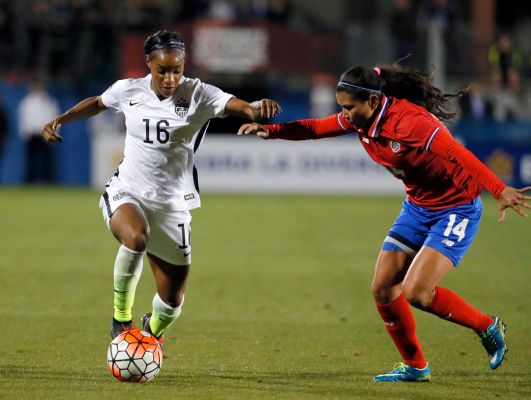
Dunn against Costa Rica (photo from newsday.com)

3.  Portugal, Sans Ronaldo, Wins the European Title.

So much for my wish that Cristiano Ronaldo would eat some crow during the 2016 UEFA Championship. The only saving grace was that he was injured during Portugal's win in the Final against France and spent most of the match on the sidelines (a little cruel, I know -- I wasn't hoping that it was a debilitating injury -- which it apparently wasn't).

I wasn't as upset about the fact that Portugal won (although France winning on home soil after all it's been through in the past year would have been nice), but the way that it accomplished the task. As mad as I get at South American teams for their diving, faked injuries, and time wasting, at least, on some level I feel as though they truly believe that it's just part of the game. The Portuguese, on the other hand, are so cynical in the way that the go about it that it's infuriating. 

After all of their disappointments at the international level, I suppose Portugal was due a few breaks in its favor.  And it got them through squandered opportunities by a French team that seemed, frankly, overwhelmed by the moment and one well placed strike by Eder that barely eluded French keeper Hugo Lloris, who seemed slightly out of position on the shot.

So a tournament that began with promise ended with a whimper (as did, to be fair, the Copa America) and Portugal got its trophy. And the beautiful game took a blow.

Tuesday, July 7, 2015

Two Seminal Moments

A lot has already been written about the Women's World Cup Final.  And there were many, many occasions worthy of reflection.

But, for me, the Final, and really the whole tournament, can be summed up in two stunning moments. Both took place in the first 16 minutes of the game in which the U.S. thrashed Japan 5-2 in the most comprehensive and mind boggling domination of any opponent in a World Cup Final.

The first was Carli Lloyd's first goal on a set piece in the third minute (I know, I probably don't have to tell you which goal was which). That goal was the final nail in the coffin of my and everyone else's criticisms of Jill Ellis as a coach. It was the perfect call at the perfect time and it worked to perfection as well.

It was also a little bit of deja vu for me, as it was very reminiscent of a corner that University High pulled off against my Charleston Catholic team several years back (immediately after which one of our defenders exclaimed: "Wow! That was sweet!"). That the University team was trained by the fellow coach that I most admired perhaps colors my appreciation for Ellis' decision. Or informs it.

For most of the pre-match hype commentators had been pointing to the superior height of the Americans and the importance of it capitalizing on that advantage on set pieces.

So what does Ellis do? Have the team spend a lot of time practicing set pieces played on the ground not in the air. On the corner Lloyd, the U.S.'s best offensive header of the ball, started her run at least 25 yards from goal, arriving in the 18 yard box as Megan Rapinoe took the kick, and steaming toward the penalty spot well ahead of her defender.

To be sure, the play needed the perfect ball by Rapinoe, a largely uncongested area in front of the keeper, and a deft touch (outside of the left foot) by Lloyd to succeed. But the area in which the ball was played was uncontested because of the attention being paid to Julie Johnston at the near post, because of Japan's overwhelming concern to guard against headers off of set pieces.

All credit to Ellis for seeing the possibilities in playing completely against form in making that call. Whether the other adjustments that she made during the tournament were fortuitous or planned (inserting Morgan Brian in the line-up due to Lauren Holiday's suspension, moving to a 4-5-1 formation -- stop insisting it's a 4-3-3 Tony DiCicco it's not! -- when Holiday was eligible again) really isn't important to me. What is that she was willing to adapt and learn. That's every bit as important for coaches as for players and the fact that she was willing to change and experiment on the biggest of stages is admirable.

And oh by the way, if you don't think that was the plan, the Americans' second set piece, won by Tobin Heath with some fine work down the right flank, resulted in a second free kick by Holiday (yeah, I was wrong about her too) played on the ground to Johnston, whose wonderful back-heel pass left Lloyd again in front of goal with the ball at her feet.

Random thought: did you notice the calls for a foul from Alex Morgan and Johnston on the second goal? I missed it while watching live, but it's clear that a Japanese player (number 19, Saori Ariyoshi) handled the ball after Johnston's flick on. If the referee saw it and didn't stop play, kudos to her. If she missed it, then it was a foreshadowing of a non-call in the second half when she missed almost the identical play.

The second seminal moment was Lloyd's third goal in 15 minutes, the one that secured the game, her hat trick, and her legacy. That audacious chip may some day be a more iconic moment in women's soccer than Brandi Chastain's penalty kick in 1999 (except for that whole Chastain taking off her shirt thing).

Everyone was still buzzing about Holiday's goal when Lloyd won the ball in midfield off of the Japanese kickoff and then suddenly it was, "Wait. What? Did that just happen?" for about 20 million people.


I saw this comment somewhere on-line after the Final, which is kind of tired but so appropriate here: "It's Carli Lloyd's world and we're just living in it."  She was a beast, she was in the zone, she put the team on her shoulders, choose whatever cliché you want. They all fit.

It took guts for Lloyd to step up and take the penalty kicks against Columbia and Germany. But it took great vision, presence, and a lot of chutzpah to even think to attempt that 60 yard chip. In the Final of the World Cup. The fact that she even thought to try it is astonishing -- particularly against a team that is renowned for its discipline. The fact that it actually went in? Inconceivable.

But it had to go in. Because really, her story, the team's story, our story, this story couldn't have ended any other way.

(photo from bbc.co.uk)

Saturday, July 4, 2015

Let's Not Get Ahead of Ourselves Here

Yes, the U.S. dominated top ranked (for now) Germany in defeating it 2-0 in the World Cup semifinal.

Yes, Japan looked pedestrian, and more than a little lucky, in downing England 2-1 in the other semifinal.

Yes, the U.S. seems to be peaking, as coach Jill Ellis has repeatedly said was the goal, at the right time.

But don't forget 2011.

After Abby Wambach's goal at the death against Brazil in the quarterfinals in 2011 eventually led to an American win on penalty kicks, the U.S. cruised 3-1 over France in the semis. It appeared that the U.S. was truly a team of destiny.

But then it lost to Japan 3-1 in the Final in penalty kicks. After extra time ended with a dramatic Japanese goal by eventual Golden Boot winner Homare Sawa. And, perhaps even more egregious, it squandered a seemingly safe 1-0 lead with nine minutes left in regulation after some Keystone Cops defending that allowed Japan to equalize when it had barely threatened the entire game.

While the U.S. defense is much stouter this time around, surely 2011 was a lesson that the Japanese are every bit as tough and resilient as are the Americans. And Japan is not without skill - its players may be the most technically adept of any at the tournament.

I've witnessed some crazy talk on Fox Sports over the last few days. 3-0 U.S. seems to be a standard prediction. Is that within the realm of possibility? Yes. Is it likely given what we know about Japan and the way it's played the last five years? No. Is it likely given the Americans' continuing inability to score in the run-of-play (two goals in the three elimination matches in this tournament)? No.

A friend suggested after the Germany game that he and I needed to continue to trash-talk the U.S. (and particularly its coach) since it seemed to result in better and better performances. And while I'm certainly prepared to do whatever I can to help the cause, Jill Ellis says she doesn't read the papers or on-line articles so I'm not sure it will make any difference other than pure superstition (to which I am admittedly not immune).

It seems that every elimination game has had at least one penalty kick. And my fear is that, as technical as the Japanese are, they won't give one away.

But they did against England. 

And they just may again tomorrow.

Has she got one more in her? (photo from kansascity.com)

Saturday, June 27, 2015

Mostly Right

Here's what I was wrong about in my last post:

1. The U.S. will inevitably lose to Germany.

The Yanks have a chance if they play as well, and play mostly the same players, as they did against China (sorry Kelley O'Hara, you were good, but you're the odd woman out as way has to be made for Megan Rapinoe). Not saying we'll win. Just no longer saying we're sure to lose.

2. Amy Rodriguez (her energy and defending from the front were exactly what the U.S. needed).

3. Assuming Canada had what it took to get past England.

Here's what I was right about in my last post:

1. Lauren Holiday.

2. Abby Wambach.

3. Carli Lloyd.

(photo from usatoday.com)

4. Germany (barely).

5. Japan.

6. Canada.

Things I meant to say and didn't:

1. In case you haven't noticed, the U.S. defense is really, really good. Can you win a World Cup with a great defense and a so-so offense? Undoubtedly. Since the first half against Australia, Hope Solo hasn't had to do much of anything in goal. That's how good Ali Krieger, Meghan Klingenberg (my personal favorite among the defenders), Julie Johnston, and Becky Sauerbrunn have been.

Yet to be determined:

1. Whether Jill Ellis has the guts to sit Wambach and Holiday against Germany. Remember my comment about how Michael Bradley is more at-ease in an attacking role when he knows Kyle Beckerman has his back? Same for Lloyd and Morgan Brian, who has improved by leaps-and-bounds since her first appearance in this Cup. And Wambach, a legendary competitor, simply hasn't got what it takes for 90 minutes of World Cup play.

This will be fun.

Thursday, June 25, 2015

Survive and Advance

How many times have you read those words in the past two weeks? In a tournament it does not matter how you win, or how good you look while winning, only that you do, we keep hearing. Survive and advance.

That's exactly what the U.S. Women's National team has done so far in the World Cup. It's also about the nicest thing that anyone has to say about its performance to-date.

And it's also why it's taken me so long to finish this post. There's something about this team (and has been for a while) that leaves me unconvinced that it will end up with a third star.

There were those shaky moments against Sweden and Australia. If not for a saving header by the shortest player on the field (Meghan Klingenberg) the U.S. would have lost to Sweden and its former coach, Pia Sundhage. And Hope Solo, not weighed down by off-the-field baggage, kept the Yanks in the match with several first half saves against the Matildas that only Solo can make.

The match with Columbia took on an edge thanks mostly to perceived slights of the American players asserted by Colombian forward Lady Andrade. Andrade's comments were curious given that publicly the U.S. players said all the right things about respecting every opponent in the knock-out stage and Columbia's shocking 2-0 upset of France in group play, not to mention that one would think that she would not want to draw attention to herself given that the last time that the two teams met she punched Abby Wambach in the face and was suspended for two games as a result.

But whatever statement the Americans might have made on the field in response was buried under another avalanche of offensive mediocrity. No matter what combination of forwards coach Jill Ellis has tried between Abby Wambach, Alex Morgan, Kristen Press, Amy Rodriguez, and Sydney Leroux, the result has been depressingly consistent - few chances, fewer shots on goal, and, since the Australia match, three goals in three games.

As a coach it always frustrated me when the press and other coaches focused on who was scoring goals, not how they were put in the position to score them. And, while Morgan has been rusty, Wambach not one but two steps slow, and Press, Rodriguez and Leroux largely ineffective, I suspect that the real root of the problem is the service that they're receiving from the midfield, specifically center mids Carli Lloyd and Lauren Holiday.

I've expressed before my fondness for Lloyd's game and my frustration with Holiday's. We may see if the U.S. is better off with Lloyd playing the more offensive ("number 10") role for the women on Friday against China, a game for which both Holiday and Megan Rapinoe are suspended. It's easy to forget now, but Lloyd did score the game winning goals in both the 2008 and 2012 Olympic Gold Medal matches.

Lloyd celebrates one of her two goals against Japan in the
2012 Olympic Gold Medal match (photo from pennlive.com)


But the problem may not be of either Lloyd's or Holiday's making - they may simply be playing the way that Ellis has instructed them to. Long balls forward and depending on set pieces is not interesting to watch and definitely not the way to play if you're playing from behind, which the U.S. has yet to be in the World Cup, fortunately.

If you want to watch how the game should be played, play hooky or DVR the Friday afternoon match between Germany and France. Notwithstanding Les Bleues' inexplicable loss to Columbia, these two teams are not only the most exciting in this year's World Cup, but also clearly the best to this point. The way that they move without the ball and play give-and-goes is a thing of beauty, and sorely lacking in the Americans' play.

The winner of that match will play the U.S.-China victor in the semi-finals. And, while I expect that the U.S. will squeak past China, I don't hold out much hope for it against whichever team survives the Germany-France match (and, really, when Germany and France meet in any competition, can you ever bet against the Germans?).

On the other side of the bracket, if it's possible Canada has been even less impressive and more predictable than the U.S. It will likely have its first real test against Japan in the semis. And will lose.

So, an all-Axis power World Cup Final anyone? 2-0 Germany in the final over Japan. And perhaps a victory for those who play the game the way it's supposed to be played.

Sunday, March 15, 2015

Then Again ...

Did I overreact to the result of a friendly?

Perhaps.

But examples of equal overreaction to the U.S. Women's win in the finals of the Algarve Cup abound as well.

Yes, the U.S. was missing Hope Solo and Megan Rapinoe and Sydney Leroux in its 2-0 loss in a friendly last month. But Rapinoe and Leroux made mere cameo appearance in its 2-0 win over France in the Algarve Cup final last week. Meanwhile, the French were missing five of their starters in the match in Portugal who had featured in the earlier game in Lorient (including both starting center backs, playmaker Louisa Nacib, and Elodie Thomis who torched the American defense repeatedly in their first meeting of the year).

What can we learn from the second match? First, as hard as it may be to admit, the team needs Solo. She is athletic and commanding in the box. She made a good save on the late penalty kick, but more importantly her presence seems to calm all of the U.S. defenders. And that unit also seems better equipped to handle fast, skilled players with Julie Johnston partnering with Becky Sauerbrunn in central defense.

Second, the team has a new star in Christen Press. While she may not have been able to shred France's Wendie Renard and Laura Georges the way she did their substitutes in the Final in Portugal, she is a dynamic player whose individual skill on the ball is going to be needed if Jill Ellis' team continues to play balls over the top to its forwards (whoever they will end up being between Alex Morgan, Amy Rodriquez, Abby Wambach, Sydney Leroux, and Press) rather than possession soccer.

Press at the Algarve Cup (photo from usatoday.com)

Which brings me to third, why I'm not sold on the team yet. It probably has more to do with the type of soccer that I like to watch than it does whether I believe the U.S. will win the Women's World Cup in Canada. It seems that Ellis is intent on playing with no true attacking wing midfielders, putting Press and Carli Lloyd out wide and letting Lauren Holiday (of whom everyone but me seems enamored as a playmaker) and Morgan Brian run the center of midfield.

Moving Press and Lloyd "out wide" means that they rarely play as out-and-out wingers, but more like additional center-mids, which is fine if you want to control possession and play a small-pass game. Which, puzzlingly, the U.S. has not done in any of the matches that it's played in that alignment. I've long expressed my admiration for the skills of Rapinoe and Tobin Heath, who excel at wing play (although Heath, like Press, is more adept at challenging players from the wing and cutting inside than Rapinoe, who sends in crosses with the best of them). If Ellis continues to use Press and Lloyd at outside mid, then the U.S. attack will be less varied, more predictable, and not nearly as entertaining as when Rapinoe and Heath play.

I don't expect that the exhibitions that the U.S. has scheduled over the next three months will tell us much about how the U.S. will fair in Canada. But they will very likely confirm what Ellis' plans are for the formation they will use and the players that she is counting to prove that Portugal, not Lorient, was the bell weather of what their chances of success are.

Sunday, February 8, 2015

Rudderless

rud·der·less
ˈrədərləs/
adjective
adjective: rudderless
  1. lacking a rudder.
    • lacking a clear sense of one's aims or principles.
      "today's leadership is rudderless"

Rudderless.

That's the one word that kept creeping into my mind, over and over again, as I watched another U.S. National Soccer team, this time the women, be outclassed and outworked.

Yes, we lost 2-0 to a very good French national team that has beaten Germany and Brazil in the past few months.

Yes, the U.S. was without some of its key players as Megan Rapinoe, Christine Rampone, Hope Solo, and Sydney Leroux didn't dress for the match and the first three didn't even make the trip for the friendlies with France and England.

Yes, the rest of the world is catching us along with the other members of the formerly exclusive club of countries that can contend for the women's World Cup.

All the more reason to need, to have to rely on and have confidence in, your coach. And in my opinion the game against the French demonstrated that the team appears to be a rudderless ship.

When, just seven months ago, U.S. Soccer decided to unceremoniously dump national team coach Tom Sermanni I wrote that the candidates to replace him were uninspiring and that, if the powers-that-be had concluded that they had made the wrong decision in hiring Sermanni, they did not have the luxury of making a second mistake in choosing his replacement with the World Cup a year away. 

One of those candidates, Jill Ellis, was chosen as the temporary and then permanent replacement for Sermanni. Ellis was born in England and her father John was a soccer coach as well. After playing for William & Mary, Ellis embarked on a coaching career in college that culminated at UCLA, where the program made eight NCAA Final Fours in her 12 years as coach. She then moved to U.S. Soccer on a full-time basis in 2011. Ellis was the temporary head coach for the team when Pia Sundhage departed in 2012 as well.

Ellis may be a fine coach. She may have the ear of her players. She may be a good organizer. She may be a good practice coach.

But she's never won anything. 

A couple of Nordic Cups, whatever that is. But no NCAA titles (in eight visits). No U-20 World Cups (the team that she coached in 2010 didn't make the semi-finals). 

When it mattered, when it came time to play the game that was the difference between finishing second or third or fourth best or hoisting the trophy in triumph, her teams always came up short. And, while sports are a perfect venue for second chances and new opportunities, nothing that has occurred since Ellis took permanent control of arguably the most prominent women's national sports team in the World indicates that things will be different this time around.

Strategically, the handling of the team, and its goalkeeper/diva Hope Solo in particular, has been troubling. While Ellis was quoted in the New York Times yesterday as saying "for every player, you have to have a Plan B" there was clearly no Plan B for the U.S. at the position that has always been one of the biggest strengths of its men's and women's teams (keeper, not diva). Julie Foudy pointed out as much in ESPNW the day before Ellis' comment was published, and I submit that I did the same over two years ago.

Tactically, the Americans were always "on the back foot," as Ian Darke likes to say, against the French. Second best in effort and ideas. Reduced by bad passes in the mid-field to booting it forward and hoping for the best. Unable, even, to take advantage of a huge potential break when the referee gifted them a penalty for a foul that both wasn't a foul and wasn't in the penalty box, only for Abby Wambach to hit a weak penalty kick that was easily saved. The midfield chased the game, with Lauren Holiday practically invisible unless she was passing to the team in the blue shirts (and, in case you didn't watch, the U.S. wore white).

I understand, and often state, that too much shouldn't be read into friendly matches. But this was one that the U.S. was apparently pointing to. Yes, Ellis wants to review her options in game situations for the World Cup. And it was encouraging to see Alex Morgan put in a full 90 minutes in her return from injury.

Morgan's presence (although not necessarily her play) was one
of the few bright spots against France. (photo from ussoccer.com)

But the lack of ideas and skill and just plain work (excepting the always solid Carli Lloyd and Tobin Heath) transcend the issue of whether this was "just a friendly." Foudy made the comment shortly after Wambach entered the game that you could sense a lift in the other U.S. players' emotions when she was on the field. But neither they, nor Ellis, should have to rely on a simple tactical change to inject energy or ingenuity into the game. And, even if it works, you can only go to that particular well so many times before it becomes routine and by definition unremarkable.

The U.S. plays England in that next friendly on Friday. After that comes the Algarve Cup, the tournament that was presumably Sermanni's undoing when the U.S. finished seventh out of eight teams a year ago. We'd better hope that Ellis has figured some things out between now and then. Because, much like Solo, I doubt that there's a "Plan B" when it comes to who will coach our national team at the World Cup in June.