We can assume, barring injury, that these players will be in the starting eleven when the U.S. men's team takes the pitch against Ghana on June 16 in Natal: Tim Howard, Matt Besler, Jermaine Jones, Michael Bradley, Clint Dempsey, and Jozy Altidore.
So that leaves us with the questions of who will man the position alongside Besler in the center of defense, who the two outside fullbacks will be, and who the two wings will be.
Against Azerbaijan, Jurgen Klinsmann started Geoff Cameron at center back, DeMarcus Beasley (left) and Fabian Johnson (right) at fullback, Alejandro Bedoya (left) and Graham Zusi (right) on the wings. Many who know more than me thought that this line-up was also the one likely to start against Ghana and at least one blogger noted that it is arguably "the best eleven players that the U.S. has on the roster." Dempsey didn't start after having some discomfort in his groin while warming up for the match (Chris Wondolowski started in his place), but Dempsey's place is in the lineup is a foregone conclusion.
Omar Gonzalez seemed a lock a few months ago to start at center back, but some nervy play and a tweaked knee seemingly have him on the outside looking in for a starting spot. Beasley started the final qualifying matches at left back, almost out of desperation, and did passably well and was the clubhouse leader to man that position in Brazil as well.
Howard, Besler, Cameron, Jones, Bradley, Dempsey, Altidore, Johnson and Zusi started, in the same positions, against Turkey on Sunday. Brad Davis and Timmy Chandler manned the left wing and back positions, respectively, in place of Bedoya and Beasley. Neither Beasley nor Gonzalez played at all, even though Klinsmann used all six of his substitutes.
The U.S. won the match 2-1 thanks to a marvelous one-two from Johnson to Bradley and back that earned Johnson his first international goal for the U.S. and man of the match honors (along with his defensive play). Dempsey added a tap-in following a mistake in the Turkish defense before the U.S. surrendered a late goal on a penalty kick awarded after Cameron handled the ball in the box (on a play that was started by a bad defensive mistake by Chandler).
My impression was that all who have started both matches did nothing in either one to severely hurt their chances to start on June 16. Being the dutiful blogger (and researching lawyer) I decided to see how soccer experts rated the U.S. performances against Turkey. The results confirmed that, much like legal research, there is no clear answer, only varying opinions. Some rated Zusi's performance highly. But Soccer America found his performance the "[m]ost disappointing of the projected World Cup starters."
That Chandler was the weakest link on the pitch was agreed to by most if not all the commentators. And if not him, then the honor went to Julian Green, the 18 year-old starlet who looked overwhelmed by the enormity of the situation after coming on as a substitute and who, honestly, should not see the field for any of the matches in Brazil.
Brad Davis, while putting in some good crosses, did nothing to lead one to conclude that he should start instead of Bedoya. His lack of pace and inability to consistently defend his side of the field probably put more pressure on Chandler than would allow a completely fair assessment of Chandler's play.
One interesting option for Klinsmann would be to play Johnson at left fullback instead of the right, where he has started both friendlies. Johnson played both left back and left wing for his club team, Hoffenheim. But Klinsmann likely has Johnson at right back to allow his best outside defender to match up with the likes of Cristiano Ronaldo in Brazil.
Johnson on the left would enable Klinsmann to start Davis, who offers more interesting offensive options than Bedoya and, if Davis pinches toward the middle as he often does, allow Johnson to make more effective offensive runs from the back. That would likely leave the right back position to DeAndre Yedlin another youngster (he's 20) who has buckets of pace but seems to rely on it at the expense of proper defensive positioning (Ronaldo would likely tear him up).
Or Klinsmann could move Cameron to right back, the position he plays for his club, Stoke, in the English Premier League, and start Gonzalez in the center of defense with Besler. But to do so would seemingly sacrifice the speed that Klinsmann values in his full backs.
All in all, it seems that those three positions, left back, left wing, and right back are the only ones up for grabs. And that Johnson will start at one of those outside back spots. So who's it going to be between Davis, Bedoya, Beasley, Johnson, and Gonzalez? My guess is Bedoya and Beasley. Saturday's match against Nigeria may tell us for certain.
Or Klinsmann may have one or two tricks up his sleeve yet ...
Howard, Besler, Cameron, Jones, Bradley, Dempsey, Altidore, Johnson and Zusi started, in the same positions, against Turkey on Sunday. Brad Davis and Timmy Chandler manned the left wing and back positions, respectively, in place of Bedoya and Beasley. Neither Beasley nor Gonzalez played at all, even though Klinsmann used all six of his substitutes.
The U.S. won the match 2-1 thanks to a marvelous one-two from Johnson to Bradley and back that earned Johnson his first international goal for the U.S. and man of the match honors (along with his defensive play). Dempsey added a tap-in following a mistake in the Turkish defense before the U.S. surrendered a late goal on a penalty kick awarded after Cameron handled the ball in the box (on a play that was started by a bad defensive mistake by Chandler).
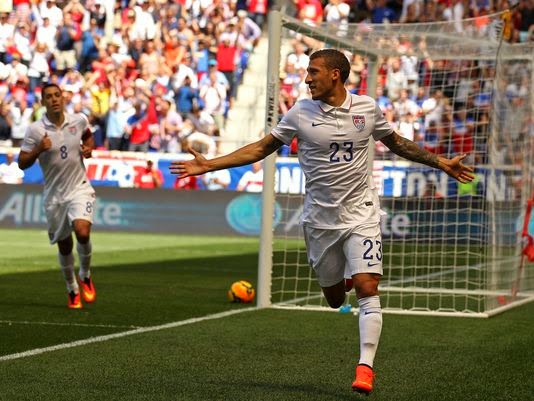 |
| Johnson celebrates his goal (photo from usatoday.com). |
My impression was that all who have started both matches did nothing in either one to severely hurt their chances to start on June 16. Being the dutiful blogger (and researching lawyer) I decided to see how soccer experts rated the U.S. performances against Turkey. The results confirmed that, much like legal research, there is no clear answer, only varying opinions. Some rated Zusi's performance highly. But Soccer America found his performance the "[m]ost disappointing of the projected World Cup starters."
That Chandler was the weakest link on the pitch was agreed to by most if not all the commentators. And if not him, then the honor went to Julian Green, the 18 year-old starlet who looked overwhelmed by the enormity of the situation after coming on as a substitute and who, honestly, should not see the field for any of the matches in Brazil.
Brad Davis, while putting in some good crosses, did nothing to lead one to conclude that he should start instead of Bedoya. His lack of pace and inability to consistently defend his side of the field probably put more pressure on Chandler than would allow a completely fair assessment of Chandler's play.
One interesting option for Klinsmann would be to play Johnson at left fullback instead of the right, where he has started both friendlies. Johnson played both left back and left wing for his club team, Hoffenheim. But Klinsmann likely has Johnson at right back to allow his best outside defender to match up with the likes of Cristiano Ronaldo in Brazil.
Johnson on the left would enable Klinsmann to start Davis, who offers more interesting offensive options than Bedoya and, if Davis pinches toward the middle as he often does, allow Johnson to make more effective offensive runs from the back. That would likely leave the right back position to DeAndre Yedlin another youngster (he's 20) who has buckets of pace but seems to rely on it at the expense of proper defensive positioning (Ronaldo would likely tear him up).
Or Klinsmann could move Cameron to right back, the position he plays for his club, Stoke, in the English Premier League, and start Gonzalez in the center of defense with Besler. But to do so would seemingly sacrifice the speed that Klinsmann values in his full backs.
All in all, it seems that those three positions, left back, left wing, and right back are the only ones up for grabs. And that Johnson will start at one of those outside back spots. So who's it going to be between Davis, Bedoya, Beasley, Johnson, and Gonzalez? My guess is Bedoya and Beasley. Saturday's match against Nigeria may tell us for certain.
Or Klinsmann may have one or two tricks up his sleeve yet ...


