Showing posts with label soccer. Show all posts

Wednesday, July 12, 2017

Cups All Around (and not a Drop to Drink)

Some observations after watching most of the Confederations Cup and attending the U.S. Men's National team Gold Cup game against Panama in Nashville:

1.  The Confederations Cup Is No Longer a Test for Anyone but the Host Country.  Sure, you can say that the Germans don't have a B Squad, or that even their second team is better than most other countries, but whatever the excuse or the analysis, the simple fact is that they breezed through the Confed Cup starting exactly zero players who started the 2014 World Cup Final against Argentina. 

While roster turnover is a fact of international soccer, and it would be a shock if Philipp Lahm or Miroslav Klose featured in the 2018 German World Cup team (since both have retired from international football), there are several players from that team (Neuer, Ozil, Muller, Boateng) who seem naturals for the next edition as well. But they were nowhere to be found on the squad as Joachim Low chose a team without a wealth of international experience. The Germans won four games and tied one, "avenging" the tie by beating Chile 1-0 in the Final.

2.  Russia Met its Lowly Expectations. Apparently the "test" for Russia hosting these games, as far as FIFA was concerned, was to prove that it could be at least superficially friendly to traveling supporters of the participating teams and avoid any overt racism, homophobia, or hooliganism. While new FIFA Capo Gianni Infantino said that the tournament was a great success, it remains to be seen whether Russia can duplicate the feat on a much larger scale, with many of the stadiums not used for the Confederations Cup still not complete. Not to mention the pesky North Korean labor abuses upon which those stadia are apparently being built.

3.  Russia's Men's Soccer Team Met its Lowly Expectations. Which is to say, it sucks. Although one player, Yuri Zhirkov, was fun to watch.

4.  Mexico is Still Mexico. Which is to say, it folds on the big stage. The best Mexico has to offer was a poor, poor second to Germany in the semis, losing 4-1, and couldn't beat a Ronaldo-less Portugal in the third place match.
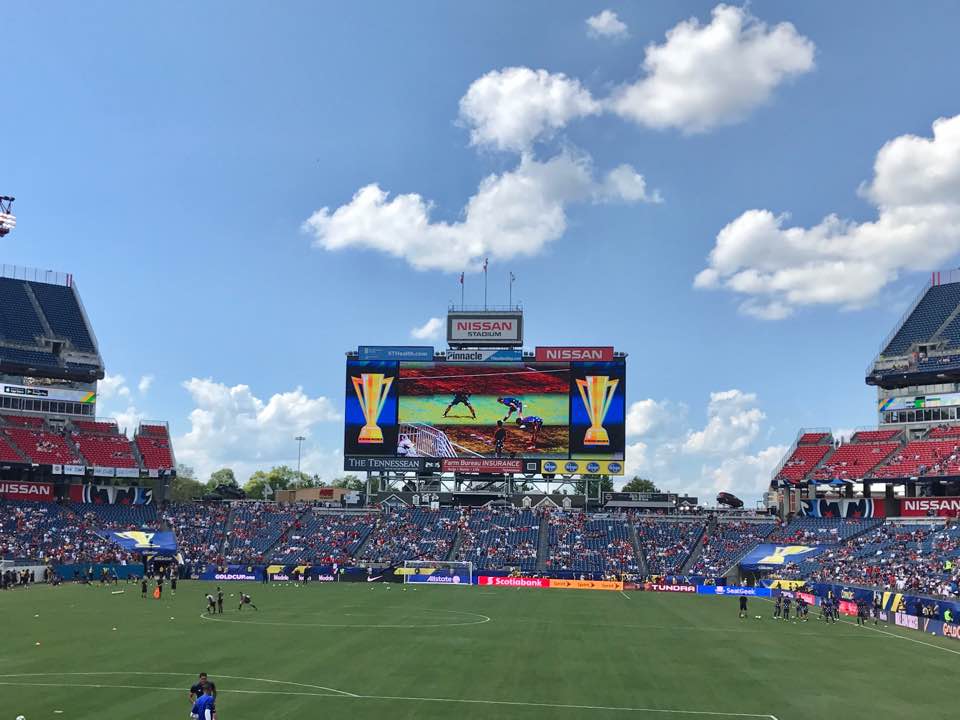
The view of Nissan Stadium in Nashville from the American
Outlaws' section prior to the U.S. v. Panama match. (photo by me)

5.  The U.S. Men's B Team is Not Germany's B Team. Or C Team. No surprise there, of course, but the performance against Panama was dross. Fortunately, the players know it and Bruce Arena knows it. While Arena chose to use the Gold Cup as a testing ground for players who are on the fringe of the potential 2018 World Cup roster, they were out-of-sorts defensively and particularly in the midfield. Which leads to the final observation ...

6.  Shut Up About Michael Bradley Already. After every U.S. match of any significance, the trolls crawl from their parents' basements to complain about how Bradley gives away the ball too much, doesn't play high enough, doesn't play back enough, blah, blah, blah. If the match against Mexico at the Azteca and a Bradley-less midfield against Panama don't convince you of Bradley's quality and the absolute necessity that he be a starting midfielder for the U.S. as long as he wants to strap on his boots and don the shirt, nothing will.

While Kellyn Acosta was good in the warm-up match against Ghana and threw himself around a bit against Panama, the other two center mids against Panama, Dax McCarty and Joe Corona, were abysmal. Here's hoping Arena gives someone (anyone) else a shot against Martinique. But only with the caveat that they will back-up, or at best play alongside, Bradley.

Thursday, December 29, 2016

U.S. Women's Soccer CBA Negotations Take an Interesting Turn

We awoke this morning to the news that the U.S. Women's National Team has parted ways with its chief negotiator, Rich Nichols, three days before its collective bargaining agreement with the U.S. Soccer Federation is set to expire.

Why and why now are relevant questions unanswered by the Women's Player's Association in its terse announcement, which merely says that Nichols will "no longer serve" as counsel to the Association, says that it is "focused on" productive conversations with U.S. Soccer regarding "our future" and looks forward to the upcoming NWSL season and an international women's tournament next March.

That immediate future will apparently proceed under the current CBA, which expires Saturday. Neither side has given the required 60-day notice of termination of that agreement,  after which either a work stoppage or a lock-out would be permitted.

Nichols has been a ferocious advocate for the women's team in negotiations with the Federation and by all appearances was the driving force in the wage discrimination complaint of five prominent players filed with the EEOC earlier this year, the defense of the Federation's suit that sought to impose the terms of an earlier CBA which forbid the players from striking before the Olympics this year (in which the Federation succeeded), and presumably in the players' public relations onslaught regarding their demands for "equal pay."

While meddling politicians and vacuous media outlets have taken up the women's team's call, as I and others have explained in the past, equal pay in the context of national soccer teams is not as simple as paying everyone the same salary or bonus or even paying equal amounts to the teams as a whole. And the EEOC complaint could, in fact, simply lead to further pay disparities in the women's professional game or the death of the women's professional league in the U.S. 

It seems likely that during negotiations (or perhaps because of the absence of negotiations) regarding a new CBA the players reached the conclusion that Nichol's approach was counterproductive to striking a bargain. Nichols has certainly raised the bar for the next counsel in terms of his zealous advocacy of the women's professional game, but perhaps a skillful negotiator and someone more willing to compromise is needed to bring the two sides together.

Certainly there's been nothing said publicly to-date by the Federation or its President Sunil Gulati to suggest that the Federation is not interested in trying to reach an agreement that does not compensate the national team players at a rate commensurate with their male counterparts, keeping in mind the revenue that each team has generated on a historical basis and U.S. Soccer's financial support for the NWSL.

Oh, but wait. There is one women's national team member who has cried foul, complaining that the Federation is "putting pressure" on the women to strike a deal. Anyone care to guess who that player might be?

Equal rights champion Hope Solo at her arraignment on
domestic violence charges (photo from washingtonpost.com)

That's right, Hope Solo. In a blog post yesterday Solo expounded on her self-proclaimed role as a champion for equal pay and takes a shot at the Federation and Gulati for "putting pressure on the players" and "trying to divide and conquer us."

To which I say: go figure. One side of a negotiation is trying to use leverage against the other? Say it ain't so, Solo! I suppose the EEOC complaint and the players' implicit threat of a strike prior to the Olympics (which caused the Federation's ultimately successful lawsuit) were not leverage, or attempts by the players to put pressure on the Federation to strike a deal?

Posturing aside, one has to wonder if the timing of Solo's post isn't an indication that she is not on-board with her fellow team members and litigants regarding Nichol's approach and was her (indirect) protest against his dismissal. In other words, Hope is the true champion of women's rights and the others are not. Certainly wouldn't be the first time that she willingly distanced herself from the common good.

Tuesday, July 26, 2016

This and That

As occasionally happens, life and work have gotten in the way of writing several planned posts. Here are a few short takes on things happening or that have happened recently in soccer:

1.  U.S. Men Are Thrashed by a South American Opponent (Again).

Was it great that the U.S. made the semi-finals of the Copa America? Yes. Should we have expected any better than 4-0 against Argentina in the semis? Well ...

Yes and no. The U.S. has played well in the knock-out rounds of some tournaments (while rarely winning). Outplaying (really, they outplayed them!) Germany in the 2002 World Cup only to be denied a shot at the semis by a missed handball that rivaled Maradona's; the second dos a cero win over Mexico in the round of 16 in the same 2002 World Cup; even the 2-1 after extra time loss to Belgium in the round of 16 in the 2014 World Cup in which the U.S. had every chance to extend the match to penalties until Wondo missed the sitter that allowed Landon Donovan fans everywhere to say "I told you so."

But there was a theme to all of those games. And it was that the U.S. was not playing a South American opponent in any of them. For some reason, in games that matter (or any match against the top teams from CONMEBOL really) the U.S. wilts. Against what are generally recognized today as the top three teams in South America (Argentina, Brazil, and Columbia) the U.S. is a disastrous 6-26-7 all-time.

No doubt the U.S. was hurt by the absences of Jermaine Jones, Alejandro Bedoya, and Bobby Wood against Argentina. But they were behind almost from the start thanks to Lionel Messi and never looked up to the task. U.S. Soccer in general and Jurgen Klinsmann in particular have to figure out how to stay in games early and win matches early, late, or any time in-between, against South American opposition if they ever hope to make the semis of a modern World Cup.

2.  The U.S. Women Tune-Up for the Olympics, with Middling Results.

The U.S. Women's Team has not been particularly scintillating in its warm-up matches for the Olympics, drawing a match and winning one against Japan (a team which, like the U.S., is regrouping or reloading as the case may be) and then beating South Africa 1-0 before thumping Costa Rica 4-0 in the final tune-up last Friday.  After last year's World Cup, however, far be it from me to question coach Jill Ellis's preparation of her squad leading into a major tournament.

With the Olympic soccer rosters limited to 18 players and a schedule of three group stage matches crammed into six days, with the quarters, semis, and finals jammed into the next week, versatility of players and coaches to adapt to fatigue, injuries, and suspensions will be at a premium. Which makes the inclusion of Megan Rapinoe, who has not played since tearing her ACL last December, in the final roster all the more curious.

The Women are in a tough group, with World number three France, Columbia, and New Zealand. But with only 12 teams in the mix, any group was going to have some difficult opposition (although, not surprisingly, hosts Brazil drew by far the easiest of the three).  The U.S. should make it out of the group, but it could be very important that they do so as the top seed as far as the strength of their quarterfinal opponent goes.

Regardless of the ultimate result, it will be exciting to see how well new star Crystal Dunn (who scored the only goal against South Africa and tallied again against Costa Rica) and starlet Mallory Pugh will fare in their first international tournaments for the senior team.

Dunn against Costa Rica (photo from newsday.com)

3.  Portugal, Sans Ronaldo, Wins the European Title.

So much for my wish that Cristiano Ronaldo would eat some crow during the 2016 UEFA Championship. The only saving grace was that he was injured during Portugal's win in the Final against France and spent most of the match on the sidelines (a little cruel, I know -- I wasn't hoping that it was a debilitating injury -- which it apparently wasn't).

I wasn't as upset about the fact that Portugal won (although France winning on home soil after all it's been through in the past year would have been nice), but the way that it accomplished the task. As mad as I get at South American teams for their diving, faked injuries, and time wasting, at least, on some level I feel as though they truly believe that it's just part of the game. The Portuguese, on the other hand, are so cynical in the way that the go about it that it's infuriating. 

After all of their disappointments at the international level, I suppose Portugal was due a few breaks in its favor.  And it got them through squandered opportunities by a French team that seemed, frankly, overwhelmed by the moment and one well placed strike by Eder that barely eluded French keeper Hugo Lloris, who seemed slightly out of position on the shot.

So a tournament that began with promise ended with a whimper (as did, to be fair, the Copa America) and Portugal got its trophy. And the beautiful game took a blow.

Wednesday, June 15, 2016

A Plateful of Soccer (Best Served Cold)

We've got the Euros all day long and the Copa America in the evenings. I'm already spoiled enough that I am perturbed that there are no Copa 100 games Wednesday before the quarterfinals start tomorrow.

As a result, writing choices abound ...

There were the U.S. men's spirited displays against Costa Rica and Paraguay (and we have to credit Jurgen Klinsmann some for that, don't we?) in not only overcoming a desultory 2-0 loss to Columbia in the first game of group play, but in ending up winning their group.

There is the game tomorrow against Ecuador, and perhaps a deserved backtrack from a certain comment about them being "minnows" in CONMEBOL when they currently lead its qualifying, are ranked 13 in the world, and have qualified for three of the last four World Cups.

But there was something even more compelling that happened on the other side of the pond.

Iceland is playing in its first major tournament ever, thanks at least in part to the expansion this year of the field at the Euros from 16 to 24 teams. But make no mistake, "Our Boys" (or "StrĂ¡karnir okkar" in Icelandic if you prefer) earned their way to the Finals by finishing second in their group in qualifying, beating The Netherlands at home and away in the process.

To put things in population perspective (as I'm want to do), Iceland's population is roughly 330,000 people, or a few thousand less than that of, yes, Kalamazoo, Michigan. As far as countries go, Iceland is wedged between Belize and The Bahamas (or 179 out of 209) in population of  FIFA member nations. But in the FIFA world rankings, Iceland is #34, between the Republic of Ireland and Sweden, and just three spots below the U.S.

The most recognizable Iceland player to international soccer fans is probably Eidur Gudjohnsen, who played, and played well, for Barcelona and Chelsea back in the day but is now 37 years old and did not start or appear off the bench for their first major competition match, against Portugal and Cristiano Ronaldo.

Interesting side note: Eidur Gudjohnsen and his father, Arnor, hold the unique distinction of being the only father and son to appear on behalf of their country in the same international match.  Arnor started the game, against Estonia in 1996, and Eidur, 17 at the time, came on in the second half as a substitute for his dad.  

In the Portugal match, Iceland, a true soccer minnow, tied mighty Portugal and Ronaldo 1-1. Iceland fought and scrapped and was a little bit lucky, but survived. Afterward they celebrated like, well, like a country that had just tied its first ever match in an international tournament against the eighth best team in the world and a player about whom my friend Mike would say "Ronaldo loves him some Ronaldo."

Portugal took the lead in the match, but Iceland, with one of the precious few chances it had, tied it 50 minutes in on a goal by Birkir Bjarnason, then held on for the next 40 minutes for the tie, surviving two Ronaldo free kicks deep into stoppage time.

Bjarnason celebrates his goal (photo from theguardian.com)

Was it particularly attractive soccer? No. But it was a demonstration of why soccer is great and why, sometimes, a team underskilled and undermanned (although, as is apparent from the picture, not undercoifed, even against pretty boy Ronaldo) can, for 90 minutes, make up for all of those deficiencies by playing gritty, desperate, team soccer.

“Iceland didn’t try anything,” whined the Portuguese captain. “They were just defend, defend, defend and playing on the counterattack. It was a lucky night for them. We should have three points but we are OK. I thought they’d won the Euros the way they celebrated at the end. It was unbelievable. When they don’t try to play and just defend, defend, defend, this in my opinion shows a small mentality and they are not going to do anything in the competition.”
To which Karo Arnason, an Iceland center-mid, responded: "tough shit."

I could add more about Ronaldo, but the Telegraph article is too well written to even try to challenge. So I leave you with these observations about Ronaldo while I hope you revel in the smorgasbord of soccer from which we are feasting, whilst Iceland parties like it's 999, and while I fervently hope someone is forced to eat a little crow:
But Ronaldo would not be Ronaldo if he did not view every single game as a stage for him alone to confirm his greatness, rather than an opportunity for any Tom, Dick or Heimar to seize their own 15 minutes of fame.
He is the ultimate back-garden bully, the kind of barbecue guest who would spend the afternoon doing step-overs past seven year-olds and nutmegging the neighbours’ arthritic collie. It is that mind-set which has made him great. You don’t score 487 career goals, including 50-plus a season for the last six seasons by routinely squaring to better-placed team-mates.
... you get the impression that even now, at the age of 31, it does not matter how luxurious the hotel suite – if Ronaldo has no goal to replay in his mind before lights-out, he does not get a good night’s sleep.

Wednesday, June 1, 2016

Glimmers of Hope

So what are we to think about the U.S. Men's National soccer team headed into the Copa America (or Copa Centenario, if you prefer)?

Consecutive wins against South American opponents in the past week? Good.

Those wins coming against traditional CONMEBOL minnows Ecuador and Bolivia? Not so good.

Four straight wins and a 6-1 record so far in 2016? Good.

The loss being in World Cup qualifying to Guatemala in a dismal 2-0 performance? Not good at all.

The introduction of new, exciting players like Darlington Nagbe, Christian Pulisic, and Steve Burnbaum? Good.

Continuing to rely on old, and old guard, players like Jermaine Jones and Kyle Beckerman, particularly in the demanding role of center midfielder? Not very good.

Obviously the upcoming Copa America will give us more information on where the national team is, and where it might be going, in World Cup qualifying and, hopefully, the 2018 World Cup itself. The recent wins have certainly quelled, for now, the anti-Klinsmann drumbeat that reached a crescendo after losses to Jamaica in the Gold Cup and Mexico in the play-in for the Confederations Cup last year.

While they are far from a guarantee for success in the upcoming Copa America, which will be against stiffer competition in a more meaningful setting, the Americans' luck appears to be turning after a dismal 2015. And not just on the field.

The U.S.'s opportunity to participate in the Copa, and indeed the entire tournament, was cast into doubt by the indictment or arrest of many top CONMEBOL and CONCACAF officials last summer and additional indictments for Traffic Sports, a major player in organizing (and skimming graft from) both the Gold Cup and Copa America. The importance of the tournament as preparation for the next World Cup cannot be understated, particularly after the ignominious denial of the chance to play in the Confederations Cup, participation in which was long touted by Klinsmann as essential to success in Russia, until it wasn't.

But whether through sheer will to actually celebrate the 100th anniversary of the competition, or the unappealing prospect of losing millions of dollars of revenue from the target-rich U.S. soccer market, the tournament will go on (although perhaps without Argentina).

While Klinsmann has talked about bringing new or younger players along slowly (hence not starting Nagbe or Pulisic against either Ecuador or Bolivia), this tournament seems the ideal opportunity to start determining whether they will be able to withstand the pressure of top flight competition in CONCACAF World Cup qualifying, particularly once it moves to the final stage (known as The Hex because of its six teams, the top three of which will qualify for the World Cup, and the fourth place team of which will advance to a playoff against the fifth place team from Asia).

The back line seems set with John Brooks and Geoff Cameron (assuming he's healthy) in the center of defense and Fabian Johnson and DeAndre Yedlin on the wings. Bobby Wood, Gyasi Zardes, and Clint Dempsey appear ready to play up front in some combination (particularly with the surprise exclusion of Jordan Morris from the squad) with Pulisic likely to come off the bench and Chris Wondolowski available to poach a last minute goal in a pinch. 


Pulisic celebrates his goal against Bolivia, which made him the
youngest goalscorer for the U.S. Men in the modern era.
(photo from www.dailymail.co.uk)

That leaves three players to man the midfield (although Zardes could play wing or Dempsey as a withdrawn forward or attacking midfielder at the top of a diamond). Michael Bradley is a shoo-in, of course. Alejandro Bedoya was, for my money, perhaps the Yanks' best player against Bolivia and seems unlikely to be left out of the starting 11 (as long as Klinsmann doesn't insist that he play in the back).

There has to be some bite, which Jones normally provides. Klinsmann could go with two defensive mids with Jones and Beckerman, but that seems unlikely, particularly given Beckerman's lack of mobility. Equally unlikely is abandoning the defense altogether and playing both Nagbe and Bedoya along with Bradley.

While Jones is an acceptable choice this summer, it's hard to see him as capable of being one in Russia. I'd like to see Klinsmann try Bradley at the bottom of a diamond with Nagbe and Bedoya the linking midfielders and Dempsey at the tip. But that's unlikely to happen since Klinsmann has insisted for more than two years now that Bradley's best position is up the field leading the attack, and for the most part Bradley has proved him right.

Another option would be to recognize that Dempsey may be too old by the time 2018 comes around and put Bradley at the top, with Nagbe and Bedoya behind, Cameron in the defensive/deep-lying mid position, and Burnbaum or Matt Besler in the center of defense with Brooks.

Given the heat that Klinsmann took last year over the team's performance it's understandable that he is reluctant to sacrifice results for experimentation in the Copa. But, in the long-term, that may be exactly what this team needs. Regardless, it's nice to talk about the options available to him, which seemed in very short supply last fall.

Wednesday, May 4, 2016

The Rise of Leicester City ... and Donald Trump

Two weird and miraculous things happened this week, one in England and one in the United States.

One says a lot about soccer and the other about our nation, the latter not in a particularly flattering way. But they are, I believe, connected.

In the English Premier League, Leicester City, a soccer club that had never won a championship at the highest level of English football in its 132 years of existence, triumphed over the biggest clubs with some of the highest payrolls in the world, clinching the title when Tottenham Hotspur could only manage a draw against London rival Chelsea. Spurs' tie put Leicester's seven point lead out of reach with two matches to play.

To put things in perspective, the metropolitan area of Leicester has about the same population as that of Kalamazoo, Michigan, while Spurs and Chelsea have that of, well, New York City (if you need something other than London as a reference). The Foxes' payroll was 17th in the Premier League at about 48 million pounds (or approximately $70 million), certainly nothing to sneeze at, but chump change in comparison to the 110.5 million pounds ($160 million) that Spurs spent to finish first last or the 215.6 million pounds ($312.5 million) that Chelsea paid out to finish ninth.

Leicester's heroes are easy to identify now, but would not have been recognized as such until very recently: leading scorer Jamie Vardy was playing non-league football four years ago; midfield wizard Riyad Mahrez was signed for a pittance two years ago; and manager Claudio Ranieri, of whom Jose Mourinho once famously said was "almost 70 ... and hasn't won anything" (Ranieri was 56 at the time), really hadn't ever won much of anything.

Mahrez (left) and his notably diverse teammates celebrate a goal.
(photo from theguardian.com)

The Foxes are the type of club that, if they weren't English, would embody the American dream. They are the epitome of grit and determination; of punching above your weight; of believing in your collective self when all around you don't even give you a thought, let alone a chance. Theirs is the story of immigrants and itinerants, of castoffs and factory workers, pulling themselves up by their bootstraps and making something wonderful of themselves collectively: The whole greater than the sum of the parts. How much more American can you get?

That's what I used to believe the American ideal was. But that was before Donald Trump, whose apparent ascendence to the Republican nomination for President is the second phenomenon of the week.

We are now, or at least a significant minority of us are, the inconsolably aggrieved. We're not interested in helping ourselves. We are unhappy with the changing world around us and instead of figuring out how to fix it, or how to adapt and lead the way as we have done for a century, we prefer to attach ourselves to a bully, a lying huckster offering not fixes but simply to point the collective middle finger of blame anywhere but at ourselves.

When asked to explain their support of a narcissistic shill with no sketch for the future let alone a road map, Trumpites resort to calling him "genuine" and "believable" and ascribing to him similar traits only slightly more oxymoronic than the notion of a billionaire populist.

There's no thought to how we might actually make America great again (even if we're not, or even if we can). Just the mindless choosing of the easy way out by blaming others and yearning for what some assumed to be a birthright - to be at the top of whatever little heap we had mentally staked out as our own.

When conservative talking heads bash soccer as being "un-American" I used to just ignore it as simple pandering. But, turns out, they may be on to something. 

If Leicester City is the new soccer, and Trump the new America.

Saturday, April 9, 2016

Killing The Goose?

"We are the best in the world" said Hope Solo in announcing her support for the EEOC complaint filed by her and four other members of the U.S. Women's National Soccer Team this past week against the U.S. Soccer Federation.

Setting aside concerns that Solo provided bulletin board material for 15 other national teams (and that she would have the temerity to bite the hand that not only fed her but provided support when she faced a domestic violence charge  (yes, I just linked to a People Magazine article) that could have ended her World Cup hopes, if not her career, last year), while Solo's statement is completely defensible given that the team is the reigning World Cup and Olympic champion, it does not conclusively prove the players' case.

Too easy, I know (photo from businessinsider.com)

By now my support of women's sports in general and soccer in particular should be well-established. I believe in level playing fields (and similarly surfaced playing fields) for men and women.

But equal opportunity does not necessarily mean equal pay.

While I am all for the women receiving pay commensurate with their work and the money that they generate for U.S. Soccer (and with their male counterparts if they are entitled to it) I'm not sure that this lawsuit is the best way to try to accomplish that. In fact, a victory for them could actually be detrimental to many of their professional soccer playing peers who are good, but not good enough to play for the national team.

The men's team and the women's team are governed by separate collective bargaining agreements, under which the men are paid substantially more for performances in international matches. Important, lawyer-type note: just because you're subject to a collective bargaining agreement does not mean that you are prohibited from bringing an equal pay claim. According to one article, when playing in an international friendly, the men can earn as much as $17,635 in bonus money for a win, $8,125 for a tie, and $5000 for a loss.  The women, meanwhile, receive a $1,350 bonus for winning a friendly, nothing if they tie or lose.

But the ways in which the men's team and the women's team members are compensated are hardly apples to apples. The men are paid strictly on a bonus system while the women are paid salaries and receive benefits more akin to those of traditional employees - severance pay and "various types of insurance" - that the men are not.  And they are also paid salaries as National Women's Soccer League players, which is where the crux of the problem, and the danger in the players' suit, lies.

U.S. Soccer, with some help from the Canadian and Mexican federations, helped start and is presumably helping keep the NWSL financially afloat. It doesn't take a photographic memory to recall the fate of the two U.S. women's professional leagues that preceded the NWSL (but it may to name them), both of which succumbed to a combination of poor management and, frankly, lack of interest in non-World Cup and Olympic seasons. It appears that the players' suit does not take into account the money that U.S. Soccer has spent to start and sustain the NWSL. [In my original post, I surmised here that the federations pay the salaries of non-federation players in the NWSL. After further investigation, I don't believe that to be the case. While information regarding NWSL individual players' salaries is not disseminated, it appears that the league pays non-federation players, while the federations only pay those of "allocated players" from one of the three participating federations. Nonetheless, the suggestion that U.S. Soccer pays the salaries of the highest-paid players in the league appears to be correct.]

The league has benefited those players, who would not otherwise have an opportunity to play professional soccer, by both giving them that chance and proving that they are worthy of consideration for the national team. Crystal Dunn, for example, was the last player cut from last year's World Cup team, but proved her mettle by being the leading scorer in the league last season. Restored to the roster, she scored five goals against Puerto Rico in the Olympic qualifying tournament and appears to be poised to play a significant role for the team in Rio.

Setting aside U.S. Soccer's apparently well-taken position that the players and their attorneys cooked the books by focusing on income from last year (when the women won the World Cup in Canada and embarked on an extended victory tour), its claim that the men's team's games over which it has control (i.e., non-World Cup games) have audiences double those of the women, and that U.S. Soccer has been at the forefront, world-wide, of commitment both to the women's game and to cajoling or compelling FIFA to support women's soccer and women in positions of power within FIFA, there's a more fundamental concern that I have with the players' complaint and the future of women's soccer in the U.S.

Where is the money to come from to pay the players if they succeed?

Unless U.S. Soccer adopts FIFA's more ... creative ways of generating income, the funds to pay a large increase in player compensation may well result in a reduction of its financial commitment  to the NWSL. And while the national team players may or may not care, that would be detrimental to the long-term health of women's professional soccer in the U.S., and perhaps to the national team as well. 

This may all be much ado about next-to-nothing. The Soccer America article suggests that the true motive for the EEOC complaint may be simply to gain leverage in the players' on-going negotiations with U.S. Soccer over a new collective bargaining agreement, particularly in light of U.S. Soccer's filing of its own complaint in February, in which it seeks court confirmation that the current collective bargaining agreement runs through the end of 2016 (fearing, presumably, a work stoppage by the players shortly before or during the Olympics).

But if it is not, if the players pursue their complaint beyond the Olympics or the (hopeful) signing of a new collective bargaining agreement, then I fear for the future of women's professional soccer in the U.S. That may or may not be of concern to Solo and her fellow litigants. But it should be to the rest of us.

Saturday, February 27, 2016

Same Song, Different Verse

So much for transition.

The U.S. Women steamrolled through the CONCACAF Olympic qualifying tournament with relative ease, beating Canada, again, 2-0 in the final with both nations already through to the Olympics in Rio later this year. Assuming, of course, that any female athlete will actually go to Rio with Olympic caliber mosquitoes buzzing around loaded with the Zika virus.

Gone from the lineup that romped over Japan in last year's World Cup final were Lauren Holiday (retired), Megan Rapine (injured), Ali Krieger, and Abby Wambach (retired - although she did not start against Japan). Kelly O'Hara, who was a reserve outside midfielder for the World Cup team, took Krieger's place on the backline, Lindsey Horan slid into midfield, and 17 year-old sensation Mallory Pugh took the third starting spot for the final.

Canada's coach John Herdman (who was quoted after the match as saying "[t]o be honest, I didn't think the U.S. troubled us massively .. They were doable tonight, and we missed a great chance on home soil" ) was apparently the only person in Houston or watching on t.v. that didn't think the Americans dominated the match. The U.S. outshot Canada 11-2, extending their unbeaten streak against our not-so-friendly neighbors to the North to 32 games. 

The only statistic that the Canadians led was fouls (16-14) although that admittedly should have been more one-sided had the Mexican referee (right, Mexican ref in a U.S. soccer title game -- makes sense CONCACAF) felt any compulsion to be the least bit consistent. For example, Carli Lloyd was called for a foul in the first half for leg-whipping a Canadian player. Fair enough. Then in the second half, Lloyd is leg-whipped in the Canadian penalty box and ... Lloyd is called for a foul.

Canada was a power in women's soccer for a brief shining period of time when Christine Sinclair was in her prime. But that time has now passed, and the Canadians have no major trophies to show for it. The stunning comeback by the Americans in the semifinal of the London Olympic tournament was the closest the Canadians will probably get anytime soon (it was so, so close) and probably still sticks in Herdman's craw.


Side note that I don't think I've shared before: C and I actually watched that game, or at least the second half and extra time, in the bar of a golf course in Canmore, Alberta. I went nuts when Wambach's penalty tied the match, then completely bonkers when Alex Morgan's header won it at the death. C felt compelled to advise everyone in attendance that I was a women's soccer coach in the U.S., hoping to save me from a lynching. It worked.

But I digress. This team is different than last year's, with Horan and Morgan Brian (awarded the Golden Ball as best player of the tournament) bossing the midfield and Alex Morgan, Pugh, Crystal Dunn (the Golden Boot winner for most goals of the tournament), and Christen Press providing scoring options. Tobin Heath performed her technical magic on the wing, but this team (possibly because of Rapinoe's absence) relied on width more from Meghan Klingenberg and O'Hara bombing up the wings from their outside back positions than from outside mids, with Heath often tucking inside, where she was when she scored the second fabulous goal against Canada to seal the game.

For me the most exciting part of the tournament, and the U.S.'s performance, was Pugh. Still a high school senior, she became the youngest women in U.S. Women's National Team history to play in an Olympic qualifier. And she was anything but a novelty act. Fast, lively, inventive, she did not appear the least bit awed by the situation. Listed as 5' 4"(perhaps standing on concrete with her cleats on), she struck me as (dare I say it?) a female Messi. She can be that good.

Mallory Pugh (photo from bleacher report.com)

And if she is, John Herdman better get used to coming up second best for a long time to come.

Monday, November 2, 2015

We Were Us Long Before You, And Will Be After

The U.S. Men's U-23 National Team only needed to beat Honduras in the CONCACAF Olympic Qualifying Tournament to assure qualification, at least somewhat erasing the humiliation of failing to qualify in 2012. Instead, it lost 2-0 and now must beat Columbia in a home-and-away two-game match next year.

The U.S. Men's National Team only needed to beat Mexico, on home soil, to secure a place in the Confederations Cup, a pre-World Cup tournament held in Russia, participation in which coach Jurgen Klinsmann described repeatedly as important to the team's development and status. It lost 3-2 in extra time but, truth be told, was flattered by the score line as Mexico dominated possession and made the Americans look slow, unimaginative, and poorly coached.
 
Bobby Wood provided one of the few bright spots in the loss
to Mexico in the CONCACAF Cup. (photo from concordmonitor.com)
 
The U.S. Men's U-17 Team only needed to defeat Chile, a team that had already been thumped 5-1 by Nigeria in Group play, to advance to the Round of 16 and the U-17 World Cup. Instead, it was thumped 4-1 and crashed out of yet another international competition.

All of which has led, understandably, to consternation among U.S. Soccer fans, many calling for Klinsmann's head while at the same time acknowledging that he's not going anywhere soon, given the financial and institutional investment that U.S. Soccer has made in him.

It's possible that this is just a hiccup, a blip that happens to almost every national team (except, it seems, Germany's) at some point during the World Cup cycle. More worrying are two other things: first, Klinsmann's seeming inability to either accept responsibility for or even acknowledge the repeated failures of the teams that are under his command as both National Team coach and Technical Director of U.S. Soccer; and, second, that clearly no one at U.S. Soccer is inclined to either require Klinsmann to be held accountable, or to have a Plan B should things continue to go downhill with Klinsmann in command.

Klinsmann was brought in to change American soccer culture. He was going to bring attacking, possession football to our second-class soccer nation.
 
It hasn't happened.
 
But I'm okay with that. Maybe that's not who we are as a soccer playing nation. Maybe we are and always will be second best when it comes to possession. Maybe we'll always be the scrappy, counterattacking team. Second-best in possession, first when the whistle blows. Some very successful teams have won trophies that way.

And that's where I really have a problem with Klinsmann: telling us that he's going to make us one kind of team, and then taking credit for us being quite another. He went on an on after the Mexico loss talking about our American grit and fight and determination, as if he had bestowed it on us from above when he arrived four years ago.

Take all the credit you want, Jurgen for trying to get us to play prettier, for bringing us some decent players with German pedigrees, and, perhaps most importantly, for raising the hopes and expectations of U.S. Soccer supporters.
 
But don't, for one minute, presume that you taught us how to fight and dig and expend every ounce of energy and never quit and never say die.

That's ours.

That's us.

And we didn't need your help for us to be that way.

Tuesday, July 7, 2015

Two Seminal Moments

A lot has already been written about the Women's World Cup Final.  And there were many, many occasions worthy of reflection.

But, for me, the Final, and really the whole tournament, can be summed up in two stunning moments. Both took place in the first 16 minutes of the game in which the U.S. thrashed Japan 5-2 in the most comprehensive and mind boggling domination of any opponent in a World Cup Final.

The first was Carli Lloyd's first goal on a set piece in the third minute (I know, I probably don't have to tell you which goal was which). That goal was the final nail in the coffin of my and everyone else's criticisms of Jill Ellis as a coach. It was the perfect call at the perfect time and it worked to perfection as well.

It was also a little bit of deja vu for me, as it was very reminiscent of a corner that University High pulled off against my Charleston Catholic team several years back (immediately after which one of our defenders exclaimed: "Wow! That was sweet!"). That the University team was trained by the fellow coach that I most admired perhaps colors my appreciation for Ellis' decision. Or informs it.

For most of the pre-match hype commentators had been pointing to the superior height of the Americans and the importance of it capitalizing on that advantage on set pieces.

So what does Ellis do? Have the team spend a lot of time practicing set pieces played on the ground not in the air. On the corner Lloyd, the U.S.'s best offensive header of the ball, started her run at least 25 yards from goal, arriving in the 18 yard box as Megan Rapinoe took the kick, and steaming toward the penalty spot well ahead of her defender.

To be sure, the play needed the perfect ball by Rapinoe, a largely uncongested area in front of the keeper, and a deft touch (outside of the left foot) by Lloyd to succeed. But the area in which the ball was played was uncontested because of the attention being paid to Julie Johnston at the near post, because of Japan's overwhelming concern to guard against headers off of set pieces.

All credit to Ellis for seeing the possibilities in playing completely against form in making that call. Whether the other adjustments that she made during the tournament were fortuitous or planned (inserting Morgan Brian in the line-up due to Lauren Holiday's suspension, moving to a 4-5-1 formation -- stop insisting it's a 4-3-3 Tony DiCicco it's not! -- when Holiday was eligible again) really isn't important to me. What is that she was willing to adapt and learn. That's every bit as important for coaches as for players and the fact that she was willing to change and experiment on the biggest of stages is admirable.

And oh by the way, if you don't think that was the plan, the Americans' second set piece, won by Tobin Heath with some fine work down the right flank, resulted in a second free kick by Holiday (yeah, I was wrong about her too) played on the ground to Johnston, whose wonderful back-heel pass left Lloyd again in front of goal with the ball at her feet.

Random thought: did you notice the calls for a foul from Alex Morgan and Johnston on the second goal? I missed it while watching live, but it's clear that a Japanese player (number 19, Saori Ariyoshi) handled the ball after Johnston's flick on. If the referee saw it and didn't stop play, kudos to her. If she missed it, then it was a foreshadowing of a non-call in the second half when she missed almost the identical play.

The second seminal moment was Lloyd's third goal in 15 minutes, the one that secured the game, her hat trick, and her legacy. That audacious chip may some day be a more iconic moment in women's soccer than Brandi Chastain's penalty kick in 1999 (except for that whole Chastain taking off her shirt thing).

Everyone was still buzzing about Holiday's goal when Lloyd won the ball in midfield off of the Japanese kickoff and then suddenly it was, "Wait. What? Did that just happen?" for about 20 million people.


I saw this comment somewhere on-line after the Final, which is kind of tired but so appropriate here: "It's Carli Lloyd's world and we're just living in it."  She was a beast, she was in the zone, she put the team on her shoulders, choose whatever clichĂ© you want. They all fit.

It took guts for Lloyd to step up and take the penalty kicks against Columbia and Germany. But it took great vision, presence, and a lot of chutzpah to even think to attempt that 60 yard chip. In the Final of the World Cup. The fact that she even thought to try it is astonishing -- particularly against a team that is renowned for its discipline. The fact that it actually went in? Inconceivable.

But it had to go in. Because really, her story, the team's story, our story, this story couldn't have ended any other way.

(photo from bbc.co.uk)

Saturday, July 4, 2015

Let's Not Get Ahead of Ourselves Here

Yes, the U.S. dominated top ranked (for now) Germany in defeating it 2-0 in the World Cup semifinal.

Yes, Japan looked pedestrian, and more than a little lucky, in downing England 2-1 in the other semifinal.

Yes, the U.S. seems to be peaking, as coach Jill Ellis has repeatedly said was the goal, at the right time.

But don't forget 2011.

After Abby Wambach's goal at the death against Brazil in the quarterfinals in 2011 eventually led to an American win on penalty kicks, the U.S. cruised 3-1 over France in the semis. It appeared that the U.S. was truly a team of destiny.

But then it lost to Japan 3-1 in the Final in penalty kicks. After extra time ended with a dramatic Japanese goal by eventual Golden Boot winner Homare Sawa. And, perhaps even more egregious, it squandered a seemingly safe 1-0 lead with nine minutes left in regulation after some Keystone Cops defending that allowed Japan to equalize when it had barely threatened the entire game.

While the U.S. defense is much stouter this time around, surely 2011 was a lesson that the Japanese are every bit as tough and resilient as are the Americans. And Japan is not without skill - its players may be the most technically adept of any at the tournament.

I've witnessed some crazy talk on Fox Sports over the last few days. 3-0 U.S. seems to be a standard prediction. Is that within the realm of possibility? Yes. Is it likely given what we know about Japan and the way it's played the last five years? No. Is it likely given the Americans' continuing inability to score in the run-of-play (two goals in the three elimination matches in this tournament)? No.

A friend suggested after the Germany game that he and I needed to continue to trash-talk the U.S. (and particularly its coach) since it seemed to result in better and better performances. And while I'm certainly prepared to do whatever I can to help the cause, Jill Ellis says she doesn't read the papers or on-line articles so I'm not sure it will make any difference other than pure superstition (to which I am admittedly not immune).

It seems that every elimination game has had at least one penalty kick. And my fear is that, as technical as the Japanese are, they won't give one away.

But they did against England. 

And they just may again tomorrow.

Has she got one more in her? (photo from kansascity.com)

Saturday, June 27, 2015

Mostly Right

Here's what I was wrong about in my last post:

1. The U.S. will inevitably lose to Germany.

The Yanks have a chance if they play as well, and play mostly the same players, as they did against China (sorry Kelley O'Hara, you were good, but you're the odd woman out as way has to be made for Megan Rapinoe). Not saying we'll win. Just no longer saying we're sure to lose.

2. Amy Rodriguez (her energy and defending from the front were exactly what the U.S. needed).

3. Assuming Canada had what it took to get past England.

Here's what I was right about in my last post:

1. Lauren Holiday.

2. Abby Wambach.

3. Carli Lloyd.

(photo from usatoday.com)

4. Germany (barely).

5. Japan.

6. Canada.

Things I meant to say and didn't:

1. In case you haven't noticed, the U.S. defense is really, really good. Can you win a World Cup with a great defense and a so-so offense? Undoubtedly. Since the first half against Australia, Hope Solo hasn't had to do much of anything in goal. That's how good Ali Krieger, Meghan Klingenberg (my personal favorite among the defenders), Julie Johnston, and Becky Sauerbrunn have been.

Yet to be determined:

1. Whether Jill Ellis has the guts to sit Wambach and Holiday against Germany. Remember my comment about how Michael Bradley is more at-ease in an attacking role when he knows Kyle Beckerman has his back? Same for Lloyd and Morgan Brian, who has improved by leaps-and-bounds since her first appearance in this Cup. And Wambach, a legendary competitor, simply hasn't got what it takes for 90 minutes of World Cup play.

This will be fun.

Thursday, June 25, 2015

Survive and Advance

How many times have you read those words in the past two weeks? In a tournament it does not matter how you win, or how good you look while winning, only that you do, we keep hearing. Survive and advance.

That's exactly what the U.S. Women's National team has done so far in the World Cup. It's also about the nicest thing that anyone has to say about its performance to-date.

And it's also why it's taken me so long to finish this post. There's something about this team (and has been for a while) that leaves me unconvinced that it will end up with a third star.

There were those shaky moments against Sweden and Australia. If not for a saving header by the shortest player on the field (Meghan Klingenberg) the U.S. would have lost to Sweden and its former coach, Pia Sundhage. And Hope Solo, not weighed down by off-the-field baggage, kept the Yanks in the match with several first half saves against the Matildas that only Solo can make.

The match with Columbia took on an edge thanks mostly to perceived slights of the American players asserted by Colombian forward Lady Andrade. Andrade's comments were curious given that publicly the U.S. players said all the right things about respecting every opponent in the knock-out stage and Columbia's shocking 2-0 upset of France in group play, not to mention that one would think that she would not want to draw attention to herself given that the last time that the two teams met she punched Abby Wambach in the face and was suspended for two games as a result.

But whatever statement the Americans might have made on the field in response was buried under another avalanche of offensive mediocrity. No matter what combination of forwards coach Jill Ellis has tried between Abby Wambach, Alex Morgan, Kristen Press, Amy Rodriguez, and Sydney Leroux, the result has been depressingly consistent - few chances, fewer shots on goal, and, since the Australia match, three goals in three games.

As a coach it always frustrated me when the press and other coaches focused on who was scoring goals, not how they were put in the position to score them. And, while Morgan has been rusty, Wambach not one but two steps slow, and Press, Rodriguez and Leroux largely ineffective, I suspect that the real root of the problem is the service that they're receiving from the midfield, specifically center mids Carli Lloyd and Lauren Holiday.

I've expressed before my fondness for Lloyd's game and my frustration with Holiday's. We may see if the U.S. is better off with Lloyd playing the more offensive ("number 10") role for the women on Friday against China, a game for which both Holiday and Megan Rapinoe are suspended. It's easy to forget now, but Lloyd did score the game winning goals in both the 2008 and 2012 Olympic Gold Medal matches.

Lloyd celebrates one of her two goals against Japan in the
2012 Olympic Gold Medal match (photo from pennlive.com)


But the problem may not be of either Lloyd's or Holiday's making - they may simply be playing the way that Ellis has instructed them to. Long balls forward and depending on set pieces is not interesting to watch and definitely not the way to play if you're playing from behind, which the U.S. has yet to be in the World Cup, fortunately.

If you want to watch how the game should be played, play hooky or DVR the Friday afternoon match between Germany and France. Notwithstanding Les Bleues' inexplicable loss to Columbia, these two teams are not only the most exciting in this year's World Cup, but also clearly the best to this point. The way that they move without the ball and play give-and-goes is a thing of beauty, and sorely lacking in the Americans' play.

The winner of that match will play the U.S.-China victor in the semi-finals. And, while I expect that the U.S. will squeak past China, I don't hold out much hope for it against whichever team survives the Germany-France match (and, really, when Germany and France meet in any competition, can you ever bet against the Germans?).

On the other side of the bracket, if it's possible Canada has been even less impressive and more predictable than the U.S. It will likely have its first real test against Japan in the semis. And will lose.

So, an all-Axis power World Cup Final anyone? 2-0 Germany in the final over Japan. And perhaps a victory for those who play the game the way it's supposed to be played.

Wednesday, June 10, 2015

That Bradley Guy Again

After the U.S. Men's Team's stunning 2-1 comeback win over Germany in today's friendly, I was tempted to write another post about Michael Bradley. But Jason Davis over at espnfc.com already has.

Or maybe I already have - Davis makes many of the same points that I did after the Netherlands match. Not that I think he's plagiarizing or anything. But maybe proof that sometimes I'm on the mark? Check out the highlighted sections below, then my post from earlier this week.

Michael Bradley leads U.S. to stunning win over World Cup champs Germany

Three musings after the United States closed out a strong European sojourn with a thrilling 2-1 win Wednesday against Germany in Cologne on Jurgen Klinsmann's first trip to his native land as U.S. national team coach.

1. Michael Bradley, playmaker

He doesn't wear the No. 10 jersey (that would be Mix Diskerud), but Michael Bradley is undoubtedly the Americans' driving creative force. Just as he did against the Netherlands, Bradley served as the key man in the U.S. attack, starting moves and setting up goals with his vision and accuracy. Apparently Klinsmann was on to something when he moved Bradley into the role last summer at the World Cup.
Back then, the Toronto FC man seemed prone to trying to do too much, effectively running himself out of games by attempting to cover too much ground. In two friendlies on this European trip, all things flowed from Bradley in the American midfield. His final passes grab the most attention, but he was equally important moving the ball, allowing the United States to gain some semblance of possession whenever possible.
Bradley in today's match against Germany (photo from espnfc.com).
After halftime changes provided him a solid backstop in Kyle Beckerman, Bradley was free to think entirely forward-first. The number of times he both started attacks and put himself in position to be available to finish them is a testament to his improving understanding of his role on this team.
The only black mark on Bradley's performance was the shot he hit directly at the German keeper, Ron-Robert Zieler that would have turned a strong 1-1 draw against the world champions into a stunning win. Luckily for Bradley, Bobby Wood arrived to lace home a wicked left-footed shot with Germany stretched, surprising the crowd and lifting the United States to a second consecutive win on the road in Europe against a top-10 team.

Monday, June 8, 2015

Insight and Eurocentricity

So much to catch up on in the world of soccer. FIFA scandal (or, more accurately, scandal finally exposed), Sepp Blatter, Hope Solo, the Women's World Cup, the Women's World Cup being played on an inferior surface.
 
But, for just a moment, a post about the game itself. Particularly, one player and how one coach can seemingly be completely insightful and completely wrong at the same time.
 
The player is Michael Bradley. While he didn't score (and frankly should have), he lead the U.S. Men's National Team to an improbable comeback win against The Netherlands last Friday in Amsterdam.
 
Bradley against Holland (photo courtesy of mlssoccer.com)
 
 
Before you say it, I know. Where do I stand on the "friendlies mean nothing" versus "friendlies tell us a lot" scale because I've been all over the place on it? But this isn't an evaluation of the entire men's team and its performance in Holland (which, frankly, was disastrous defensively) but of one player and his standout play and what it tells us about him and about Jurgen Klinsmann as a coach and as technical director of the Men's National Team.

First, the good news. Bradley was clearly the standout player on the pitch, for either team, and that includes Robin Van Persie, Klaas-Jan Huntelaar, and Memphis Depay (who was excellent going forward for the Dutch, but not so great in defense).Bradley pulled all the right strings for the U.S., including going on this mazy run that led to Bobby Wood's game winner at the death:

 
Bradley's excellence says much about him and his coach. Of Bradley, it tells us that he's willing to adjust his game, to bow to his coach's will for the good of the team (he is, after all, a coach's son). Since well before the 2014 World Cup Klinsmann has insisted that Bradley's role should be that of the attacking midfielder. And, for a long-time, many insisted that it wasn't working. With his great work rate and apparent defensive proclivity, Bradley continued to drop into the defensive mid role with which he seemed more comfortable.
 
The fruits of Klinsmann's insistence, and Bradley's compliance, were on display against Holland. Perhaps because Bradley knows that with Kyle Beckerman in the holding midfielder spot he can be more comfortable moving forward. perhaps out of desperation because, down 3-1 on the road there was no reason to play it safe. But whatever the reason, the hope is that Bradley is now comfortable with his new home.
 
Speaking of new homes, Bradley's performance again calls into question Klinsmann's mantra that the best American players need to play in Europe against the best competition to reach their competitive peaks. While admittedly the competition in the European professional leagues is still higher than that of MLS, Bradley's transformation has occurred not in Holland or Germany or Italy, which were all stops in his career, but in MLS playing for Toronto FC.
 
For every Bradley or Dempsey whose game has clearly benefited from playing in Europe, there are seemingly several Altidores and Sheas who sat on their benches in Europe and only played (and returned into the national team top tier) after returning to MLS. 
 
Is Europe still better? Yes. But only for players who play.
 
Hopefully Klinsmann the technical director will understand that message sometime soon.

Sunday, January 25, 2015

Good is Dumb

"So Lone Starr, you see that evil will always triumph, because good is dumb."

So says Dark Helmet to Lone Starr in the movie Spaceballs after he's tricked him for the umpteenth time.

But it could just as easily be FIFA czar Sepp Blatter speaking to Abby Wambach or Megan Rapinoe or Marta.  Because this week came the news that evil had indeed triumphed once again over good as the 84 women soccer players who had filed a complaint with the Human Rights Tribunal of Ontario over FIFA's insistence that this year's Women's World Cup be played exclusively on artificial turf had abandoned their lawsuit.

Basically, FIFA broke all the rules when it comes to conducting litigation, yet, in the end, it won. Again.

It refused to mediate with the players after being ordered to by the Tribunal. It refused to even meet with the players' counsel. It was accused of, and may well have, coerced the national teams of the players who filed the complaint into discriminating against those who participated in the lawsuit.

But in the end its tactics of stalling, blackmailing, and just bald-faced lying about turf and soccer and inequality among the sexes wore down the women and won the day for evil.

"I am hopeful that the players' willingness to contest the unequal playing fields -
and the tremendous pubic support we received during the effort - marks the start
of even greater activism to ensure fair treatment when it comes to women's sports."
Abby Wambach (photo from foxsports.com)

So much for the thought that the rule of law would prevail where reason, negotiation, investigation, and public ridicule had failed. The players' lawsuit, however well-founded, however compelling, again failed to bring FIFA to a public accounting. We were dumb to think that this time the result would be different.

Usually, when I write a post like this one, I try to include links to other articles and posts to demonstrate that I'm not just making this stuff up. But when it comes to FIFA, I've decided that's pointless. It makes stuff up all the time, doesn't play by the rules, and still wins. Every time.

Ultimately, the players say that they abandoned their complaint because they, unlike FIFA, were "putting soccer first" and realized that the lawsuit, at this late date, could have no positive effect. And they were correct. It became obvious that FIFA would have abandoned the tournament altogether rather than admit that a court of law has authority over it, and rather than making the simple accommodation that it had made before for men's World Cups by installing temporary grass fields.

No, it is clear that only one thing motivates FIFA, that it will bow to only one master not ensconced in its palaces in Geneva.

Money.

Lots of it.

Perhaps, completely apart from the plight of its women players, the tide may be turning. Not for the women in 2015, but for the men in 2018 or 2022.

This week came news that three "second-tier" sponsors of the 2014 Men's World Cup were not renewing their sponsorships for the next two World Cups. Presumably because of the rampant corruption that marked the bidding processes that allowed Russia and Qatar to steal the right to host the next two World Cups.

FIFA insists that this is business as usual and that there are other suitors lined up to replace Castrol, Johnson & Johnson, and Continental. Perhaps.

But we can only hope that this is the dawn of a new era. Clearly FIFA will continue to operate above the law as long as the bottom line is satisfied. But maybe, just maybe, there won't be new shills ponying up millions to replace those that have finally had enough.

A fat lot of good that will do the women who play on fake grass this summer in Canada, knowing that their male counterparts will not be required to do the same in Russia in 2018 or Qatar in 2022.