Showing posts with label Jurgen Klinsmann. Show all posts

Thursday, June 1, 2017

Giving Klinsmann His Due (If He's Owed It)

I know I've been incredibly wishy-washy about Jurgen Klinsmann over the years here.

Aside: You may ask: "Who cares about Klinsmann at this point? He's gone. Arena's got the men's team headed in the right direction. Enough is enough." But it's not, because ... well, because I've been searching in vain for something that interests me enough to post about, and this is where I landed. With the enigma that is Klinsmann.

I defended Klinsmann's decision to not include Landon Donovan in the 2014 World Cup roster, then admitted that it may have been a mistake. I took his side when critics accused him of being too European (or un-American), then took him to task for trying to assert ownership of the uniquely American traits of his team and players.

Ultimately, even though I liked the energy and inventiveness he brought to the position of National Team coach, I agreed that Coach Klinsmann needed to go based upon the U.S. team's miserable results in the first two matches of The Hex CONCACAF qualifying.

But I'm wondering now if his defense of his performance after he was let go, that his time with the team and its abrupt end was "an incomplete picture" was closer to the truth than we may have suspected at the time. At least as far as his second job, as technical director of all of the U.S. Men's teams, is concerned.


A bemused Klinsmann at a press conference
(photo from zimbio.com)

The recent showings by the U.S. Men's U-20 and U-17 teams have led me to think that Klinsmann was undervalued as a developer of young players, or at least of putting a system in place to help them succeed. While there are a variety of factors that no doubt play into the recent successes of our national teams with a "U" in front of them (MLS youth programs, more young players turning pro rather than going to college, more youth players signing with European clubs while young, etc.), I can't help but think that Klinsmann had something to do with the improvement, and indeed some of the other factors listed above.

Although his criticism of MLS was sometimes unwarranted and generally just not helpful, whether because of that criticism or just the organic growth of the league and its teams, much of the improvement in our national youth teams is due to the fact that most of the players at the U-17 level up are now professionals, a far cry from 10 years ago. It was Klinsmann who beat the drums for the professional development of young players (admittedly, at the expense of college soccer).

By the same token, the fact that more and more young Americans are going to Europe to play must play a role in the overall improvement of their national teams, not only from a technical aspect, but also simply from a comfort level of playing against the best in the world on a weekly basis. One has to look no farther than Christian Pulisic, who age-wise is eligible to be playing in the U-20 World Cup now being held in South Korea, but talent-wise has already graduated to the full men's team, to see the added value in playing professionally in one of the best leagues in the world (in his case, the German Bundesliga).  Again, it was Klinsmann who beat the drums for players to play professionally at the highest level (i.e., in Europe) although this again put him at odds with our American soccer establishment (such as it is) in the MLS.

The genesis of this post is the U-20 World Cup, in which, to this point, the Americans have never looked overmatched, have been inventive going forward, and have actually possessed the ball for long periods of time! After going down 2-0 in the first game against Ecuador, the U.S. fought back to tie at two, only for a gaffe/howler/_______ (insert English football phrase you deem most suitable) by American goalkeeper ... (wait for it ...) Jonathan Klinsmann, only to then score again in the fourth minute of extra time to earn a tie.

The Young Yanks then beat Senegal 1-0 and tied Saudi Arabia 1-1 after a series of incredibly bad refereeing decision that left them a man down for 55 minutes and three men down (due to yellow card accumulation) for the knockout stage match against New Zealand. And all of this was accomplished after the team's primary playmaker, Gedion Zelalem, was subbed off with an apparently serious knee injury only half of an hour into the Ecuador match.

While the group stage was encouraging, the New Zealand match was a revelation. Despite starting three players who had seen little playing time to that point, the Americans dismantled the Kiwis 6-0, as 17 year-old U.S. starlet (hauling out all the Brit football terms here) Josh Sargent scored his fourth goal of the tournament, and five others chipped in a tally as well.

As is always the case, Sargent's goal scoring has attracted much of the media attention (and interest from another Bundesliga club). But the work of those under coach Tab Ramos's guidance in the midfield and defense has been equally admirable.  Even operating without Zelalem, the team has looked confident on the ball and, except for the first half hour against Ecuador, preternaturally poised.

Similarly, the U-17 team (led by Sargent) had a good run in CONCACAF qualifying, winning a spot in that World Cup by tromping Cuba 6-2 before falling 5-4 in penalty kicks to Mexico in the Final.

Maybe it's the fact that Jurgen Klinsmann has been present for the U.S. U-20 World Cup matches, watching his son perform well (for the most part) in goal, that has led me to think of him a little more kindly and want to give him credit for our recent success at the youth levels. But I can't shake the feeling that, while Dad is present, his director ghost is too, and is more than a little pleased to see that his work is bearing fruit.

Tuesday, July 26, 2016

This and That

As occasionally happens, life and work have gotten in the way of writing several planned posts. Here are a few short takes on things happening or that have happened recently in soccer:

1.  U.S. Men Are Thrashed by a South American Opponent (Again).

Was it great that the U.S. made the semi-finals of the Copa America? Yes. Should we have expected any better than 4-0 against Argentina in the semis? Well ...

Yes and no. The U.S. has played well in the knock-out rounds of some tournaments (while rarely winning). Outplaying (really, they outplayed them!) Germany in the 2002 World Cup only to be denied a shot at the semis by a missed handball that rivaled Maradona's; the second dos a cero win over Mexico in the round of 16 in the same 2002 World Cup; even the 2-1 after extra time loss to Belgium in the round of 16 in the 2014 World Cup in which the U.S. had every chance to extend the match to penalties until Wondo missed the sitter that allowed Landon Donovan fans everywhere to say "I told you so."

But there was a theme to all of those games. And it was that the U.S. was not playing a South American opponent in any of them. For some reason, in games that matter (or any match against the top teams from CONMEBOL really) the U.S. wilts. Against what are generally recognized today as the top three teams in South America (Argentina, Brazil, and Columbia) the U.S. is a disastrous 6-26-7 all-time.

No doubt the U.S. was hurt by the absences of Jermaine Jones, Alejandro Bedoya, and Bobby Wood against Argentina. But they were behind almost from the start thanks to Lionel Messi and never looked up to the task. U.S. Soccer in general and Jurgen Klinsmann in particular have to figure out how to stay in games early and win matches early, late, or any time in-between, against South American opposition if they ever hope to make the semis of a modern World Cup.

2.  The U.S. Women Tune-Up for the Olympics, with Middling Results.

The U.S. Women's Team has not been particularly scintillating in its warm-up matches for the Olympics, drawing a match and winning one against Japan (a team which, like the U.S., is regrouping or reloading as the case may be) and then beating South Africa 1-0 before thumping Costa Rica 4-0 in the final tune-up last Friday.  After last year's World Cup, however, far be it from me to question coach Jill Ellis's preparation of her squad leading into a major tournament.

With the Olympic soccer rosters limited to 18 players and a schedule of three group stage matches crammed into six days, with the quarters, semis, and finals jammed into the next week, versatility of players and coaches to adapt to fatigue, injuries, and suspensions will be at a premium. Which makes the inclusion of Megan Rapinoe, who has not played since tearing her ACL last December, in the final roster all the more curious.

The Women are in a tough group, with World number three France, Columbia, and New Zealand. But with only 12 teams in the mix, any group was going to have some difficult opposition (although, not surprisingly, hosts Brazil drew by far the easiest of the three).  The U.S. should make it out of the group, but it could be very important that they do so as the top seed as far as the strength of their quarterfinal opponent goes.

Regardless of the ultimate result, it will be exciting to see how well new star Crystal Dunn (who scored the only goal against South Africa and tallied again against Costa Rica) and starlet Mallory Pugh will fare in their first international tournaments for the senior team.

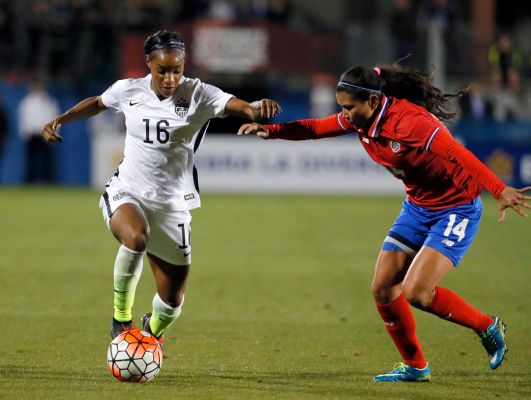
Dunn against Costa Rica (photo from newsday.com)

3.  Portugal, Sans Ronaldo, Wins the European Title.

So much for my wish that Cristiano Ronaldo would eat some crow during the 2016 UEFA Championship. The only saving grace was that he was injured during Portugal's win in the Final against France and spent most of the match on the sidelines (a little cruel, I know -- I wasn't hoping that it was a debilitating injury -- which it apparently wasn't).

I wasn't as upset about the fact that Portugal won (although France winning on home soil after all it's been through in the past year would have been nice), but the way that it accomplished the task. As mad as I get at South American teams for their diving, faked injuries, and time wasting, at least, on some level I feel as though they truly believe that it's just part of the game. The Portuguese, on the other hand, are so cynical in the way that the go about it that it's infuriating. 

After all of their disappointments at the international level, I suppose Portugal was due a few breaks in its favor.  And it got them through squandered opportunities by a French team that seemed, frankly, overwhelmed by the moment and one well placed strike by Eder that barely eluded French keeper Hugo Lloris, who seemed slightly out of position on the shot.

So a tournament that began with promise ended with a whimper (as did, to be fair, the Copa America) and Portugal got its trophy. And the beautiful game took a blow.

Wednesday, June 15, 2016

A Plateful of Soccer (Best Served Cold)

We've got the Euros all day long and the Copa America in the evenings. I'm already spoiled enough that I am perturbed that there are no Copa 100 games Wednesday before the quarterfinals start tomorrow.

As a result, writing choices abound ...

There were the U.S. men's spirited displays against Costa Rica and Paraguay (and we have to credit Jurgen Klinsmann some for that, don't we?) in not only overcoming a desultory 2-0 loss to Columbia in the first game of group play, but in ending up winning their group.

There is the game tomorrow against Ecuador, and perhaps a deserved backtrack from a certain comment about them being "minnows" in CONMEBOL when they currently lead its qualifying, are ranked 13 in the world, and have qualified for three of the last four World Cups.

But there was something even more compelling that happened on the other side of the pond.

Iceland is playing in its first major tournament ever, thanks at least in part to the expansion this year of the field at the Euros from 16 to 24 teams. But make no mistake, "Our Boys" (or "StrĂ¡karnir okkar" in Icelandic if you prefer) earned their way to the Finals by finishing second in their group in qualifying, beating The Netherlands at home and away in the process.

To put things in population perspective (as I'm want to do), Iceland's population is roughly 330,000 people, or a few thousand less than that of, yes, Kalamazoo, Michigan. As far as countries go, Iceland is wedged between Belize and The Bahamas (or 179 out of 209) in population of  FIFA member nations. But in the FIFA world rankings, Iceland is #34, between the Republic of Ireland and Sweden, and just three spots below the U.S.

The most recognizable Iceland player to international soccer fans is probably Eidur Gudjohnsen, who played, and played well, for Barcelona and Chelsea back in the day but is now 37 years old and did not start or appear off the bench for their first major competition match, against Portugal and Cristiano Ronaldo.

Interesting side note: Eidur Gudjohnsen and his father, Arnor, hold the unique distinction of being the only father and son to appear on behalf of their country in the same international match.  Arnor started the game, against Estonia in 1996, and Eidur, 17 at the time, came on in the second half as a substitute for his dad.  

In the Portugal match, Iceland, a true soccer minnow, tied mighty Portugal and Ronaldo 1-1. Iceland fought and scrapped and was a little bit lucky, but survived. Afterward they celebrated like, well, like a country that had just tied its first ever match in an international tournament against the eighth best team in the world and a player about whom my friend Mike would say "Ronaldo loves him some Ronaldo."

Portugal took the lead in the match, but Iceland, with one of the precious few chances it had, tied it 50 minutes in on a goal by Birkir Bjarnason, then held on for the next 40 minutes for the tie, surviving two Ronaldo free kicks deep into stoppage time.

Bjarnason celebrates his goal (photo from theguardian.com)

Was it particularly attractive soccer? No. But it was a demonstration of why soccer is great and why, sometimes, a team underskilled and undermanned (although, as is apparent from the picture, not undercoifed, even against pretty boy Ronaldo) can, for 90 minutes, make up for all of those deficiencies by playing gritty, desperate, team soccer.

“Iceland didn’t try anything,” whined the Portuguese captain. “They were just defend, defend, defend and playing on the counterattack. It was a lucky night for them. We should have three points but we are OK. I thought they’d won the Euros the way they celebrated at the end. It was unbelievable. When they don’t try to play and just defend, defend, defend, this in my opinion shows a small mentality and they are not going to do anything in the competition.”
To which Karo Arnason, an Iceland center-mid, responded: "tough shit."

I could add more about Ronaldo, but the Telegraph article is too well written to even try to challenge. So I leave you with these observations about Ronaldo while I hope you revel in the smorgasbord of soccer from which we are feasting, whilst Iceland parties like it's 999, and while I fervently hope someone is forced to eat a little crow:
But Ronaldo would not be Ronaldo if he did not view every single game as a stage for him alone to confirm his greatness, rather than an opportunity for any Tom, Dick or Heimar to seize their own 15 minutes of fame.
He is the ultimate back-garden bully, the kind of barbecue guest who would spend the afternoon doing step-overs past seven year-olds and nutmegging the neighbours’ arthritic collie. It is that mind-set which has made him great. You don’t score 487 career goals, including 50-plus a season for the last six seasons by routinely squaring to better-placed team-mates.
... you get the impression that even now, at the age of 31, it does not matter how luxurious the hotel suite – if Ronaldo has no goal to replay in his mind before lights-out, he does not get a good night’s sleep.

Wednesday, June 1, 2016

Glimmers of Hope

So what are we to think about the U.S. Men's National soccer team headed into the Copa America (or Copa Centenario, if you prefer)?

Consecutive wins against South American opponents in the past week? Good.

Those wins coming against traditional CONMEBOL minnows Ecuador and Bolivia? Not so good.

Four straight wins and a 6-1 record so far in 2016? Good.

The loss being in World Cup qualifying to Guatemala in a dismal 2-0 performance? Not good at all.

The introduction of new, exciting players like Darlington Nagbe, Christian Pulisic, and Steve Burnbaum? Good.

Continuing to rely on old, and old guard, players like Jermaine Jones and Kyle Beckerman, particularly in the demanding role of center midfielder? Not very good.

Obviously the upcoming Copa America will give us more information on where the national team is, and where it might be going, in World Cup qualifying and, hopefully, the 2018 World Cup itself. The recent wins have certainly quelled, for now, the anti-Klinsmann drumbeat that reached a crescendo after losses to Jamaica in the Gold Cup and Mexico in the play-in for the Confederations Cup last year.

While they are far from a guarantee for success in the upcoming Copa America, which will be against stiffer competition in a more meaningful setting, the Americans' luck appears to be turning after a dismal 2015. And not just on the field.

The U.S.'s opportunity to participate in the Copa, and indeed the entire tournament, was cast into doubt by the indictment or arrest of many top CONMEBOL and CONCACAF officials last summer and additional indictments for Traffic Sports, a major player in organizing (and skimming graft from) both the Gold Cup and Copa America. The importance of the tournament as preparation for the next World Cup cannot be understated, particularly after the ignominious denial of the chance to play in the Confederations Cup, participation in which was long touted by Klinsmann as essential to success in Russia, until it wasn't.

But whether through sheer will to actually celebrate the 100th anniversary of the competition, or the unappealing prospect of losing millions of dollars of revenue from the target-rich U.S. soccer market, the tournament will go on (although perhaps without Argentina).

While Klinsmann has talked about bringing new or younger players along slowly (hence not starting Nagbe or Pulisic against either Ecuador or Bolivia), this tournament seems the ideal opportunity to start determining whether they will be able to withstand the pressure of top flight competition in CONCACAF World Cup qualifying, particularly once it moves to the final stage (known as The Hex because of its six teams, the top three of which will qualify for the World Cup, and the fourth place team of which will advance to a playoff against the fifth place team from Asia).

The back line seems set with John Brooks and Geoff Cameron (assuming he's healthy) in the center of defense and Fabian Johnson and DeAndre Yedlin on the wings. Bobby Wood, Gyasi Zardes, and Clint Dempsey appear ready to play up front in some combination (particularly with the surprise exclusion of Jordan Morris from the squad) with Pulisic likely to come off the bench and Chris Wondolowski available to poach a last minute goal in a pinch. 


Pulisic celebrates his goal against Bolivia, which made him the
youngest goalscorer for the U.S. Men in the modern era.
(photo from www.dailymail.co.uk)

That leaves three players to man the midfield (although Zardes could play wing or Dempsey as a withdrawn forward or attacking midfielder at the top of a diamond). Michael Bradley is a shoo-in, of course. Alejandro Bedoya was, for my money, perhaps the Yanks' best player against Bolivia and seems unlikely to be left out of the starting 11 (as long as Klinsmann doesn't insist that he play in the back).

There has to be some bite, which Jones normally provides. Klinsmann could go with two defensive mids with Jones and Beckerman, but that seems unlikely, particularly given Beckerman's lack of mobility. Equally unlikely is abandoning the defense altogether and playing both Nagbe and Bedoya along with Bradley.

While Jones is an acceptable choice this summer, it's hard to see him as capable of being one in Russia. I'd like to see Klinsmann try Bradley at the bottom of a diamond with Nagbe and Bedoya the linking midfielders and Dempsey at the tip. But that's unlikely to happen since Klinsmann has insisted for more than two years now that Bradley's best position is up the field leading the attack, and for the most part Bradley has proved him right.

Another option would be to recognize that Dempsey may be too old by the time 2018 comes around and put Bradley at the top, with Nagbe and Bedoya behind, Cameron in the defensive/deep-lying mid position, and Burnbaum or Matt Besler in the center of defense with Brooks.

Given the heat that Klinsmann took last year over the team's performance it's understandable that he is reluctant to sacrifice results for experimentation in the Copa. But, in the long-term, that may be exactly what this team needs. Regardless, it's nice to talk about the options available to him, which seemed in very short supply last fall.

Monday, November 2, 2015

We Were Us Long Before You, And Will Be After

The U.S. Men's U-23 National Team only needed to beat Honduras in the CONCACAF Olympic Qualifying Tournament to assure qualification, at least somewhat erasing the humiliation of failing to qualify in 2012. Instead, it lost 2-0 and now must beat Columbia in a home-and-away two-game match next year.

The U.S. Men's National Team only needed to beat Mexico, on home soil, to secure a place in the Confederations Cup, a pre-World Cup tournament held in Russia, participation in which coach Jurgen Klinsmann described repeatedly as important to the team's development and status. It lost 3-2 in extra time but, truth be told, was flattered by the score line as Mexico dominated possession and made the Americans look slow, unimaginative, and poorly coached.
 
Bobby Wood provided one of the few bright spots in the loss
to Mexico in the CONCACAF Cup. (photo from concordmonitor.com)
 
The U.S. Men's U-17 Team only needed to defeat Chile, a team that had already been thumped 5-1 by Nigeria in Group play, to advance to the Round of 16 and the U-17 World Cup. Instead, it was thumped 4-1 and crashed out of yet another international competition.

All of which has led, understandably, to consternation among U.S. Soccer fans, many calling for Klinsmann's head while at the same time acknowledging that he's not going anywhere soon, given the financial and institutional investment that U.S. Soccer has made in him.

It's possible that this is just a hiccup, a blip that happens to almost every national team (except, it seems, Germany's) at some point during the World Cup cycle. More worrying are two other things: first, Klinsmann's seeming inability to either accept responsibility for or even acknowledge the repeated failures of the teams that are under his command as both National Team coach and Technical Director of U.S. Soccer; and, second, that clearly no one at U.S. Soccer is inclined to either require Klinsmann to be held accountable, or to have a Plan B should things continue to go downhill with Klinsmann in command.

Klinsmann was brought in to change American soccer culture. He was going to bring attacking, possession football to our second-class soccer nation.
 
It hasn't happened.
 
But I'm okay with that. Maybe that's not who we are as a soccer playing nation. Maybe we are and always will be second best when it comes to possession. Maybe we'll always be the scrappy, counterattacking team. Second-best in possession, first when the whistle blows. Some very successful teams have won trophies that way.

And that's where I really have a problem with Klinsmann: telling us that he's going to make us one kind of team, and then taking credit for us being quite another. He went on an on after the Mexico loss talking about our American grit and fight and determination, as if he had bestowed it on us from above when he arrived four years ago.

Take all the credit you want, Jurgen for trying to get us to play prettier, for bringing us some decent players with German pedigrees, and, perhaps most importantly, for raising the hopes and expectations of U.S. Soccer supporters.
 
But don't, for one minute, presume that you taught us how to fight and dig and expend every ounce of energy and never quit and never say die.

That's ours.

That's us.

And we didn't need your help for us to be that way.

Wednesday, June 10, 2015

That Bradley Guy Again

After the U.S. Men's Team's stunning 2-1 comeback win over Germany in today's friendly, I was tempted to write another post about Michael Bradley. But Jason Davis over at espnfc.com already has.

Or maybe I already have - Davis makes many of the same points that I did after the Netherlands match. Not that I think he's plagiarizing or anything. But maybe proof that sometimes I'm on the mark? Check out the highlighted sections below, then my post from earlier this week.

Michael Bradley leads U.S. to stunning win over World Cup champs Germany

Three musings after the United States closed out a strong European sojourn with a thrilling 2-1 win Wednesday against Germany in Cologne on Jurgen Klinsmann's first trip to his native land as U.S. national team coach.

1. Michael Bradley, playmaker

He doesn't wear the No. 10 jersey (that would be Mix Diskerud), but Michael Bradley is undoubtedly the Americans' driving creative force. Just as he did against the Netherlands, Bradley served as the key man in the U.S. attack, starting moves and setting up goals with his vision and accuracy. Apparently Klinsmann was on to something when he moved Bradley into the role last summer at the World Cup.
Back then, the Toronto FC man seemed prone to trying to do too much, effectively running himself out of games by attempting to cover too much ground. In two friendlies on this European trip, all things flowed from Bradley in the American midfield. His final passes grab the most attention, but he was equally important moving the ball, allowing the United States to gain some semblance of possession whenever possible.
Bradley in today's match against Germany (photo from espnfc.com).
After halftime changes provided him a solid backstop in Kyle Beckerman, Bradley was free to think entirely forward-first. The number of times he both started attacks and put himself in position to be available to finish them is a testament to his improving understanding of his role on this team.
The only black mark on Bradley's performance was the shot he hit directly at the German keeper, Ron-Robert Zieler that would have turned a strong 1-1 draw against the world champions into a stunning win. Luckily for Bradley, Bobby Wood arrived to lace home a wicked left-footed shot with Germany stretched, surprising the crowd and lifting the United States to a second consecutive win on the road in Europe against a top-10 team.

Monday, June 8, 2015

Insight and Eurocentricity

So much to catch up on in the world of soccer. FIFA scandal (or, more accurately, scandal finally exposed), Sepp Blatter, Hope Solo, the Women's World Cup, the Women's World Cup being played on an inferior surface.
 
But, for just a moment, a post about the game itself. Particularly, one player and how one coach can seemingly be completely insightful and completely wrong at the same time.
 
The player is Michael Bradley. While he didn't score (and frankly should have), he lead the U.S. Men's National Team to an improbable comeback win against The Netherlands last Friday in Amsterdam.
 
Bradley against Holland (photo courtesy of mlssoccer.com)
 
 
Before you say it, I know. Where do I stand on the "friendlies mean nothing" versus "friendlies tell us a lot" scale because I've been all over the place on it? But this isn't an evaluation of the entire men's team and its performance in Holland (which, frankly, was disastrous defensively) but of one player and his standout play and what it tells us about him and about Jurgen Klinsmann as a coach and as technical director of the Men's National Team.

First, the good news. Bradley was clearly the standout player on the pitch, for either team, and that includes Robin Van Persie, Klaas-Jan Huntelaar, and Memphis Depay (who was excellent going forward for the Dutch, but not so great in defense).Bradley pulled all the right strings for the U.S., including going on this mazy run that led to Bobby Wood's game winner at the death:

 
Bradley's excellence says much about him and his coach. Of Bradley, it tells us that he's willing to adjust his game, to bow to his coach's will for the good of the team (he is, after all, a coach's son). Since well before the 2014 World Cup Klinsmann has insisted that Bradley's role should be that of the attacking midfielder. And, for a long-time, many insisted that it wasn't working. With his great work rate and apparent defensive proclivity, Bradley continued to drop into the defensive mid role with which he seemed more comfortable.
 
The fruits of Klinsmann's insistence, and Bradley's compliance, were on display against Holland. Perhaps because Bradley knows that with Kyle Beckerman in the holding midfielder spot he can be more comfortable moving forward. perhaps out of desperation because, down 3-1 on the road there was no reason to play it safe. But whatever the reason, the hope is that Bradley is now comfortable with his new home.
 
Speaking of new homes, Bradley's performance again calls into question Klinsmann's mantra that the best American players need to play in Europe against the best competition to reach their competitive peaks. While admittedly the competition in the European professional leagues is still higher than that of MLS, Bradley's transformation has occurred not in Holland or Germany or Italy, which were all stops in his career, but in MLS playing for Toronto FC.
 
For every Bradley or Dempsey whose game has clearly benefited from playing in Europe, there are seemingly several Altidores and Sheas who sat on their benches in Europe and only played (and returned into the national team top tier) after returning to MLS. 
 
Is Europe still better? Yes. But only for players who play.
 
Hopefully Klinsmann the technical director will understand that message sometime soon.

Sunday, September 7, 2014

Trying to Keep College Soccer Relevant

While forces outside of the NCAA's control are compelling it to change the way that it administers its revenue-churning men's football and basketball competitions, at least one group is attempting to address issues from within. And in a "non-revenue" sport at that.

Led by WVU's Athletic Director, Oliver Luck (a former quarterback at the school and, perhaps more importantly for this subject, the former General Manager of MLS's Houston Dynamo) a group of college coaches, athletic directors, and administrators are trying to convince the NCAA and MLS that college soccer should move to all-season sport status, with the College Cup to take place in June, not November as it currently does.

The proposed changes would also allow more training time to college soccer teams and are aimed at improving training techniques and game preparation. Such a move would, hopefully, raise the level of play to that of lower division soccer in other countries. 

If the proposal is adopted, it would inject new life into college soccer in the U.S., which has been marginalized by MLS and its youth teams. Whether that diminution is a bad thing or not depends on who you ask. And when you ask them.

U.S. men's national team coach Jurgen Klinsmann has been particularly vocal about the need for the top-level U.S. players to play in Europe and its young national team players to train year-round with the best teams in the best training facilities, whether they be in Europe or with an MLS youth team in the States.

It's undeniable that the very best players in the World have, for generations, honed their craft in just that way - by playing constantly, with the highest level of coaching, against the best opponents. That is in fact how Klinsmann rose from an apprenticeship at his family's bakery to his fame as a World Cup hero and as feared striker for a number of prominent clubs in Europe.

But the problem with the European model is that for every Klinsmann or Messi or Rooney that it produces there are hundreds of faceless youngsters who became adults with no vocational ambitions to fulfill, tossed to the side because they're not quite big enough or fast enough. While some of the best youth programs offer education as well as soccer as a part of the curriculum, the primary reason that players are enrolled is to learn how to play soccer, not learn in the classroom.

Klinsmann, too, seems somewhat equivocal with regard to how he views American soccer, at both the developmental and professional levels. While he insists that the best players should play in Europe against the best of the world, he made Clint Dempsey the national team captain at the World Cup despite Dempsey's return to MLS last season. And, least we forget, Dempsey came of age as a player not after training in the depths of some professional team's youth ranks, but at Furman University.

Dempsey during his playing days at Furman,
(photo from furman.edu)

Perhaps most interestingly, among the players named to the U.S. squad for the recent friendly against the Czech Republic was Jordan Morris, the first collegiate player to appear on the roster since 1999. Morris apparently impressed Klinsmann while the national team trained at Stanford, where Morris is a sophomore, in scrimmages between the school's team and the U.S. men. While Morris was a player for the Seattle Sounders' youth team, he chose education over professional soccer in signing with Stanford instead of the Sounders.

Morris did not appear in the match, which the U.S. won 1-0 on an Alejandro Bedoya goal. But Morris' inclusion in the squad is hard to read as anything other than an indication that Klinsmann both recognizes his talent as a 19 year-old and validates the developmental training that he received in the Sounders' youth organization and at Stanford.

There are undoubtedly serious problems with the way the NCAA administers its revenue sports. Luck's proposal, however, presents an opportunity to the organization and its member institutions to make strides toward providing education for both sports and for life after sports, with the latter undoubtedly being the vocational destination for a vast majority of their players. 

The Soccer America article linked above suggests that Luck's proposal may well fail because, as a non-revenue sport, soccer simply isn't on the radar of may college athletic directors and presidents. They may either not want to set a precedent for other sports to seek a similar change, or simply not care enough about the development of college soccer to devote time to consideration of a change in how and when it is played.

Such a reaction (or non-reaction as the case may be) will simply be further confirmation of what the true "value" of college athletics to those that administer them is. And it would once again expose the NCAA's insistence to refer to those that play college sports as "student-athletes" for the sham that it is increasingly perceived to be.

Tuesday, July 15, 2014

Truly the World's Cup

I watched the U.S. vs. Belgium match in a pub in Canmore, Alberta with C and a bunch of U.S. vacationers. 

I marveled, with my countrymen, at Tim Howard.

I wondered how many would say "I told you so" when Wondo missed the sitter.

No caption necessary (photo from grantland.com).

I groaned when Belgium scored, and scored again. I said to C after the first goal "Klinsmann has to sub Green for Bedoya" (honest, I really did). He listened after the second, and we cheered Green's fantastic goal, then groaned again as chances went wanting at the death.

I listened to Columbia vs. Brazil on XM radio driving from Lake Louise to Jasper, glad I was watching the Canadian Rockies out the car window instead of the match as I heard the cynical play of the former purveyors of the beautiful game and the exasperating refereeing described, convinced that FIFA had stacked the deck in Brazil's favor in every conceivable but subtle way.

I saw two German tourists, faces painted with the German flag, on a sunny Tuesday morning in Banff. Little did they, or I, know what lay in store a few hours later. 

I passed a bar in the Calgary airport those few hours later, saw the game was on, and did a double, then a triple, take. The graphic read: "0 Brazil 4 Germany". In the 27th minute. I asked the guy standing next to me, still incredulous, "is that score right?" He assured me it was with a wry smile. I rushed back to the gate to tell C (she's of 100% German ancestry) of the score and that I was going to watch the rest of the first half, at least.

I rubbed my eyes when, not five minutes later, back at the bar, the graphic said: "0 Brazil 5 Germany." This time I just looked at the same guy, and he just nodded. Not a word was exchanged or needed.

I watched the French CBC station coverage at half time, deciding that even that lovely language couldn't put a pretty face on being down 0-5 in your own World Cup.

I decided that, at least this once, I was wrong about FIFA.

I followed The Netherlands game against Argentina, getting home from work to watch la Albicelestes win on PKs, a result that seemed neither deserved nor undeserved. Then I saw the Dutch destroy a slightly less desultory Brazil in the Third Place match.

I ambiguously watched the Final, half rooting for Germany because of that familial connection, half rooting for Argentina because I believe Messi to be the best player of this, and perhaps any, generation and that this was probably his best chance to add "world champion" to his resume. 

I was pleased that it was not another boring, tentative final, at least not in the first half, and that it was settled not by PKs but by two moments of brilliance (Schurrle's cross and Gotze's finish).

I was glad that a record number of my countrymen watched with me.

Welcome to the World's Cup and the World's game, American. Stick around for a while.

Thursday, June 26, 2014

Through

I'm spent.

I've written before about my ambivalence about my love of sports. Particularly soccer. Particularly a soccer tournament run by an organization as corrupt as FIFA.

But I've also resolved to embrace my obsession. And so I watched the U.S. game against Germany with E, didn't sit the whole first half, didn't even sit at half time while eating and pacing. E didn't either, although I'm not sure out of superstition or just nervousness. I hadn't been so nervous since my last Regional championship game. Or my last trial. Or the Ghana match.

I in my Klinsmannesque blue USA polo, E in his brand new away jersey that he had just opened, a present on his 23rd birthday. Moaning, muttering, yelling at the ref (which will either amuse or confirm the suspicions of my referee friends - and, no, I do not count the zebra in the photo to the right giving me a card among them).

This one (photo from ussoccerplayers.com)
Only after Muller scored (and what a fabulous strike) did I decide that particular talisman was broken and sat and watched, as much what was happening in the Portugal-Ghana game as ours, and fretted and groaned and, in the end, exalted. At a loss.

Some of my friends and family, new to soccer, still have problems with the nuances. What is up with added time? Why do players dive with impunity? How can losing a battle mean winning a war?

It's all part of the magic, my friends. There's often the chance of a last gasp. There's always the hesitation for the whistle, the pointing of the arm, the brandishing of the card. And there's also the ability to rely, in the group stage anyway, on good work already done and grinding out a result, and hoping that someone else keeps playing hard on the biggest sporting stage in the World. 

Thanks Portugal. Thanks Ronaldo (never thought I'd say that).

We're through. And that's really all that matters right now. The shirt can stay. 

I'm sitting for the Belgium game, though.

Some random thoughts:

Klinsmann got it right again. I thought Geoff Cameron needed to go after Portugal, and evidently Klinsmann did too. But he stuck to his guns that Omar Gonzalez was his right central defender on the bench and started Gonzalez against Germany. And Gonzalez was very, very good.

Tim Howard was fantastic. Jermaine Jones again was huge, but about as spent as me when the game ended. Bradley not great but better. Dempsey also exhausted (time to get someone else up front -- Altidore or Johannsson -- and let Dempsey play withdrawn?).

If you like soccer, or humor, or even better both, check out the Men in Blazers podcast from Grantland. Spider bites with questionable consequences, tiny bananas, Tiricoism, and, best of all, #wetherrara. These guys are fantastic.

Ian Darke was driving me crazy during the match. E and I kept yelling at him to quit restating the obvious and jinxing us. Michael Ballack, on the other hand, has gotten much better as a studio analyst.

And speaking of improved performances, I begrudgingly give credit to FIFA for lowering the boom on Suarez.

Belgium? I'll take our chances. And Argentina after that? That would be something not to miss.

Sunday, June 22, 2014

Post-Match Musings - U.S. v. Portugal

I take back all the bad things I've been writing about Alexi Lalas. His observations immediately after the Americans' 2-2 draw against Portugal were spot on. It was a great match and the Yanks would have been thrilled with four points from the first two games if they had been offered prior to the start of the World Cup. 

It's up to Jurgen Klinsmann to convince the team of that. That we're still in good shape and have showed the world what teamwork and hard work can accomplish. But while the last play of the Portugal match was the most disappointing, there were several things to be concerned about coming out of the match.

One is that Klinsmann's magical substitution touch abandoned him at a crucial point of the game. I understand the idea behind taking Graham Zusi out and putting Omar Gonzalez in the center of defense with a few minutes left (to waste time, for starters). But Gonzalez hasn't done much right in the last month and he was completely absent (out wide to the right and behind the play) when Portugal equalized. Perhaps he was in to man mark Cristiano Ronaldo, but he did a poor job of that as well. He should have been in front of the cross from Ronaldo to head it away, but even with fresh legs was out of the play as it occurred.

Which brings us to the worst performance over 90 minutes - that of Geoff Cameron. Lalas forgave him the horrible miss hit that put the ball at Nani's feet five yards out with only Tim Howard to beat five minutes into the match, but I can't. It was the kind of mistake you excuse at lower levels of soccer, but not in the World Cup. Cameron then compounded the error by being behind Varela when he headed in Ronaldo's cross to tie the game at the death. Ball watching in the 95th minute? Amateurish.

I understand a coach wanting to keep his defense consistent absent suspensions or injury, but one has to think that John Brooks will be seriously considered to replace Cameron against Germany on Thursday. After the Ghana match Klinsmann said that Brooks is his left central defense substitute (i.e., for Matt Besler) and Gonzalez the sub on the right. But Brooks and Besler have to be considered to pair against Germany, particularly given Brooks' familiarity with many of the German players.

He's convinced me as a commentator, but is it 
too late to put him back in the center of defense? 
(photo from content.usatoday.com)

As for the good news -- I start with Besler. He was fantastic throughout the match. Apparently Howard was voted Man of the Match, but for me it was Besler without question. Things could have fallen completely apart after Cameron's miscue, but Besler held it together, stepping when he needed to and distributing well from the back.

Jermaine Jones was very good again, although not as good as against Ghana, save for his fantastic goal. Kyle Beckerman worked hard and had some good touches, although he also was not as outstanding as he was against The Black Stars. One has to wonder, at 32 years of age apiece, whether Jones and Beckerman will have enough left in the tank to go the full 90 minutes against Germany (particularly with three days of rest while the Germans have four - thanks FIFA!).

Clint Dempsey worked very hard and deserved his goal (I had a player score a goal with her stomach once - in a 1-0 upset win over the school that at the time was ranked first in the state - so I appreciate particularly that method of scoring).  Zusi gave away the ball too much, but his perfectly weighted pass set Dempsey up for the belly ball that looked at the time like it had put the Yanks in the Final 16. Howard made one fantastic save, but on a rebound shot from a ball off the post that seemed to go right through his hands.

Honestly, very few of our players except for Besler had outstanding games. Michael Bradley was once again sub-par (but please don't talk to me about how Klinsmann should pull him for the next match - we have no one else who can even come close to being able to do what Bradley does even on a bad day). That should bode well for our chances against Germany.

A win or draw against Germany and we're on to the Round of 16. A loss, and we might still get in depending on the result of the Portugal v. Ghana match. And if Germany draws against us they are not only in, but top the group. 

Don't think that it hasn't already crossed my mind (and those of the powers-that-be in both the Ghanaian  and Portuguese Football Federations) that a dull, goalless draw against a German team that the Americans' coach starred for as a player and coached on this very stage would suit both countries' purposes just fine, thank you very much. 

Such an approach, however, doesn't seem to be in Klinsmann's DNA (remember when we could have sent Mexico packing if not for two stoppage time goals that broke Panama's heart eight months ago?). And it's hard to see the Germans giving either Klinsmann or the U.S. any quarter either ("uh, Ms. Merkel, about that whole listening to your phone calls thing? We're really, really sorry now").

If only we had held on. If only Cameron had taken a better touch early or marked his man late. If only Bradley hadn't given the ball away in the center of the field. If only Gonzalez had done the one thing he was put in the game to do.

But this is American soccer. We're second in the Group of Death with everything to play for, coming off of two gutty performances with a warrior leading us on the field as our captain. We don't coast or dazzle or do things the easy way. But, more often than not, we find a way.

Still, just this once, I would have been fine with us taking the easy way.

Thursday, June 19, 2014

Where Were You When Brooks Scored?

When your job is not that of full-time blogger, work sometimes gets in the way of posting. So it was with me on Monday, as I watched the U.S. v. Ghana match not at an American Outlaws watch party, or in the comfort of my own home, but on a boat in the middle of the Hudson River.

Fortunately a combination of my on-and-off whining for several weeks and the ingenuity of the good folks at USLAW meant that we had our own watch party on board, even though it was via the internet and on Univision (there was no sound anyway, so the fact that few of us could have understood any part of the broadcast other than "Gooooooooaaaaallllllllllll" really didn't matter).

As we motored under the Brooklyn Bridge and the Manhattan Bridge (under which there was also a watch party significantly better attended than ours), some ate, some took in the sights, and others watched the game and cheered and groaned and critiqued (it was a bunch of lawyers after all) and was on the edge of its collective seat for 90 minutes plus stoppage time -- interminable, excruciating stoppage time.

And while, admittedly, the reaction of those lawyers wasn't as exuberant as that of many of those shown in the video below, I wouldn't trade the experience for any others - except maybe for those who were in attendance in Natal. 


Just as with Landon Donovan's goal against Algeria in 2010, I suspect I'll always remember where I was when I jumped and shouted and acted like a fool when John Brooks' header went in and the U.S. vanquished the demon of Ghana in the World Cup. After the game, we glided past the Statue of Liberty and I took a picture and Tweeted this:


Good on you John Brooks, the unlikeliest of goal scoring heroes, and you Jurgen Klinsmann for, once again, making magical substitutions at crucial times (thinking more of the addition of Graham Zusi - who delivered the cross that Brooks headed - than Brooks here).

Aaron Johannsson kept yelling in his Brooks' ear after the goal, "just believe it." John's not alone Aaron. It took us all a while to believe.

Thursday, June 12, 2014

Oh Please

I'm going back on my word to not post again before the World Cup starts. I'll just eke this one under the wire. And all at the risk of appearing a bigger and bigger Jurgen Klinsmann apologist. Or his lawyer.

Still, I'm about to start tearing my hair out. And this is good therapy.

The newest hubbub surrounding Klinsmann concerns his comments, made  in a New York Times Magazine article and repeated yesterday at a press conference in Brazil, that it is not realistic to talk now about winning the 2014 World Cup.

The media and the social media sphere went into a frenzy. "That's un-American!" was the general theme. Since Alexi Lalas has blathered on for months about how we ought to go into this World Cup planning to win or we shouldn't bother showing up, I'm sure he made plenty of comments along those lines last night on ESPN's two-hour extravaganza previewing the tournament.

I'm not sure that he did because the show was so painfully bad that I couldn't watch for more than a minute at a time. ESPN paraded out panels and panels of so-called experts, most of whom speak English with one unintelligible accent or another. Including a woman from the UK who will be some sort of studio host and immediately flubbed her second line on the show. Why does ESPN insist on having foreigners talk to us about soccer? I'm sure Julie Foudy could do her job more intelligently and intelligibly than she. Michael Ballack was particularly ill at ease, which would have made continued watching a little like gawking at a wreck. I was tempted, but kept driving at normal speed and ended up in South Park, Colorado instead.

But I digress. While I can only assume Lalas's indignation, there are plenty of examples in print. The devastating observations of Gregg Doyel, (a columnist for cbssports.com whose bona fides are that he "covered the ACC for the Charlotte Observer, the Marlins for the Miami Herald, and Brooksville (Fla.) Hernando for the Tampa Tribune. He was 4-0 (3 KO's!) as an amateur boxer, and volunteers for the ALS Association" Alrighty then, he's got the credentials!) are one example.

Doyel goes on, and on, and on shaking his pompoms and rattling his saber, using the tired trick of repeating Klinsmann's statement in italics while railing about how it's obvious from the statement that Klinsmann ain't "from around here" and that he has a lot to learn about American guts and ingenuity, blah blah blah. Another noted soccer journalist, Mike Wilbon of ESPN, apparently took umbrage with Klinsmann's questioning of Kobe Bryant's salary in the article and told Klinsmann to "[g]et the Hell out" of the country. 

The only problem with Doyel and his ilk is that they are taking Klinsmann's statement completely out of context. Klinsmann did not say and has not said that the U.S. cannot win this World Cup. He has simply said that now is not the time to talk about it. 

Clearly uninterested in winning (photo from nytimes.com)

Klinsmann's exact quote yesterday, as reported by several different sources was: 
"I think for us now talking about winning a World Cup is just not realistic,” he said. “If you do it like Greece in 2004, I think that nobody from Greece would have said, ‘We’re going to win the European Championship,’ but they did. At the end of the day, soccer, the beautiful thing is it’s unpredictable. You don’t know what happens.
“First we’ve got to make it through the group," he says, "so let’s stay with our feet on the ground and say, ‘Let’s get that group first done,’ and then the sky is the limit. But before and half-a-year before and even now (a day) before the World Cup starts, to say that we should win the World Cup is just not realistic.”
Makes sense, right? Brazil has won five World Cups. Italy has four. Germany has three. The U.S. has been to one semi-final, in 1930 when no one was paying attention. Klinsmann is merely saying "let's not get ahead of ourselves here. There are countries that can realistically say before the World Cup 'we want to win.' Or even 'we expect to win.' But the U.S., with its pedigree, is not yet one of them. Let's get through the group and then see what happens."

Over and over everyone reports, or even defends, the comment as "Klinsmann: Unrealistic for U.S. to expect title." But the quote was "for us now talking about winning a World Cup is just not realistic." Now, as in right now or "half-a-year before." I am not parsing words, just taking them at face value. And what Klinsmann clearly said was absolutely correct, absolutely defensible, and absolutely coach speak. Let's take one game at a time. Let's put one foot in front of the other. Let's talk about our chances of winning a World Cup sometime after we make it out of the Group of Death.

I don't know what works the rabble rousers into their collective froth about Klinsmann. Is it the temerity that he showed to come from another country to coach "us"? Is it axing Donovan? Or is it just the usual soccer haters who seize the opportunity to throw cold water on the American psyche when once every four years (or two if the women do well) millions more Americans pay attention to soccer than the rest of the time?

Any way you choose, perhaps they could begin to show at least a shred of journalistic integrity by accurately quoting the man before excoriating him for something he did not say. Or just simply keep ignoring the game as they do the rest of the three years and eleven months of every four years.

Go back to covering high school football. We've got soccer to watch.

Tuesday, June 10, 2014

The Trick Up His Sleeve

I ended my post about the U.S. vs. Turkey match saying that Jurgen Klinsmann might have trick or two up his sleeve before the first World Cup match against Ghana next Monday.

Turns out he had at least one, and we didn't have to wait until that game to see it.

The U.S. won its final warm-up match before Brazil, beating Nigeria 2-1 with two goals from Jozy Altidore (the first among the easiest he'll ever score, the second a vicious strike from 12 yards out).  Nigeria pulled back a consolation goal on a penalty kick in the 86th minute to ruin keeper Tim Howard's shut out in a match in which he won his 100th cap for the Stars and Stripes.

The U.S. rolled onto the pitch against Nigeria in a formation featuring two defensive midfielders (Kyle Beckerman and Jermaine Jones) and no true left winger. That left Graham Zusi on the bench (apparently confirming the opinions of those who were less than impressed with his performance against the Turks) and the Americans with no right wing. While a departure from the previous two matches, this was the formation that had guided the Yanks through qualifying, including topping the Hex for the third straight time.

As predicted, Alejandro Bedoya was back at left wing against Nigeria after making way for Brad Davis in the Turkey match and DeMarcus Beasley was again at left back in place of Timmy Chandler, unimpressive against the Turks.

Contrary to what you might imagine, this formation actually created more chances than did the one used against Azerbaijan and Turkey which featured two forwards, two out-and-out wingers and two center-mids. Dempsey played more like a withdrawn striker than a partner alongside Altidore, Jones was more offensive, often drifting out wide (but tracked back as well), and Michael Bradley bossed the midfield and teamed with Dempsey to direct the attack.

This allowed more room for Altidore to roam, and also opened up the wings for marauding attacks from Beasley and right back Fabian Johnson who was brilliant offensively once again. Bedoya lacked quality in the attacking half of the field, but his defensive work was a big improvement over Davis's. Nigeria had the majority of possession in the first half but never looked particularly threatening, while the Americans' counterattack always looked likely to score.

The U.S. defense was solid most of the game. Central defenders Matt Besler committed a late foul that was whistled for a deserved penalty, but while he has been downgraded by some for the foul (and his play in general), the penalty was largely the fault of Omar Gonzalez, who came on late and was badly beaten by a Nigerian attacker in the build-up that resulted in the penalty and the goal.

Beckerman (15) sorts things out with Cameron and 
Besler (5) in the Nigeria match. (photo from usatoday.com)

After dominating the African champions, it seems likely that the U.S. starting 11 against Nigeria will take the field in the same formation against Ghana. It remains to be seen whether the U.S. has the strength and speed in the midfield, and the familiarity and organization in the back, to deal with the Ghanaian attack. But Beckerman's insertion into the line-up gives some hope for a more organized defense and a more creative attack.

And that hope is needed after Ghana demolished South Korea 4-0 last night in its last tune-up for Brazil. While the scoreline is intimidating, apparently Ghana did not dominate play as comprehensively as it indicates and South Korea was hurt by poor finishing.  Still, Ghana is spoiled for choices in the midfield and up top and will probably give the U.S. more to worry about as far as attacking options go than will Portugal.

Klinsmann appears to have this group as ready as it can be for the Group of Death. Two teams will survive, that much we know. Klinsmann has admitted that a win over Ghana is essential to the U.S. being one of those two. The time for analysis is over. Only the true test on the field remains.

Monday, June 2, 2014

What Have We Learned So Far?

We can assume, barring injury, that these players will be in the starting eleven when the U.S. men's team takes the pitch against Ghana on June 16 in Natal: Tim Howard, Matt Besler, Jermaine Jones, Michael Bradley, Clint Dempsey, and Jozy Altidore. 

So that leaves us with the questions of who will man the position alongside Besler in the center of defense, who the two outside fullbacks will be, and who the two wings will be.

Against Azerbaijan, Jurgen Klinsmann started Geoff Cameron at center back, DeMarcus Beasley (left) and Fabian Johnson (right) at fullback, Alejandro Bedoya (left) and Graham Zusi (right) on the wings. Many who know more than me thought that this line-up was also the one likely to start against Ghana and at least one blogger noted that it is arguably "the best eleven players that the U.S. has on the roster." Dempsey didn't start after having some discomfort in his groin while warming up for the match (Chris Wondolowski started in his place), but Dempsey's place is in the lineup is a foregone conclusion.

Omar Gonzalez seemed a lock a few months ago to start at center back, but some nervy play and a tweaked knee seemingly have him on the outside looking in for a starting spot. Beasley started the final qualifying matches at left back, almost out of desperation, and did passably well and was the clubhouse leader to man that position in Brazil as well.

Howard, Besler, Cameron, Jones, Bradley, Dempsey, Altidore, Johnson and Zusi started, in the same positions, against Turkey on Sunday. Brad Davis and Timmy Chandler manned the left wing and back positions, respectively, in place of Bedoya and Beasley. Neither Beasley nor Gonzalez played at all, even though Klinsmann used all six of his substitutes.

The U.S. won the match 2-1 thanks to a marvelous one-two from Johnson to Bradley and back that earned Johnson his first international goal for the U.S. and man of the match honors (along with his defensive play). Dempsey added a tap-in following a mistake in the Turkish defense before the U.S. surrendered a late goal on a penalty kick awarded after Cameron handled the ball in the box (on a play that was started by a bad defensive mistake by Chandler).

Johnson celebrates his goal (photo from usatoday.com).

My impression was that all who have started both matches did nothing in either one to severely hurt their chances to start on June 16. Being the dutiful blogger (and researching lawyer) I decided to see how soccer experts rated the U.S. performances against Turkey. The results confirmed that, much like legal research, there is no clear answer, only varying opinions. Some rated Zusi's performance highly. But Soccer America found his performance the "[m]ost disappointing of the projected World Cup starters."

That Chandler was the weakest link on the pitch was agreed to by most if not all the commentators. And if not him, then the honor went to Julian Green, the 18 year-old starlet who looked overwhelmed by the enormity of the situation after coming on as a substitute and who, honestly, should not see the field for any of the matches in Brazil.

Brad Davis, while putting in some good crosses, did nothing to lead one to conclude that he should start instead of Bedoya. His lack of pace and inability to consistently defend his side of the field probably put more pressure on Chandler than would allow a completely fair assessment of Chandler's play.

One interesting option for Klinsmann would be to play Johnson at left fullback instead of the right, where he has started both friendlies. Johnson played both left back and left wing for his club team, Hoffenheim. But Klinsmann likely has Johnson at right back to allow his best outside defender to match up with the likes of Cristiano Ronaldo in Brazil.

Johnson on the left would enable Klinsmann to start Davis, who offers more interesting offensive options than Bedoya and, if Davis pinches toward the middle as he often does, allow Johnson to make more effective offensive runs from the back. That would likely leave the right back position to DeAndre Yedlin another youngster (he's 20) who has buckets of pace but seems to rely on it at the expense of proper defensive positioning (Ronaldo would likely tear him up).

Or Klinsmann could move Cameron to right back, the position he plays for his club, Stoke, in the English Premier League, and start Gonzalez in the center of defense with Besler. But to do so would seemingly sacrifice the speed that Klinsmann values in his full backs.

All in all, it seems that those three positions, left back, left wing, and right back are the only ones up for grabs. And that Johnson will start at one of those outside back spots. So who's it going to be between Davis, Bedoya, Beasley, Johnson, and Gonzalez? My guess is Bedoya and Beasley. Saturday's match against Nigeria may tell us for certain.

Or Klinsmann may have one or two tricks up his sleeve yet ...