Wednesday, October 19, 2016

Please, please

I know it's only sports and there's a debate on that may well decide the final fate of our country, of our little experiment in constitutional democracy. 

There are more important things. To others. Including me.

I remember going to Wrigley Field as a youngster with a busload of Swedes from the Vikings' Club, giddy on morning herring, and highballs and Bloody Marys (the adults, not me), heckling passers-by (again the adults, not me) en route to another Cubs' loss.

I remember watching at my grandparents' house in Blue Island as Jack Brickhouse called Ernie Banks's 500th home run.


I remember 1969, 1984, 1989, 2015, and especially 2003.

I remember my Grandpa and his 60+ years of loyalty and sadness ("those damn Cubs") and my Dad and his 70+ years of anticipation and delusion. 

Please, please. Just this once. Let the little guy, the underdog, the endurer of 108 years of misery and frustration and ultimately false hope, come out on top.

photo from http://cdn9.whiskeyriff.com
Go Cubs Go.

Thursday, September 15, 2016

A Eulogy

Charles Nelson was a complicated man.  He was, I believe, the personification of something that we used to hear a lot about, but which his left-leaning son has long felt was in short supply: a compassionate conservative.  The son of a Swedish immigrant steelworker who was a card carrying union member his entire life and a woman who grew up in rural South Dakota, he was a self-made man, a life-long Republican, who believed, first and foremost, in our legal system and in justice for all.  Dad was an animal lover who also loved to hunt.  He was a Christian who, as many here have already attested, enjoyed a ribald joke. He had what some might describe as an inelegant golf swing, but readily offered advice to others on theirs, whether solicited it or not.

photo courtesy of Jeff Nelson

He allowed his sons to find their way in the world with little direct instruction, but with substantial influence.  When his eldest son turned from an eighth grader who made a “Nixon Now, More than Ever” poster to a high school senior distributing Mo Udall flyers outside of the plants in Jackson when the shifts changed he never protested.  Don’t get me wrong, there were a few topics that I studiously avoided discussing with Dad, chief among them global climate change.  But he rarely drew bright lines when it came to raising his sons, or in making and remaking himself. 

The advice that Dad gave Jeff and me regarding our vocational choices was relatively simple: “(1) I don’t care what you do for your careers once you get your medical degrees; (2) If you go into the armed services, go in as an officer; and (3) If you go into the armed services, never volunteer for anything.”  The fact that Jeff and I ignored the first, and Jeff the third, of those admonitions was the culmination of what I suspect was a long-standing realization that we would not choose the paths that he recommended, although our math and science grades likely softened the blow with regard to the whole career in medicine thing.  I do know that, regardless, he was proud that his sons both followed in his footsteps, that his daughters-in-law were actual and de facto lawyers, and that his grandson Ethan will be a third-generation Nelson lawyer.

There were things he could have been truly disappointed about in Jeff and me but wasn't: the failure of either of us to embrace the Boy Scouts despite Dad’s status as an Eagle Scout; my refusal to accept an invitation to join the cross country team despite being asked by the coach to do so; consideration of journalism as a career; consideration of photography as a career.

He could be, and was, hard on us when it came to some things, particularly our grades and the chores that we were given to do around the house.  I’ll never forget when I came home one day my junior year in high school to tell Mom and Dad that I had been named a National Merit Scholar Semi-Finalist only to be told by Dad that, if that was the case, I should have been making better grades.  If only I had known at any point before the last month what I know now (discovered after Jeff and I were going through things at our house several weeks ago), I surely would have had a conversation with Dad about it: my grades were better than his in college and law school. 

There was another discovery that I made sifting through the house that speaks more of Dad as the truly humble person, despite all that he achieved, that he was.  We knew that Dad had run track and cross-country at Carleton College, and that his roommate was the author and distance running guru Hal Higdon.  But that was about all that we knew of his athletic career.  Lo and behold, I discovered two weeks ago that not only did Dad run, but he ran very well.  In the 1953 Conference Track Championship, Mr. Higdon won the mile and Dad finished third.  Both the Carleton cross-country team and the track team won their conference meets in his senior year, with descriptions of both teams as being talented, with the talent running deep.  This reflects Dad’s outlook regarding life: the run, and the hard work preparing for the run, are most important. 

This is a philosophy that Dad maintained, and perhaps came close to perfecting, in his second career as a Judge.  He tackled the work of a jurist with the same enthusiasm that he had as a litigator, but through that job he demonstrated that he was willing to continue to learn, to grow, and, I believe, to become more passionate about life and more compassionate about those whose lives were in his hands.  I find it interesting and humbling that, just as Dad was undoubtedly better known as, and defined by, his “second career” so too Jeff and I have been shaped by and identified with vocations that we pursued beyond our law degrees.  As proud as I know he was that both Jeff and I are lawyers, I believe he may have been more proud of our second careers: Jeff's as an Army officer and mine as a soccer coach. Jeff and I often remarked to each other that we couldn't have imagined being in the other's shoes: either in Afghanistan or Guatemala or the Middle East for training or tours; or on a soccer field with a gaggle of high school girls six days a week for three months a year for ten years.  But, honestly, neither could we have imagined those endeavors for ourselves, or considered the possibilities of what we could achieve through them, without having in the backs of our minds what Dad consistently told us: do what YOU want, but once you choose to do it, stay the course and do it well.

The one thing about Dad that was uncomplicated was his faith and his unwavering lack of fear of death.  I remember being horrified as a child when Dad came home to declare to us that he had just purchased a life insurance policy that had a double indemnity clause and that, if he would ever have a heart attack, we should drag him to the top of the stairs and throw him down so that the benefits would increase.  Later in life he often referred to and planned for what to do when he died and gave generous gifts of support for us and our families with the simple notation: “in lieu of my death.”  He left few details regarding this service other than the day of the week on which it should be held (so as not to disrupt anyone’s work, I suspect), but more express ones for the “reception with drinks at the Club to follow.” 

Jeff read from Matthew, which I would expect from my Southern Baptist brother.  I chose (thanks to Cindy) this short passage from Ecclesiastes, probably the most irreligious of any book of the Bible, in which Solomon teaches us that one should embrace the simple pleasures of daily life: eating, drinking, and taking enjoyment in one's work, which are gifts from the hand of God.  Ecclesiastes chapter 7, verse 2 simply states: "You learn more at a funeral than at a feast." This is what I believe Dad would want us to learn today, and what he expected from Jeff, from me, and from all who are here:

For Pete’s Sake don’t mope; be strong.  Be of strong faith as well, but whatever your faith or belief system is, do not try to impose it on others.  Laugh.  Love.  Most importantly, celebrate life.  How we celebrate his life today he left for us to decide, and I hope we have done him justice.  But as for life itself, he very much intended for us to celebrate that now, and for as long as we can.

Tuesday, July 26, 2016

This and That

As occasionally happens, life and work have gotten in the way of writing several planned posts. Here are a few short takes on things happening or that have happened recently in soccer:

1.  U.S. Men Are Thrashed by a South American Opponent (Again).

Was it great that the U.S. made the semi-finals of the Copa America? Yes. Should we have expected any better than 4-0 against Argentina in the semis? Well ...

Yes and no. The U.S. has played well in the knock-out rounds of some tournaments (while rarely winning). Outplaying (really, they outplayed them!) Germany in the 2002 World Cup only to be denied a shot at the semis by a missed handball that rivaled Maradona's; the second dos a cero win over Mexico in the round of 16 in the same 2002 World Cup; even the 2-1 after extra time loss to Belgium in the round of 16 in the 2014 World Cup in which the U.S. had every chance to extend the match to penalties until Wondo missed the sitter that allowed Landon Donovan fans everywhere to say "I told you so."

But there was a theme to all of those games. And it was that the U.S. was not playing a South American opponent in any of them. For some reason, in games that matter (or any match against the top teams from CONMEBOL really) the U.S. wilts. Against what are generally recognized today as the top three teams in South America (Argentina, Brazil, and Columbia) the U.S. is a disastrous 6-26-7 all-time.

No doubt the U.S. was hurt by the absences of Jermaine Jones, Alejandro Bedoya, and Bobby Wood against Argentina. But they were behind almost from the start thanks to Lionel Messi and never looked up to the task. U.S. Soccer in general and Jurgen Klinsmann in particular have to figure out how to stay in games early and win matches early, late, or any time in-between, against South American opposition if they ever hope to make the semis of a modern World Cup.

2.  The U.S. Women Tune-Up for the Olympics, with Middling Results.

The U.S. Women's Team has not been particularly scintillating in its warm-up matches for the Olympics, drawing a match and winning one against Japan (a team which, like the U.S., is regrouping or reloading as the case may be) and then beating South Africa 1-0 before thumping Costa Rica 4-0 in the final tune-up last Friday.  After last year's World Cup, however, far be it from me to question coach Jill Ellis's preparation of her squad leading into a major tournament.

With the Olympic soccer rosters limited to 18 players and a schedule of three group stage matches crammed into six days, with the quarters, semis, and finals jammed into the next week, versatility of players and coaches to adapt to fatigue, injuries, and suspensions will be at a premium. Which makes the inclusion of Megan Rapinoe, who has not played since tearing her ACL last December, in the final roster all the more curious.

The Women are in a tough group, with World number three France, Columbia, and New Zealand. But with only 12 teams in the mix, any group was going to have some difficult opposition (although, not surprisingly, hosts Brazil drew by far the easiest of the three).  The U.S. should make it out of the group, but it could be very important that they do so as the top seed as far as the strength of their quarterfinal opponent goes.

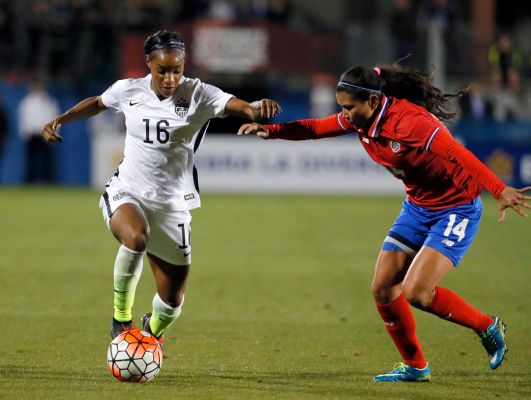
Regardless of the ultimate result, it will be exciting to see how well new star Crystal Dunn (who scored the only goal against South Africa and tallied again against Costa Rica) and starlet Mallory Pugh will fare in their first international tournaments for the senior team.

Dunn against Costa Rica (photo from newsday.com)

3.  Portugal, Sans Ronaldo, Wins the European Title.

So much for my wish that Cristiano Ronaldo would eat some crow during the 2016 UEFA Championship. The only saving grace was that he was injured during Portugal's win in the Final against France and spent most of the match on the sidelines (a little cruel, I know -- I wasn't hoping that it was a debilitating injury -- which it apparently wasn't).

I wasn't as upset about the fact that Portugal won (although France winning on home soil after all it's been through in the past year would have been nice), but the way that it accomplished the task. As mad as I get at South American teams for their diving, faked injuries, and time wasting, at least, on some level I feel as though they truly believe that it's just part of the game. The Portuguese, on the other hand, are so cynical in the way that the go about it that it's infuriating. 

After all of their disappointments at the international level, I suppose Portugal was due a few breaks in its favor.  And it got them through squandered opportunities by a French team that seemed, frankly, overwhelmed by the moment and one well placed strike by Eder that barely eluded French keeper Hugo Lloris, who seemed slightly out of position on the shot.

So a tournament that began with promise ended with a whimper (as did, to be fair, the Copa America) and Portugal got its trophy. And the beautiful game took a blow.

Wednesday, June 15, 2016

A Plateful of Soccer (Best Served Cold)

We've got the Euros all day long and the Copa America in the evenings. I'm already spoiled enough that I am perturbed that there are no Copa 100 games Wednesday before the quarterfinals start tomorrow.

As a result, writing choices abound ...

There were the U.S. men's spirited displays against Costa Rica and Paraguay (and we have to credit Jurgen Klinsmann some for that, don't we?) in not only overcoming a desultory 2-0 loss to Columbia in the first game of group play, but in ending up winning their group.

There is the game tomorrow against Ecuador, and perhaps a deserved backtrack from a certain comment about them being "minnows" in CONMEBOL when they currently lead its qualifying, are ranked 13 in the world, and have qualified for three of the last four World Cups.

But there was something even more compelling that happened on the other side of the pond.

Iceland is playing in its first major tournament ever, thanks at least in part to the expansion this year of the field at the Euros from 16 to 24 teams. But make no mistake, "Our Boys" (or "StrĂ¡karnir okkar" in Icelandic if you prefer) earned their way to the Finals by finishing second in their group in qualifying, beating The Netherlands at home and away in the process.

To put things in population perspective (as I'm want to do), Iceland's population is roughly 330,000 people, or a few thousand less than that of, yes, Kalamazoo, Michigan. As far as countries go, Iceland is wedged between Belize and The Bahamas (or 179 out of 209) in population of  FIFA member nations. But in the FIFA world rankings, Iceland is #34, between the Republic of Ireland and Sweden, and just three spots below the U.S.

The most recognizable Iceland player to international soccer fans is probably Eidur Gudjohnsen, who played, and played well, for Barcelona and Chelsea back in the day but is now 37 years old and did not start or appear off the bench for their first major competition match, against Portugal and Cristiano Ronaldo.

Interesting side note: Eidur Gudjohnsen and his father, Arnor, hold the unique distinction of being the only father and son to appear on behalf of their country in the same international match.  Arnor started the game, against Estonia in 1996, and Eidur, 17 at the time, came on in the second half as a substitute for his dad.  

In the Portugal match, Iceland, a true soccer minnow, tied mighty Portugal and Ronaldo 1-1. Iceland fought and scrapped and was a little bit lucky, but survived. Afterward they celebrated like, well, like a country that had just tied its first ever match in an international tournament against the eighth best team in the world and a player about whom my friend Mike would say "Ronaldo loves him some Ronaldo."

Portugal took the lead in the match, but Iceland, with one of the precious few chances it had, tied it 50 minutes in on a goal by Birkir Bjarnason, then held on for the next 40 minutes for the tie, surviving two Ronaldo free kicks deep into stoppage time.

Bjarnason celebrates his goal (photo from theguardian.com)

Was it particularly attractive soccer? No. But it was a demonstration of why soccer is great and why, sometimes, a team underskilled and undermanned (although, as is apparent from the picture, not undercoifed, even against pretty boy Ronaldo) can, for 90 minutes, make up for all of those deficiencies by playing gritty, desperate, team soccer.

“Iceland didn’t try anything,” whined the Portuguese captain. “They were just defend, defend, defend and playing on the counterattack. It was a lucky night for them. We should have three points but we are OK. I thought they’d won the Euros the way they celebrated at the end. It was unbelievable. When they don’t try to play and just defend, defend, defend, this in my opinion shows a small mentality and they are not going to do anything in the competition.”
To which Karo Arnason, an Iceland center-mid, responded: "tough shit."

I could add more about Ronaldo, but the Telegraph article is too well written to even try to challenge. So I leave you with these observations about Ronaldo while I hope you revel in the smorgasbord of soccer from which we are feasting, whilst Iceland parties like it's 999, and while I fervently hope someone is forced to eat a little crow:
But Ronaldo would not be Ronaldo if he did not view every single game as a stage for him alone to confirm his greatness, rather than an opportunity for any Tom, Dick or Heimar to seize their own 15 minutes of fame.
He is the ultimate back-garden bully, the kind of barbecue guest who would spend the afternoon doing step-overs past seven year-olds and nutmegging the neighbours’ arthritic collie. It is that mind-set which has made him great. You don’t score 487 career goals, including 50-plus a season for the last six seasons by routinely squaring to better-placed team-mates.
... you get the impression that even now, at the age of 31, it does not matter how luxurious the hotel suite – if Ronaldo has no goal to replay in his mind before lights-out, he does not get a good night’s sleep.

Wednesday, June 1, 2016

Glimmers of Hope

So what are we to think about the U.S. Men's National soccer team headed into the Copa America (or Copa Centenario, if you prefer)?

Consecutive wins against South American opponents in the past week? Good.

Those wins coming against traditional CONMEBOL minnows Ecuador and Bolivia? Not so good.

Four straight wins and a 6-1 record so far in 2016? Good.

The loss being in World Cup qualifying to Guatemala in a dismal 2-0 performance? Not good at all.

The introduction of new, exciting players like Darlington Nagbe, Christian Pulisic, and Steve Burnbaum? Good.

Continuing to rely on old, and old guard, players like Jermaine Jones and Kyle Beckerman, particularly in the demanding role of center midfielder? Not very good.

Obviously the upcoming Copa America will give us more information on where the national team is, and where it might be going, in World Cup qualifying and, hopefully, the 2018 World Cup itself. The recent wins have certainly quelled, for now, the anti-Klinsmann drumbeat that reached a crescendo after losses to Jamaica in the Gold Cup and Mexico in the play-in for the Confederations Cup last year.

While they are far from a guarantee for success in the upcoming Copa America, which will be against stiffer competition in a more meaningful setting, the Americans' luck appears to be turning after a dismal 2015. And not just on the field.

The U.S.'s opportunity to participate in the Copa, and indeed the entire tournament, was cast into doubt by the indictment or arrest of many top CONMEBOL and CONCACAF officials last summer and additional indictments for Traffic Sports, a major player in organizing (and skimming graft from) both the Gold Cup and Copa America. The importance of the tournament as preparation for the next World Cup cannot be understated, particularly after the ignominious denial of the chance to play in the Confederations Cup, participation in which was long touted by Klinsmann as essential to success in Russia, until it wasn't.

But whether through sheer will to actually celebrate the 100th anniversary of the competition, or the unappealing prospect of losing millions of dollars of revenue from the target-rich U.S. soccer market, the tournament will go on (although perhaps without Argentina).

While Klinsmann has talked about bringing new or younger players along slowly (hence not starting Nagbe or Pulisic against either Ecuador or Bolivia), this tournament seems the ideal opportunity to start determining whether they will be able to withstand the pressure of top flight competition in CONCACAF World Cup qualifying, particularly once it moves to the final stage (known as The Hex because of its six teams, the top three of which will qualify for the World Cup, and the fourth place team of which will advance to a playoff against the fifth place team from Asia).

The back line seems set with John Brooks and Geoff Cameron (assuming he's healthy) in the center of defense and Fabian Johnson and DeAndre Yedlin on the wings. Bobby Wood, Gyasi Zardes, and Clint Dempsey appear ready to play up front in some combination (particularly with the surprise exclusion of Jordan Morris from the squad) with Pulisic likely to come off the bench and Chris Wondolowski available to poach a last minute goal in a pinch. 


Pulisic celebrates his goal against Bolivia, which made him the
youngest goalscorer for the U.S. Men in the modern era.
(photo from www.dailymail.co.uk)

That leaves three players to man the midfield (although Zardes could play wing or Dempsey as a withdrawn forward or attacking midfielder at the top of a diamond). Michael Bradley is a shoo-in, of course. Alejandro Bedoya was, for my money, perhaps the Yanks' best player against Bolivia and seems unlikely to be left out of the starting 11 (as long as Klinsmann doesn't insist that he play in the back).

There has to be some bite, which Jones normally provides. Klinsmann could go with two defensive mids with Jones and Beckerman, but that seems unlikely, particularly given Beckerman's lack of mobility. Equally unlikely is abandoning the defense altogether and playing both Nagbe and Bedoya along with Bradley.

While Jones is an acceptable choice this summer, it's hard to see him as capable of being one in Russia. I'd like to see Klinsmann try Bradley at the bottom of a diamond with Nagbe and Bedoya the linking midfielders and Dempsey at the tip. But that's unlikely to happen since Klinsmann has insisted for more than two years now that Bradley's best position is up the field leading the attack, and for the most part Bradley has proved him right.

Another option would be to recognize that Dempsey may be too old by the time 2018 comes around and put Bradley at the top, with Nagbe and Bedoya behind, Cameron in the defensive/deep-lying mid position, and Burnbaum or Matt Besler in the center of defense with Brooks.

Given the heat that Klinsmann took last year over the team's performance it's understandable that he is reluctant to sacrifice results for experimentation in the Copa. But, in the long-term, that may be exactly what this team needs. Regardless, it's nice to talk about the options available to him, which seemed in very short supply last fall.

Wednesday, May 4, 2016

The Rise of Leicester City ... and Donald Trump

Two weird and miraculous things happened this week, one in England and one in the United States.

One says a lot about soccer and the other about our nation, the latter not in a particularly flattering way. But they are, I believe, connected.

In the English Premier League, Leicester City, a soccer club that had never won a championship at the highest level of English football in its 132 years of existence, triumphed over the biggest clubs with some of the highest payrolls in the world, clinching the title when Tottenham Hotspur could only manage a draw against London rival Chelsea. Spurs' tie put Leicester's seven point lead out of reach with two matches to play.

To put things in perspective, the metropolitan area of Leicester has about the same population as that of Kalamazoo, Michigan, while Spurs and Chelsea have that of, well, New York City (if you need something other than London as a reference). The Foxes' payroll was 17th in the Premier League at about 48 million pounds (or approximately $70 million), certainly nothing to sneeze at, but chump change in comparison to the 110.5 million pounds ($160 million) that Spurs spent to finish first last or the 215.6 million pounds ($312.5 million) that Chelsea paid out to finish ninth.

Leicester's heroes are easy to identify now, but would not have been recognized as such until very recently: leading scorer Jamie Vardy was playing non-league football four years ago; midfield wizard Riyad Mahrez was signed for a pittance two years ago; and manager Claudio Ranieri, of whom Jose Mourinho once famously said was "almost 70 ... and hasn't won anything" (Ranieri was 56 at the time), really hadn't ever won much of anything.

Mahrez (left) and his notably diverse teammates celebrate a goal.
(photo from theguardian.com)

The Foxes are the type of club that, if they weren't English, would embody the American dream. They are the epitome of grit and determination; of punching above your weight; of believing in your collective self when all around you don't even give you a thought, let alone a chance. Theirs is the story of immigrants and itinerants, of castoffs and factory workers, pulling themselves up by their bootstraps and making something wonderful of themselves collectively: The whole greater than the sum of the parts. How much more American can you get?

That's what I used to believe the American ideal was. But that was before Donald Trump, whose apparent ascendence to the Republican nomination for President is the second phenomenon of the week.

We are now, or at least a significant minority of us are, the inconsolably aggrieved. We're not interested in helping ourselves. We are unhappy with the changing world around us and instead of figuring out how to fix it, or how to adapt and lead the way as we have done for a century, we prefer to attach ourselves to a bully, a lying huckster offering not fixes but simply to point the collective middle finger of blame anywhere but at ourselves.

When asked to explain their support of a narcissistic shill with no sketch for the future let alone a road map, Trumpites resort to calling him "genuine" and "believable" and ascribing to him similar traits only slightly more oxymoronic than the notion of a billionaire populist.

There's no thought to how we might actually make America great again (even if we're not, or even if we can). Just the mindless choosing of the easy way out by blaming others and yearning for what some assumed to be a birthright - to be at the top of whatever little heap we had mentally staked out as our own.

When conservative talking heads bash soccer as being "un-American" I used to just ignore it as simple pandering. But, turns out, they may be on to something. 

If Leicester City is the new soccer, and Trump the new America.

Saturday, April 9, 2016

Killing The Goose?

"We are the best in the world" said Hope Solo in announcing her support for the EEOC complaint filed by her and four other members of the U.S. Women's National Soccer Team this past week against the U.S. Soccer Federation.

Setting aside concerns that Solo provided bulletin board material for 15 other national teams (and that she would have the temerity to bite the hand that not only fed her but provided support when she faced a domestic violence charge  (yes, I just linked to a People Magazine article) that could have ended her World Cup hopes, if not her career, last year), while Solo's statement is completely defensible given that the team is the reigning World Cup and Olympic champion, it does not conclusively prove the players' case.

Too easy, I know (photo from businessinsider.com)

By now my support of women's sports in general and soccer in particular should be well-established. I believe in level playing fields (and similarly surfaced playing fields) for men and women.

But equal opportunity does not necessarily mean equal pay.

While I am all for the women receiving pay commensurate with their work and the money that they generate for U.S. Soccer (and with their male counterparts if they are entitled to it) I'm not sure that this lawsuit is the best way to try to accomplish that. In fact, a victory for them could actually be detrimental to many of their professional soccer playing peers who are good, but not good enough to play for the national team.

The men's team and the women's team are governed by separate collective bargaining agreements, under which the men are paid substantially more for performances in international matches. Important, lawyer-type note: just because you're subject to a collective bargaining agreement does not mean that you are prohibited from bringing an equal pay claim. According to one article, when playing in an international friendly, the men can earn as much as $17,635 in bonus money for a win, $8,125 for a tie, and $5000 for a loss.  The women, meanwhile, receive a $1,350 bonus for winning a friendly, nothing if they tie or lose.

But the ways in which the men's team and the women's team members are compensated are hardly apples to apples. The men are paid strictly on a bonus system while the women are paid salaries and receive benefits more akin to those of traditional employees - severance pay and "various types of insurance" - that the men are not.  And they are also paid salaries as National Women's Soccer League players, which is where the crux of the problem, and the danger in the players' suit, lies.

U.S. Soccer, with some help from the Canadian and Mexican federations, helped start and is presumably helping keep the NWSL financially afloat. It doesn't take a photographic memory to recall the fate of the two U.S. women's professional leagues that preceded the NWSL (but it may to name them), both of which succumbed to a combination of poor management and, frankly, lack of interest in non-World Cup and Olympic seasons. It appears that the players' suit does not take into account the money that U.S. Soccer has spent to start and sustain the NWSL. [In my original post, I surmised here that the federations pay the salaries of non-federation players in the NWSL. After further investigation, I don't believe that to be the case. While information regarding NWSL individual players' salaries is not disseminated, it appears that the league pays non-federation players, while the federations only pay those of "allocated players" from one of the three participating federations. Nonetheless, the suggestion that U.S. Soccer pays the salaries of the highest-paid players in the league appears to be correct.]

The league has benefited those players, who would not otherwise have an opportunity to play professional soccer, by both giving them that chance and proving that they are worthy of consideration for the national team. Crystal Dunn, for example, was the last player cut from last year's World Cup team, but proved her mettle by being the leading scorer in the league last season. Restored to the roster, she scored five goals against Puerto Rico in the Olympic qualifying tournament and appears to be poised to play a significant role for the team in Rio.

Setting aside U.S. Soccer's apparently well-taken position that the players and their attorneys cooked the books by focusing on income from last year (when the women won the World Cup in Canada and embarked on an extended victory tour), its claim that the men's team's games over which it has control (i.e., non-World Cup games) have audiences double those of the women, and that U.S. Soccer has been at the forefront, world-wide, of commitment both to the women's game and to cajoling or compelling FIFA to support women's soccer and women in positions of power within FIFA, there's a more fundamental concern that I have with the players' complaint and the future of women's soccer in the U.S.

Where is the money to come from to pay the players if they succeed?

Unless U.S. Soccer adopts FIFA's more ... creative ways of generating income, the funds to pay a large increase in player compensation may well result in a reduction of its financial commitment  to the NWSL. And while the national team players may or may not care, that would be detrimental to the long-term health of women's professional soccer in the U.S., and perhaps to the national team as well. 

This may all be much ado about next-to-nothing. The Soccer America article suggests that the true motive for the EEOC complaint may be simply to gain leverage in the players' on-going negotiations with U.S. Soccer over a new collective bargaining agreement, particularly in light of U.S. Soccer's filing of its own complaint in February, in which it seeks court confirmation that the current collective bargaining agreement runs through the end of 2016 (fearing, presumably, a work stoppage by the players shortly before or during the Olympics).

But if it is not, if the players pursue their complaint beyond the Olympics or the (hopeful) signing of a new collective bargaining agreement, then I fear for the future of women's professional soccer in the U.S. That may or may not be of concern to Solo and her fellow litigants. But it should be to the rest of us.