Thursday, June 12, 2014

Oh Please

I'm going back on my word to not post again before the World Cup starts. I'll just eke this one under the wire. And all at the risk of appearing a bigger and bigger Jurgen Klinsmann apologist. Or his lawyer.

Still, I'm about to start tearing my hair out. And this is good therapy.

The newest hubbub surrounding Klinsmann concerns his comments, made  in a New York Times Magazine article and repeated yesterday at a press conference in Brazil, that it is not realistic to talk now about winning the 2014 World Cup.

The media and the social media sphere went into a frenzy. "That's un-American!" was the general theme. Since Alexi Lalas has blathered on for months about how we ought to go into this World Cup planning to win or we shouldn't bother showing up, I'm sure he made plenty of comments along those lines last night on ESPN's two-hour extravaganza previewing the tournament.

I'm not sure that he did because the show was so painfully bad that I couldn't watch for more than a minute at a time. ESPN paraded out panels and panels of so-called experts, most of whom speak English with one unintelligible accent or another. Including a woman from the UK who will be some sort of studio host and immediately flubbed her second line on the show. Why does ESPN insist on having foreigners talk to us about soccer? I'm sure Julie Foudy could do her job more intelligently and intelligibly than she. Michael Ballack was particularly ill at ease, which would have made continued watching a little like gawking at a wreck. I was tempted, but kept driving at normal speed and ended up in South Park, Colorado instead.

But I digress. While I can only assume Lalas's indignation, there are plenty of examples in print. The devastating observations of Gregg Doyel, (a columnist for cbssports.com whose bona fides are that he "covered the ACC for the Charlotte Observer, the Marlins for the Miami Herald, and Brooksville (Fla.) Hernando for the Tampa Tribune. He was 4-0 (3 KO's!) as an amateur boxer, and volunteers for the ALS Association" Alrighty then, he's got the credentials!) are one example.

Doyel goes on, and on, and on shaking his pompoms and rattling his saber, using the tired trick of repeating Klinsmann's statement in italics while railing about how it's obvious from the statement that Klinsmann ain't "from around here" and that he has a lot to learn about American guts and ingenuity, blah blah blah. Another noted soccer journalist, Mike Wilbon of ESPN, apparently took umbrage with Klinsmann's questioning of Kobe Bryant's salary in the article and told Klinsmann to "[g]et the Hell out" of the country. 

The only problem with Doyel and his ilk is that they are taking Klinsmann's statement completely out of context. Klinsmann did not say and has not said that the U.S. cannot win this World Cup. He has simply said that now is not the time to talk about it. 

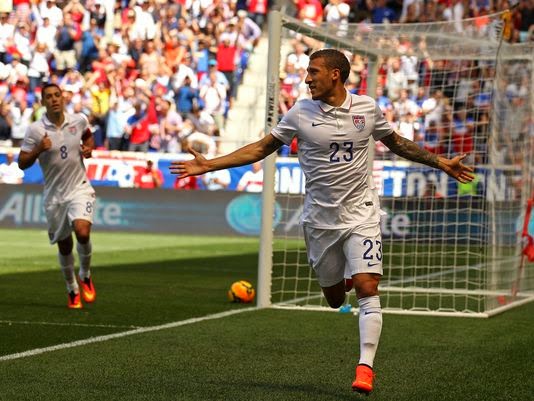
Clearly uninterested in winning (photo from nytimes.com)

Klinsmann's exact quote yesterday, as reported by several different sources was: 
"I think for us now talking about winning a World Cup is just not realistic,” he said. “If you do it like Greece in 2004, I think that nobody from Greece would have said, ‘We’re going to win the European Championship,’ but they did. At the end of the day, soccer, the beautiful thing is it’s unpredictable. You don’t know what happens.
“First we’ve got to make it through the group," he says, "so let’s stay with our feet on the ground and say, ‘Let’s get that group first done,’ and then the sky is the limit. But before and half-a-year before and even now (a day) before the World Cup starts, to say that we should win the World Cup is just not realistic.”
Makes sense, right? Brazil has won five World Cups. Italy has four. Germany has three. The U.S. has been to one semi-final, in 1930 when no one was paying attention. Klinsmann is merely saying "let's not get ahead of ourselves here. There are countries that can realistically say before the World Cup 'we want to win.' Or even 'we expect to win.' But the U.S., with its pedigree, is not yet one of them. Let's get through the group and then see what happens."

Over and over everyone reports, or even defends, the comment as "Klinsmann: Unrealistic for U.S. to expect title." But the quote was "for us now talking about winning a World Cup is just not realistic." Now, as in right now or "half-a-year before." I am not parsing words, just taking them at face value. And what Klinsmann clearly said was absolutely correct, absolutely defensible, and absolutely coach speak. Let's take one game at a time. Let's put one foot in front of the other. Let's talk about our chances of winning a World Cup sometime after we make it out of the Group of Death.

I don't know what works the rabble rousers into their collective froth about Klinsmann. Is it the temerity that he showed to come from another country to coach "us"? Is it axing Donovan? Or is it just the usual soccer haters who seize the opportunity to throw cold water on the American psyche when once every four years (or two if the women do well) millions more Americans pay attention to soccer than the rest of the time?

Any way you choose, perhaps they could begin to show at least a shred of journalistic integrity by accurately quoting the man before excoriating him for something he did not say. Or just simply keep ignoring the game as they do the rest of the three years and eleven months of every four years.

Go back to covering high school football. We've got soccer to watch.

Tuesday, June 10, 2014

The Trick Up His Sleeve

I ended my post about the U.S. vs. Turkey match saying that Jurgen Klinsmann might have trick or two up his sleeve before the first World Cup match against Ghana next Monday.

Turns out he had at least one, and we didn't have to wait until that game to see it.

The U.S. won its final warm-up match before Brazil, beating Nigeria 2-1 with two goals from Jozy Altidore (the first among the easiest he'll ever score, the second a vicious strike from 12 yards out).  Nigeria pulled back a consolation goal on a penalty kick in the 86th minute to ruin keeper Tim Howard's shut out in a match in which he won his 100th cap for the Stars and Stripes.

The U.S. rolled onto the pitch against Nigeria in a formation featuring two defensive midfielders (Kyle Beckerman and Jermaine Jones) and no true left winger. That left Graham Zusi on the bench (apparently confirming the opinions of those who were less than impressed with his performance against the Turks) and the Americans with no right wing. While a departure from the previous two matches, this was the formation that had guided the Yanks through qualifying, including topping the Hex for the third straight time.

As predicted, Alejandro Bedoya was back at left wing against Nigeria after making way for Brad Davis in the Turkey match and DeMarcus Beasley was again at left back in place of Timmy Chandler, unimpressive against the Turks.

Contrary to what you might imagine, this formation actually created more chances than did the one used against Azerbaijan and Turkey which featured two forwards, two out-and-out wingers and two center-mids. Dempsey played more like a withdrawn striker than a partner alongside Altidore, Jones was more offensive, often drifting out wide (but tracked back as well), and Michael Bradley bossed the midfield and teamed with Dempsey to direct the attack.

This allowed more room for Altidore to roam, and also opened up the wings for marauding attacks from Beasley and right back Fabian Johnson who was brilliant offensively once again. Bedoya lacked quality in the attacking half of the field, but his defensive work was a big improvement over Davis's. Nigeria had the majority of possession in the first half but never looked particularly threatening, while the Americans' counterattack always looked likely to score.

The U.S. defense was solid most of the game. Central defenders Matt Besler committed a late foul that was whistled for a deserved penalty, but while he has been downgraded by some for the foul (and his play in general), the penalty was largely the fault of Omar Gonzalez, who came on late and was badly beaten by a Nigerian attacker in the build-up that resulted in the penalty and the goal.

Beckerman (15) sorts things out with Cameron and 
Besler (5) in the Nigeria match. (photo from usatoday.com)

After dominating the African champions, it seems likely that the U.S. starting 11 against Nigeria will take the field in the same formation against Ghana. It remains to be seen whether the U.S. has the strength and speed in the midfield, and the familiarity and organization in the back, to deal with the Ghanaian attack. But Beckerman's insertion into the line-up gives some hope for a more organized defense and a more creative attack.

And that hope is needed after Ghana demolished South Korea 4-0 last night in its last tune-up for Brazil. While the scoreline is intimidating, apparently Ghana did not dominate play as comprehensively as it indicates and South Korea was hurt by poor finishing.  Still, Ghana is spoiled for choices in the midfield and up top and will probably give the U.S. more to worry about as far as attacking options go than will Portugal.

Klinsmann appears to have this group as ready as it can be for the Group of Death. Two teams will survive, that much we know. Klinsmann has admitted that a win over Ghana is essential to the U.S. being one of those two. The time for analysis is over. Only the true test on the field remains.

Monday, June 2, 2014

What Have We Learned So Far?

We can assume, barring injury, that these players will be in the starting eleven when the U.S. men's team takes the pitch against Ghana on June 16 in Natal: Tim Howard, Matt Besler, Jermaine Jones, Michael Bradley, Clint Dempsey, and Jozy Altidore. 

So that leaves us with the questions of who will man the position alongside Besler in the center of defense, who the two outside fullbacks will be, and who the two wings will be.

Against Azerbaijan, Jurgen Klinsmann started Geoff Cameron at center back, DeMarcus Beasley (left) and Fabian Johnson (right) at fullback, Alejandro Bedoya (left) and Graham Zusi (right) on the wings. Many who know more than me thought that this line-up was also the one likely to start against Ghana and at least one blogger noted that it is arguably "the best eleven players that the U.S. has on the roster." Dempsey didn't start after having some discomfort in his groin while warming up for the match (Chris Wondolowski started in his place), but Dempsey's place is in the lineup is a foregone conclusion.

Omar Gonzalez seemed a lock a few months ago to start at center back, but some nervy play and a tweaked knee seemingly have him on the outside looking in for a starting spot. Beasley started the final qualifying matches at left back, almost out of desperation, and did passably well and was the clubhouse leader to man that position in Brazil as well.

Howard, Besler, Cameron, Jones, Bradley, Dempsey, Altidore, Johnson and Zusi started, in the same positions, against Turkey on Sunday. Brad Davis and Timmy Chandler manned the left wing and back positions, respectively, in place of Bedoya and Beasley. Neither Beasley nor Gonzalez played at all, even though Klinsmann used all six of his substitutes.

The U.S. won the match 2-1 thanks to a marvelous one-two from Johnson to Bradley and back that earned Johnson his first international goal for the U.S. and man of the match honors (along with his defensive play). Dempsey added a tap-in following a mistake in the Turkish defense before the U.S. surrendered a late goal on a penalty kick awarded after Cameron handled the ball in the box (on a play that was started by a bad defensive mistake by Chandler).

Johnson celebrates his goal (photo from usatoday.com).

My impression was that all who have started both matches did nothing in either one to severely hurt their chances to start on June 16. Being the dutiful blogger (and researching lawyer) I decided to see how soccer experts rated the U.S. performances against Turkey. The results confirmed that, much like legal research, there is no clear answer, only varying opinions. Some rated Zusi's performance highly. But Soccer America found his performance the "[m]ost disappointing of the projected World Cup starters."

That Chandler was the weakest link on the pitch was agreed to by most if not all the commentators. And if not him, then the honor went to Julian Green, the 18 year-old starlet who looked overwhelmed by the enormity of the situation after coming on as a substitute and who, honestly, should not see the field for any of the matches in Brazil.

Brad Davis, while putting in some good crosses, did nothing to lead one to conclude that he should start instead of Bedoya. His lack of pace and inability to consistently defend his side of the field probably put more pressure on Chandler than would allow a completely fair assessment of Chandler's play.

One interesting option for Klinsmann would be to play Johnson at left fullback instead of the right, where he has started both friendlies. Johnson played both left back and left wing for his club team, Hoffenheim. But Klinsmann likely has Johnson at right back to allow his best outside defender to match up with the likes of Cristiano Ronaldo in Brazil.

Johnson on the left would enable Klinsmann to start Davis, who offers more interesting offensive options than Bedoya and, if Davis pinches toward the middle as he often does, allow Johnson to make more effective offensive runs from the back. That would likely leave the right back position to DeAndre Yedlin another youngster (he's 20) who has buckets of pace but seems to rely on it at the expense of proper defensive positioning (Ronaldo would likely tear him up).

Or Klinsmann could move Cameron to right back, the position he plays for his club, Stoke, in the English Premier League, and start Gonzalez in the center of defense with Besler. But to do so would seemingly sacrifice the speed that Klinsmann values in his full backs.

All in all, it seems that those three positions, left back, left wing, and right back are the only ones up for grabs. And that Johnson will start at one of those outside back spots. So who's it going to be between Davis, Bedoya, Beasley, Johnson, and Gonzalez? My guess is Bedoya and Beasley. Saturday's match against Nigeria may tell us for certain.

Or Klinsmann may have one or two tricks up his sleeve yet ...

Friday, May 23, 2014

Donovan Out; Wondo In

I could say I saw this coming.

Then again, I could say I didn't.

I admit that after his performance during last year's Gold Cup I thought that Landon Donovan had secured a place on the 2014 U.S. World Cup team. But a lot has happened since then. 

Donovan's poor form in MLS so far this season (he has yet to score and while he has two assists, has not significantly influenced the L.A. Galaxy's performance this year) for one. And Donovan's admission that his age (or his current physical or mental condition) no longer allows him to train as hard for as many days in a row as he used to be able to for another.

Ultimately Donovan's form, age, and competition from younger or more in-form players led Jurgen Klinsmann to leave Donovan off of the 23-man roster that will travel to Brazil. The reaction from fans and pundits of the team has been vocal and varied.

Some believe that the decision will be disastrous for the team. Some believe that it's indicative of Klinsmann insuring that everyone understands that he, and he alone, is in charge. Others believe that it was warranted or even inevitable. 

I just don't see this as a display of power by Klinsmann. If anything, I believe that he clearly established last year that this is his team, not Donovan's or anyone else's, when he excluded Donovan from the squad for a series of friendlies and qualifiers. 

As for all the fans and supposed experts who criticize the move as stupid or wrong or biased I can only say: "Shut. Up."

I'm particularly sensitive to individuals who are wont to second-guess strategic coaching decisions, especially those who arrive at their conclusions based on what they've read or heard or seen on television. Most have no idea what has gone on at practice, in the locker room, in Klinsmann's conversations with his staff, or in his head.

Unless we start with the premise that Klinsmann is intentionally making decisions that are bad for the team and its chances for success in Brazil (which is nothing short of crazy), now hardly seems to be the time to criticize them. Does the specter of Donovan bearing down on them strike more fear into Portugal's or Germany's or Ghana's defenders than, say, Brad Davis or Julian Green? While the armchair managers certainly seem to think so, on what possible basis can they reach that conclusion other than pure speculation?

If the U.S. trails late in a match and Donovan isn't there to be brought off the bench, no doubt some will point to that moment (if the Yanks don't rally) as proof of Klinsmann's mistake. But in all likelihood the player that Klinsmann has in mind for that situation is Chris Wondolowski, whose inclusion in the roster is a cause for celebration. 

Wondolowski played college soccer for NCAA Division II Chico State, then worked his way through the reserve teams of the San Jose Earthquakes, the Houston Dynamo, and then San Jose again before bursting on the scene with the senior San Jose squad in 2010. Wondo made his first national team appearance at the advanced age of 29, scored his first international goal in last year's Gold Cup at 30, and followed that up four days later by notching a hat-trick against Belize while wearing a shirt with the misspelled "Wondowlowski" on the back.

Making a name for himself, even if the wrong one.
(photo from prosoccertalk.nbsports.com)

Wondo has earned a reputation for hard work and for being a consummate poaching forward. He doesn't always look pretty doing it, but the guy just scores goals when he's supposed to, and sometimes when he isn't. In other words, just the player you want to come off the bench late in a match when a goal is needed.

Surely, Klinsmann turned just such a scenario over in his head when deciding who to include on the roster. As well as who to use for late match set pieces (Brad Davis) or who may provide some late match toughness in the midfield (Kyle Beckerman), or who could serve as a replacement for a potentially suspended Jermaine Jones (Beckerman again).

As with the end of my last post, I note again that whether Klinsmann's 23-man roster is the "right" one will be proven, at least in part, by how those players perform in Brazil. Or, perhaps, even in qualifying for (and hopefully at) the 2018 World Cup.

But, for now, let's let Klinsmann be the coach and we be the fans, nothing more and nothing less. And let's celebrate Donovan's career as one of the best player to ever put on the shirt of his nation's team. And let's celebrate the fact that a guy whose name that team couldn't even spell right a year ago will don that same shirt (for the first, and probably last, time) at this year's World Cup.

Post Script: Came across this blog post while researching my next one. Eeriely similar to mine. I swear I hadn't seen it when I wrote mine.

Wednesday, May 21, 2014

Two Not So Fitting Farewells - Part Two

Meanwhile, over on the XY side of things, last week Jurgen Klinsmann announced his preliminary squad of 30 players that will go to camp in California to train for the World Cup this summer in Brazil.

There were no real surprises on the list, including the omission of Eddie Johnson from the team. And while not surprising, and seemingly handled well by Klinsmann, Johnson's omission is unfortunate given his service to his country's team.

While Klinsmann kept his word and chose players for the squad who were, for the most part, performing well for their clubs (Landon Donovan being one notable exception), it's not easy to forget Johnson's play during the CONCACAF qualifying rounds that was one of the biggest reasons that the U.S. is going to Brazil in the first place.

The men struggled early in the third round of qualifying and, with a record of 2-1-1, were playing away to "minnows" Antigua and Barbuda. In danger of coming away with no better than a draw, Johnson  scored both goals in a 2-1 win, including the game winner in the 90th minute.

Then Johnson made appearances in eight of the Hex (fourth round) qualifying matches, scoring two goals including the game winner in the latest Dos a Cero victory over Mexico in Columbus.


But that was while Johnson was flying high and scoring goals for the Seattle Sounders last MLS season. After finding success in MLS with Dallas and Kansas City, his career had taken a wrong turn in stints in the English Premier League and the English Championship, only to be revived in 2012 and 2013 with Seattle.

After last season, Johnson, feeling he was underpaid, essentially forced a trade from Seattle to D.C. United (Seattle was unable to meet Johnson's wage demands because of the MLS salary cap). While the salary increase was merited, Johnson didn't do his potential spot on the national team any favors by moving to the team with the worst scoring record in MLS history in 2013, or by explaining his scoring futility since joining D.C. by saying that in Seattle he was fed by "better guys that had more quality on the ball."

Johnson's complaint and the resulting fallout were consistent with the general perception of Johnson, which that he is moody and not a team player. In explaining why he had felt compelled to explain to his teammates why he threw them under the bus, Johnson said: "I don't want them to think I am better than them. That's always been the perception of my career: I'm a prima donna, I'm a bad teammate, I'm bad in the locker room. That's not the case." 

Klinsmann specifically said that the incident "had nothing to do with the decision" to not name Johnson to the 30-man squad, instead implying that Johnson had simply fallen behind other players vying for forward spots on the team. And it is arguable that Johnson's exclusion is less painful now than it will be for the seven players who will train in Palo Alto and participate in the friendly matches between now and June 2 only to not make the 23-man team that will travel to Brazil.

Klinsmann has more difficult decisions ahead in determining the
final roster of 23 that will play in Brazil. (photo from ussoccer.com)

It is, however, a bitter pill for Johnson to swallow, particularly given his role in getting the team to Brazil in the first place. And another example of how U.S. soccer has become both more internally competitive and more cold-hearted. Perhaps that's what we need to be able to compete with the best in the world. It will be up to Klinsmann and those 23 players with him in Brazil to prove that we can on the pitch as well as we recently have off of it.

Tuesday, May 13, 2014

Two Not So Fitting Farewells - Part One

You could take two recent decisions involving the U.S. Men's and Women's national teams as good signs. As indications that we are big time now, that we make heartless decisions based on what we think is best for our programs, nothing more and nothing less.

Or you could see it as the passing of an era, from a time when our national soccer teams, perhaps to a fault, recognized past service or gave longer leash to a coach because it was the right thing, even if it wasn't necessarily in the best interests of the team (Briana Scurry starting in the 2007 World Cup semifinals instead of Hope Solo comes to mind, but perhaps then-coach Greg Ryan would disagree, since the fallout from that determination cost him his job).

The first decision involved the "shocking" dismissal last month of Women's head coach Tom Sermanni. Unlike Pia Sundhage's last game, there was no celebration after Sermanni's last match as coach, in which the U.S. beat China 3-0. In fact, other than Sunil Gulati and perhaps handful of others, no one knew that it was Sermanni's last match.

That victory came on the heels of a disappointing performance by the squad in the Algrave Cup, an annual women's tournament held in Portugal. The U.S. drew with eventual runners-up Japan in their first group match before losing to Sweden 1-0 and to Denmark by a shocking 5-3 score. Sweden is now coached by Sundhage, adding insult to the injury of a seventh place finish.

Sermanni coaching during the match vs. Japan at the Algrave
Cup. The team's performance at the tournament was at least a
part of his undoing. (photo from soccerblog.dallasnews.com)

While the team's performance in Portugal was admittedly underwhelming, it did not seem to be sufficient justification for a change. The termination came as a shock to Sermanni who is universally beloved by his players and seemingly deserved better, or, at the least, some notice that a change was being considered.

In the aftermath of the firing, pundits offered varying theories on the reasons for and the timing of Sermanni's departure. With CONCACAF Wold Cup qualifying set to take place in October for the 2015 Women's World Cup to be held in Canada, time is short for another coach to impose his or her vision on the team.

Gulati denied that a player revolt provoked Sermanni's dismissal, but it's hard to believe that the veterans of the squad were happy with Sermanni's habit of thrusting players new to the national team into starting spots (and, in particular, leaving Abby Wambach on the bench for the entire match against Japan and for all but five minutes against Denmark). Gulati did admit in his press conference that he gained information from "people in and around the team" that played a role in the decision, along with an assessment of "where the team's going and heading," and the performance in Portugal.

It's inconceivable that the decision was made with anything other than the best of intentions - clearly, Gulati and others in the U.S. Soccer brain trust thought the team was headed in the wrong direction (or, more likely, in no particular direction). With a qualification tournament upcoming that was nearly the team's undoing four years ago (remember the loss to Mexico? the play-off matches against Italy?) surely part of what played into Sermanni's firing was that if a change had to be made, it had to be made soon.

So, Sermanni wasn't the answer. Fair enough. But who is? The anticipation was that a new coach would be named by early May, but it's nearly the middle of the month and still no new coach. The list of candidates, frankly, isn't that inspiring (although Sundhage's former assistant, Tony Gustavsson, is an intriguing option). And time is growing short.

One thing is certain: if we are in a new, cold world of soccer with our women's national team, the choice this time had better be the right one. Or heads other than just the next coach's ought to roll.

Sunday, May 11, 2014

Soccer the Way It's Meant to Be

That was my tweet as I sat in the stands at Sporting Park in suburban Kansas City, soaking in the atmosphere before Sporting Kansas City's match against the Columbus Crew last Sunday. And I think I got it just right.

The crowd was fantastic throughout, singing, chanting, banging on drums and rooting their club on. And, I have to admit, that while I've supported the Crew since their inception, I certainly got caught up in the atmosphere and understood why the fans loved the team and that the feeling was clearly reciprocated by the players. Maybe that's why I wasn't the least disappointed that KC won the match 2-0.

Sporting KC's magnificent facility.

The contrast between the Kansas City crowd and those at Crew games was stark. While, admittedly, the Crew haven't given their fans a whole lot to cheer about in the past few years, the suspicion sneaked over you that there was something more fundamental at work - that the KC fans have embraced the sport and their club, while the Columbus fans have not, and probably never will.

More's the pity because the clubs are siblings of the same father - Lamar Hunt, one of the founding members of the MLS originally owned both franchises. But while, despite its professional football and baseball teams, the Kansas City area has become fervent about professional soccer, Columbus has not.

Rather than dwelling on the contrasts between the two franchises, however, I found more comfort in contrasting my experience at Sporting Kansas City Park with that of the first few MLS matches I ever saw in person. They were Crew games at what was then a decrepit Ohio State Stadium. Even putting aside my person distaste with regard to the facility and its regular tenant, it was a cold tomb in which the 10,000 or so in attendance on a good day were swallowed up by 80,000 empty seats.

From those humble beginnings, MLS has grown to scenes like those I witnessed last Sunday, on a beautiful day, with the sun streaming down on the natural grass pitch in a beautiful stadium dedicated to professional soccer. And similar scenes play out every weekend from one coast to the other, particularly in Seattle and Portland (although both have Field Turf pitches, which I can personally attest is beneficial where grass doesn't grow well, but is still not real grass) and Salt Lake City and Philadelphia and Houston.

Columbus corner kick in front of the "Cauldron".

We have become a soccer nation. And, at least some times, we play soccer the way it's meant to be.