Friday, December 14, 2012

Favorite Songs of 2012 - Songs 21-30

Here is the start to my list of favorite songs from 2012. As with last year's posts, and my Facebook posts from 2009-2010, these are songs released either in this year or the past year. A few entries, and a few more artists, appear on some real music critics' lists for 2012, but I assure you that is merely coincidence.

21. Everybody Talks by Neon Trees.

"Hey honey you could be my drug.
You could be my new prescription.
Too much could be an overdose;
All this trash talk make me itchin'."


Close to a guilty pleasure. But a pleasure it is.

22. Gold on the Ceiling by The Black Keys.

"Clouds covered love's barbed-wire snare.
Strung up, strung out, I just can't go without."


A little blues, a little straight-up rock 'n roll (T-Rex, perhaps?).

23. Grand Optimist by City & Colour.

"I fear I'm dying. From complications.
Complications, due to things that I've left undone.
That all my debts will be left unpaid,
feel like a cripple without a cane.
And a jack of all trades
who's a master of none."


I could see that it would suck, growing up a pessimist with an optimistic dad.

24. North Side Gal by J.D. McPherson.

"I got some good talk, but not enough game.
Wooing the sweet thing; oh ain't it a shame.
Every time I try.
Crazy about a north side gal."

 
The juke joint is rockin'.

24. JERK! by Stephie Coplan and The Pedestrians.

"Cut the small talk, cut to the chase, cut the cord, cut the crap.
Set the mood, set the tone, set the vibe, set the beat, set the trap.
Appear unimpressed with the dress that I bought today just for this.
Think of someone else while you're giving me that half-hearted post-sex kiss."


Stephie sent me a personal note enclosing her cd that I ordered from the band's website. If that doesn't get you on my list, nothing will. 

26. Love Interruption by Jack White.

"I want love to
forget that you offended me;
Or how you have defended me
when everybody tore me down.
Yeah and I want love to
change my friends to enemies;
change my friends to enemies,
and show me how it's all my fault."


A little dark, even by Mr. White's standards.  Love the video -- makes the lyrics seem plaintive rather than angry.

27. Bloody Mary (Nerve Endings) by Silversun Pickups.

"See you laughing in a picture;
but I know it's out of place.
You barely cried.
But you made it out alive."


A perennial list resident. I have no idea what the "artsy" parts of the video symbolize.

28. Hold On by Alabama Shakes.

"So, bless my heart. And bless my mind.
Got so much to do. I ain't got much time.
So, must be someone up above sayin':
C'mon girl. You got to get back up!"


I would love to see them live.

29. Songs for Teenagers by Fake Problems.

"Last night is all a blur to me.
I don't remember anything.
But at vaguely recall
being alone."


Sounds like a happy song. Until you listen to the lyrics.

30. Country Roads by Mike Doughty.

"Almost heaven, West Virginia.
Blue Ridge Mountains, Shenandoah River.
Life is old there, older than the trees.
Younger than the mountains, blowing like a breeze."


One of my favorite artists, singing about my favorite state.

Sunday, December 9, 2012

Learning to Live with It

If you follow women's soccer, or the tabloids, you've probably heard about Hope Solo's drunken bachelorette/bachelor party/melee, followed by her appearance at a hearing on domestic battery charges that she brought against her fiancee (now husband), a former NFL player with an impressive history of run-ins with the law including DUI, possession with intent to distribute, and, most disturbingly, sexual assault.

Various folks have weighed in on what should or should not be off limits with regard to Solo and what appear to be some questionable life choices (not that that should be particularly shocking given her public declarations in the past). But my take is a little different. It's about the choices that coaches and teams are sometimes forced to make.

Coaches are fond of saying that they have one set of rules that applies to all players. But they know, and the players know, that that's not always the case.

At any level, coaches have to make adjustments and even exceptions for exceptional players. And they have to depend on the players to understand that it's for the good of the team that they do so, even if  the players that exceptions are made for aren't "team players."

After watching the U.S. Women's team in the Olympics, reading Solo's controversial comments regarding Brandi Chastain's commentary and the lack of public support that she received for those comments from her teammates and coaches, and then watch the last two friendlies that the team played against the Republic of Ireland, I wonder how much tongue biting and eye rolling goes on inside the team when Solo opens her mouth. Because two things are clear: first, Solo, true to her name, is not a team player; and, second, the team really, really needs her.

Um, that look pretty much says it all.

Admittedly, it may not be fair to evaluate based on two halves of two friendlies, but Solo's backup, Nicole Barnhart, looked very shaky in her two appearances. While her decision-making would undoubtedly benefit from more game time, she looked indecisive on crosses and balls in the box.

Keepers are like left-handed pitchers in baseball -- they're often viewed as the odd-balls, marching to the beat of a different drummer (no doubt in part because they are the only players allowed to use their hands). But that doesn't mean they can't or don't have to be good teammates.

It will be interesting to see how the new head coach of the National Team, Tom Sermanni, deals with Solo. Perhaps, like Pia Sundhage before him, he will decide that regardless of the distractions, it's best for the team that he tolerate them as best as he and the team can. But we should also probably hope (pun intended) that somewhere in the program a replacement is being groomed.


Sunday, November 25, 2012

Third Time's a Charm?

Amidst the orgy of turkey, Black Friday, and college football this past week you may have missed the announcement that, for the third time in the past 12 years, a women's professional soccer league will begin play in the U.S. this coming spring.

The WUSA was formed in the wake of the U.S. Women's National Team's triumph in the 1999 World Cup here in the U.S. Much as the formation of MLS following the men's World Cup in the States in 1994, the notion was that it was the perfect time to start a women's league with all the momentum that the sport had gained after the climatic final game, won by Brandi Chastain's famous pk.

That league folded after just three years though, drowning in debt caused, at least in part, by the signing of big name players from abroad and (based on the attendance and limited television exposure and dollars) high salaries for the players. The WUSA tried to hang on through the next year, holding a few "exhibition" matches which were essentially all-star games, but finally gave up the ghost.

Women's Professional Soccer jumped into the void for another three years, but it seemed even more doomed from the start. Feuding (and seemingly imbalanced), owners, lackluster crowds, and frankly dull play led to another three seasons, but even the most hard core fan would be hard-pressed to name more than one team, let alone more than one champion. The WPS played in 2009-2011, but in January of this year announced a hiatus and eventually disbanded.

The success of the U.S. Women's National Team this summer in London, however, led to renewed talk of another women's professional league. While the WPS had tried to associate with MLS and thus reduce facilities costs, the effort never seemed to take hold outside of, perhaps, Philadelphia. The announcement of the new league, however, came not from potential owners but from Sunil Gulati, the President of the U.S. Soccer Federation. 

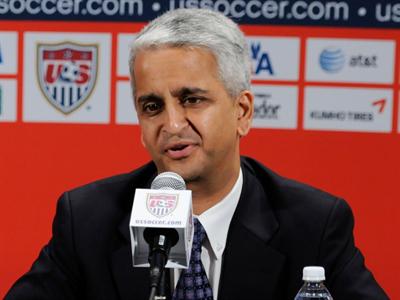
Gulati, whose day job is a senior lecturer in economics at Columbia, believes he has finally developed a  "sustainable" economic model for the women's professional game in the States. The as-yet-unnamed league will work in cooperation with the U.S., Canadian, and Mexican Soccer Federations in paying the salaries of many of the players in the league. U.S. Soccer will also finance the administrative costs of the league, presumably while trying to ensure that costs are held in some close approximation to the revenues generated by attendance, television rights, and collateral income.

Gulati, at the press conference announcing
the formation of the new women's league.

The new league will also likely follow more closely the MLS model by limiting, at least initially, the number of foreign players allocated to each club ("foreign" meaning in this context non-American, Canadian, or Mexican) and to begin play in smaller venues to enhance fan participation and camaraderie.

While it remains to be seen whether a women's professional league is sustainable in the U.S., Gulati's plan seems to have the kernels of the model that could work. But what else would you expect from an Economics professor who has been called "the single most important person in the development of soccer in this country"? 

Saturday, November 17, 2012

This Ball is Always Round

Sometime back I mentioned in a post that one of my all-time favorite books about soccer is The Ball is Round. Unfortunately though, for many who play the game, the ball isn't always round. Or even much of a ball.

An article in The New York Times (which I first saw linked on Rachel Maddow's Facebook page) last week highlights an obvious fact: kids in the poorest countries not only do not play with balls that are round, they often play with balls that are not even balls but rather rough spheres fashioned from trash or debris. Efforts by relief organizations to provide them with "real" soccer balls often fail because the balls are quickly torn or otherwise deflated by the rocky conditions on which the children play their games.

Cue Tim Jahnigen and his quest to bring durable soccer balls to kids in the poorest countries in the world. The article recounts Jahnigen seeing a documentary about children in Darfur who found joy in playing soccer, even though the balls were made out of garbage and string.

Something of a renaissance man, Jahnigen has held a variety of jobs and engaged in a number of pursuits before turning his efforts to inventing an indestructible ball. You don't need me to recount the entire Times article (linked in the second paragraph) but it's an interesting story that involves, among other things, Crocs and Sting.

The balls are expensive, at least in part because it costs so much to ship them where they are needed (they are not only indestructible, they're also not deflatable). Still, if you're looking to make a charitable donation this holiday season, why not give a kid somewhere a ball that will always be there for him or her? You can buy a ball, or make a donation, here.

Lest it be completely lost on us, there is also a certain beauty to make-shift balls.  As I was writing this post, my friend Michael sent me a link to this series of pictures by Jessica Hilltout that she has taken of cobbled together balls. 

"Domingo's Ball, Mozambique."

These balls, or at least their photographs, certainly are artful. But those who play with them I'm sure would rather play with one that rolls true and stays round.

Thursday, October 18, 2012

Time to Even it Up?

What I kind of remember about 1968:

The USS Pueblo.
The Chicago Democratic Convention.

What I remember about 1968:

Martin Luther King, Jr.'s assassination.

What happened in 1968 that is still so clear it's like it happened yesterday:

Bobby Kennedy's assassination.
The World Series.

It's hard to convey to anyone born decades later than me how crazy it was to be a 10-year-old in 1968. Everything seemed relatively safe in my sleepy little Michigan town. Until "everything" started to explode.  Dr. King, the Olympics, the riots, the election, the Chicago cops. Who could you trust? Where was it safe? 

I watched most of the 1968 World Series at school. Not on my tablet. Not on my i-phone. On a grainy black and white t.v. in my school cafeteria. I hung with every pitch and at-bat, as did my classmates, Detroit, and most of the Mitten State.

The Tigers helped everyone forget, for a while anyway, the turmoil that was 1968. It brought together a  city and a state torn apart by race, by inequality, by war. And it allowed all of us, for at least seven magical games, to think about something simple - competition. And to collectively succeed at something when success at anything seemed impossible.

Baseball was my sport as a kid. It was the only sport I played as an organized competition and the one I followed more than any other as a fan. I still have my baseball card collection. I can still name the starting nine of the Tigers that year (from memory, without cheating: c Bill Freehan; 1b Norm Cash; 2b Dick McAuliffe; 3b Don Wert; ss Ray Oyler; lf Willie Horton; cf Mickey Stanley; rf Al Kaline/Jim Northrup; pinch-hitter extraordinaire Gates Brown). I remember Denny McLain's 31 wins, and the pitching of Mickey Lolich, and Earl Wilson, and Joe Sparma, and John Hiller.

One of my boyhood heroes.

The Tigers romped through the American League that season, winning the pennant by 12 games. But ahead lay the St. Louis Cardinals and their pitching monster, Bob Gibson. The Tigers went down in the Series 3-1 at a time when only two teams had ever come back from such a deficit to win a seven game series. Gibson was unhittable in Games One and Four, and yet, somehow, a self-described pot bellied, big eared unheralded guy named Mickey stopped him and the Cards in Game Seven to win the Series.

All of this seemed relevant this evening, as I watched the Tigers clinch their 11th American League crown and await their National League opponent, which appears likely, for the fourth time, to be the St. Louis Cardinals. The "Gashouse Gang" Cardinals beat the Bengals in 1934, the Tigers won in '68, and the Cardinals were best again in 2006. It seems time to me to even that scoreline.

The ultimate twist of fate? While this ten year-old was watching the series in his little town in Michigan, rooting for the Tigers, there was a nine year-old girl watching in a small town outside of St. Louis, rooting just as hard for the Cardinals. We have been married now for 30 years. A lesson, perhaps, that sports can divide as well as unite. 

Monday, October 15, 2012

Life, Death, and Litigation

The murmuring has become a cacophony. The trickle a tidal wave. The silent suffering a public crisis.

What was once a hidden secret, shrouded by machismo and shame, is now public. Former NFL players are dying, or sickened, because they played the game they loved.

Most weren't injured all at once. Not in a Darryl Stingley-Jack Tatum moment. But a little at a time. Tackle-by-tackle. Collision-by-collision.

The NFL is trying to address the problem. Banning hits on defenseless players. Prohibiting helmet-to-helmet contact. Commissioner Roger Goodell's recent public relations nightmare, the Saints' "bountygate" fiasco, did not occur because the NFL is somehow suddenly opposed to the violent collisions that were its hallmark. The NFL is worried about its players. And worried about getting sued.

Alex Karras, a Lion of my youth, a Lion of life, died last week. He suffered from kidney failure. But more tragically, he suffered from dementia caused, he contended, by repeated concussions incurred during the Golden Age of football in the 1950's and 1960's.

"The Mad Duck" was not the archetypal dumb jock. Far from it. He clashed with coaches he thought tyrannical, acted, was a sportscaster, and a businessman. He was also one of the greatest defensive linemen in the history of the NFL.

Alex Karras, near the end of his playing days.

But as Karras' health failed, he became part of a group of former NFL players who sued the league early this year, claiming a variety of health problems as a result of head injuries caused by the NFL's alleged failure to provide safe playing conditions.

I don't know enough about the medicine to know if Karras and his fellow plaintiffs have a legitimate case. I tend to think that the science and medicine regarding concussions and their long-term effect is recent and still evolving. And as a result, it may be difficult for the former players to prove that the NFL intentionally submitted them to unsafe conditions and repeated injury.

One thing I'm relatively certain of, however, is that the NFL's recent emphasis on avoiding injury, sitting players with concussions until medical clearance, and the suspension and fining of players who engage in what used to be acceptable conduct on the field (leading with the helmet, spearing, dumping quarterbacks and running backs on their heads after forward progress is stopped) is the result of concerns for player safety, and also for potential liability.

Roger Goodell is the CEO of a multi-billion dollar industry and understands that his job is to maximize and protect the owners' product and their wealth. While Karras and his co-plaintiffs may or may not pose a threat to that wealth, the current generation of players, 20 or 30 years down the road, almost certainly does given what we now know about concussions and their long term effect on the brain.

Every time some announcer or pundit or former player or even current player decries the "softening" of the game, they are longing for a day when life was simpler, when we knew not what we asked of the players. And they ignore both the science and the economic might of what professional football is today.

All of this is, of course, too late for The Mad Duck and his generation. But if the changes, however motivated, allow us to bask a little longer in the reflected light of today's stars in the future, or to delight in the multi-facetedness of a player who we just saw as a brute, then that makes us all a little richer. And a little less guilty for watching on Sunday afternoons.

Tuesday, October 2, 2012

What if We Decided Not to Blame Anyone?


"scape·goat/ˈskāpˌgōt/

Noun:
1. (in the Bible) A goat sent into the wilderness after the Jewish chief priest had symbolically laid the sins of the people upon it (Lev. 16). 2. One that is made to bear the blame of others.
Verb:
Make a scapegoat of.
Synonyms:
whipping boy - fall guy - goat"


After attending all three days of competitive play at the Ryder Cup, I too got caught up in the discussions in the aftermath of the Meltdown at Medinah. 

"Who should we blame?" all the commentators asked. Various candidates were offered (Jim Furyk, Steve Stricker, Tiger Woods, and Captain Davis Love chief among them). "Did we lose it or they win it?" was a conversation I engaged in as well. After discussing some of the above candidates, we decided it was a little of both -- some of our guys lost matches they could or should have won, some of their guys (chief among them Justin Rose) won matches they had every reason to believe they had already lost.

Jim Furyk reacts to a missed putt on the final day.

As the sting has faded though, I've been thinking more about our need (and by "our" I mean Mankind, Humankind, all us people, etc., not just Americans and not just the Ryder Cup) to attach blame and find a scapegoat. Particularly interesting, or troubling, is the definition above: "one that is made to bear the blame of others."

I understand that with multiple 24-hour sports, news, and golf television and radio it is inevitable that in the endless effort to fill air time every result and action will be overanalyzed. But I can't help but think that at least part of why we do so, or even listen while others do, is to find someone to "bear our blame." Not the blame of losing an exhibition golf match (anymore than our average counterpart in Europe can take credit for the victory), but for our collective discontent and feeling that we're no longer the masters of our domain.

So at least as far as this Ryder Cup goes, I'm not looking for a scapegoat, not placing blame. The Euros won, and did so with passion and flair. Let's just leave it at that.

Random observations from three days at Medinah:

"USA! USA! USA!" is insipid. C'mon people we can do better. I suggest that for the next Ryder Cup on U.S. soil (or even Gleneagles in 2014 for that matter) we enlist Sam's Army or the American Outlaws (which are U.S. Soccer supporter groups, not biker gangs) to instruct all American fans in some proper songs.

One of the five coolest moments in my sports spectating life was watching and listening as Ian Poulter and Bubba Watson got the fans amped up on the first tee on Saturday afternoon, then hit while they were still in a frenzy. If you didn't see it, you have to watch.


Not sure why, but golfers on the whole strike me as the most universally likable athletes.

Except for Sergio Garcia, who I've never really liked.