Showing posts with label professional soccer. Show all posts

Tuesday, March 25, 2014

The New Normal

First there was the call for the anonymous trailblazer, the modern day Jackie Robinson.

Then there was Robbie Rogers (although the "American" sports-centric press barely gives him passing mention).

And now Michael Sam. And Jason Collins (although Collins was really before Rogers or Sam, but wasn't playing professionally at the time).

This is the third year in a row that I've felt compelled to write about sexual orientation in sports, right around this time each year. And my how the dialogue has changed. From the (apparently) radical idea that athletes can hasten societal change, we are now at the point where the vast majority of the country recognizes that Rogers, Sam, and Collins are helping do exactly that. 

Sure, there has been the predictable backlash (primarily behind the anonymous curtain of social media), but there has been much more pubic praise for the fortitude that was displayed in coming out (Sam) and signing an NBA contract as its first publicly gay player (Collins). There's even the interesting symmetry between Collins' debut with his new team, the Brooklyn Nets, and Robinson's Brooklyn Dodgers.

Michael Sam (photo from theshadowleague.com)

To be clear: I am by no means claiming this as a victory for sports over society. Obviously, a conscious decision has been made by many in our country over the last few years to reexamine our attitudes toward sexuality, both individually and collectively. But, because they are such a part of our social consciousness, sports, more than perhaps anything else, cause us to examine issues that we may have casual or even subconscious predilections toward in a new way.

Interesting, too, is that "news" regarding female athletes coming out is no longer really news. While one might think that this is due in part to simple stereotyping (i.e., female athletes being regarded as "mannish"), I believe it's more likely attributable to the realization that female athletes were the real ground breakers regarding sexual orientation long before males made, or more precisely were required to make, their sexuality a public issue.

Billy Jean King, Martina Navratilova, and Sheryl Swoopes paved the way for Megan Rapinoe, Britney Griner, and Abby Wambach. To such an extent that, while Wambach's marriage to her long-time partner last year did make the headlines, it seemed that it was more because of who she was (one of the most visible female athletes in the country) not because she was marrying another woman. In other words, just another celebrity wedding in Hawaii.

Wambach said as much when she commented: "I can't speak for other people, but for me, I feel like gone are the days that you need to come out of a closet. I never felt like I was in a closet. I never did."

It certainly won't be tomorrow, and it may not be next year, but sooner or later, that day is coming for male athletes as well.

Wednesday, January 15, 2014

FIFA's Hypocrisy Knows No Bounds - Part II

Unless the European leagues all decide that they should change their seasons to a March to November schedule. Which is exactly what they appear to be considering.

The acting chairman of the European Club Association, Karl-Heinz Rummenigge (who is also the "top official" of Bayern Munich, almost indisputably the best soccer club in the world at the moment), just last week floated the idea that the European leagues should consider playing a Spring to late Fall season just like ... well, just like the MLS season that has drawn Sepp Blatter's wrath for years.

Rummenigge's reasoning makes so much sense, highlighting the issues (particularly bad weather) that Russian professional soccer has been endured since it switched its season to coincide with UEFA's, that FIFA will find very hard to ignore.

First, Rummenigge points out that, in Germany, France, or England "summer is the best period of the year. And that is the season we don't play. In deepest winter, when it is very cold and snowing, we play nearly all the time in conditions that are disagreeable for both players and spectators. It is not logical."

Not that logic has ever gotten in the way of Blatter's or FIFA's edicts in the past.

What may well appeal to both, however, is his second argument: that switching to a March to November season would ease the pressure on those who play for both club and country by clearly demarcating the club and international seasons. Many clubs now agonize over losing players in the middle of their seasons to train and play with their national teams, taking them away from their "paying jobs" and risking fatigue and injury.

And who knows? Maybe Rummenigge's idea was floated as part of a wider scheme by Blatter himself to justify what I wrote about in the first part of this post -- moving the 2022 Qatar World Cup to the winter of 2022-23. This may be the first step in allowing Blatter to retreat from his previous hard-line position on the seasons of the MLS and Russian professional leagues and appear as eminently reasonable in doing so.

The Russians listened when Blatter told them to move their
season. And for that these players say: "Thanks Sepp!"

Either way, if the European leagues move their seasons Don Garber, the MLS Commissioner, will breathe a huge sigh of relief. And all of Blatter's blathering about its non-competitiveness because of the position of its season will be revealed as just that.

Wednesday, May 22, 2013

Plenty Not to Like

Who put Bud Selig in charge of MLS?

There seem to be few explanations other than Selig-esque crass commercialism to justify the decision announced this week that the 20th MLS franchise has been awarded to New York City and its new owners, Manchester City and the New York Yankees. But apparently MLS Commissioner Don Garber is not only willing to take credit for the anointment of the newest club, he appears to actually thinks it's a good one.

Put together two of the most hated sports franchises in the universe and plop them down in a city that has shown a complete inability to support one, let alone two, professional soccer teams and you get what, exactly, that is appealing?

One wonders if the awkwardly named N.Y.C.F.C. was saddled with the moniker just to even things up with the New York Red Bulls and their uninspiring identification. "Go over-caffinated, sugary energy drinks!" doesn't lend itself to song or loyalty any more than the attempts by other MLS franchises to pander to Euro-snob U.S. fans by changing their names to sadly mimic storied franchises overseas ("FC Dallas", "Sporting Kansas City", "Real Salt Lake").


As smart as the decision was to add first Seattle, then Portland and Vancouver (with their devoted fan bases and true rivalries) to the fold in recent years, the selection of another New York City franchise appears even more ill-conceived than the attempt to create a rival for the L.A. Galaxy was by adding Chivas USA (whose attendance is abysmal so far in 2013).

Derbies aren't like sea-monkeys. They don't magically appear when you add water, or, in this case, a big pile of oil money and the Yankees' "mystique." That the Yankees were added as a minority owner in what appears to be an attempt to leverage Randy Levine's ability to strong-arm local politicians into handing over the use of public spaces to build nine figure playgrounds for rich owners makes the decision even more odious.

While the eight million or so denizens of The Big Apple will now have their choice of two soccer teams to ignore, those throughout much of the rest of the nation, many with soccer-rich traditions that pre-date both Garber and MLS, are left scratching their heads and wondering what they have to do to warrant consideration for franchises 21 and 22, which are apparently still in the works.

Prior to the NYC announcement, Garber had had identified Miami, Atlanta, Minneapolis, and Orlando as possibilities for additional expansion. Orlando actually makes some sense, based on the dearth of professional soccer at the highest level in the fourth most populous state in the country. Miami has already had its chance and it, like Atlanta, has consistently proven for decades its inability to sustain franchises other than pro football. Minneapolis? A nice place in July and August, but it will almost certainly need a turf field, which causes its own problems.

The wrong-headed approach to MLS expansion appears to be driven by identifying owner groups seeking a franchise and then either choosing somewhere to plop it, or to accede to their demands for a location, rather than on the fan-base of an area and its interest in soccer. St. Louis, with a long history of soccer enthusiasm and excellence in support of teams at the youth and college levels, is ignored not because it wouldn't support a franchise, but because the individual who has put himself at the forefront of its efforts to capture a club is likely not up to the task. And don't even get me started on poor Rochester, which carried the banner for soccer in New York State for years and isn't even close to being in the conversation anymore.

More and more, despite its bizarre and inscrutable rules regarding salaries, designated players, and player contracts, MLS is just another American professional sport. While the players are still expected to be grateful for whatever is thrown their way, when it comes to ownership and the location of franchises, money is the only thing that talks.

Sunday, November 25, 2012

Third Time's a Charm?

Amidst the orgy of turkey, Black Friday, and college football this past week you may have missed the announcement that, for the third time in the past 12 years, a women's professional soccer league will begin play in the U.S. this coming spring.

The WUSA was formed in the wake of the U.S. Women's National Team's triumph in the 1999 World Cup here in the U.S. Much as the formation of MLS following the men's World Cup in the States in 1994, the notion was that it was the perfect time to start a women's league with all the momentum that the sport had gained after the climatic final game, won by Brandi Chastain's famous pk.

That league folded after just three years though, drowning in debt caused, at least in part, by the signing of big name players from abroad and (based on the attendance and limited television exposure and dollars) high salaries for the players. The WUSA tried to hang on through the next year, holding a few "exhibition" matches which were essentially all-star games, but finally gave up the ghost.

Women's Professional Soccer jumped into the void for another three years, but it seemed even more doomed from the start. Feuding (and seemingly imbalanced), owners, lackluster crowds, and frankly dull play led to another three seasons, but even the most hard core fan would be hard-pressed to name more than one team, let alone more than one champion. The WPS played in 2009-2011, but in January of this year announced a hiatus and eventually disbanded.

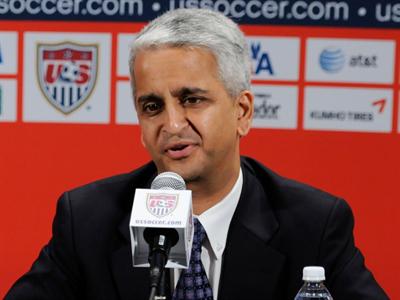
The success of the U.S. Women's National Team this summer in London, however, led to renewed talk of another women's professional league. While the WPS had tried to associate with MLS and thus reduce facilities costs, the effort never seemed to take hold outside of, perhaps, Philadelphia. The announcement of the new league, however, came not from potential owners but from Sunil Gulati, the President of the U.S. Soccer Federation. 

Gulati, whose day job is a senior lecturer in economics at Columbia, believes he has finally developed a  "sustainable" economic model for the women's professional game in the States. The as-yet-unnamed league will work in cooperation with the U.S., Canadian, and Mexican Soccer Federations in paying the salaries of many of the players in the league. U.S. Soccer will also finance the administrative costs of the league, presumably while trying to ensure that costs are held in some close approximation to the revenues generated by attendance, television rights, and collateral income.

Gulati, at the press conference announcing
the formation of the new women's league.

The new league will also likely follow more closely the MLS model by limiting, at least initially, the number of foreign players allocated to each club ("foreign" meaning in this context non-American, Canadian, or Mexican) and to begin play in smaller venues to enhance fan participation and camaraderie.

While it remains to be seen whether a women's professional league is sustainable in the U.S., Gulati's plan seems to have the kernels of the model that could work. But what else would you expect from an Economics professor who has been called "the single most important person in the development of soccer in this country"? 

Wednesday, March 30, 2011

The Drop

Every year around this time throughout Europe sportswriters and commentators and fans start talking about The Drop.  Relegation and promotion (or, I guess, promotion and relegation if your glass is half full) are features of almost every professional soccer league in the world not in the U.S. or Australia.

Rather ironic, since relegation is the most democratic, or Darwinian, of all sporting concepts. Each year in one or two or three of the clubs that finish in the bottom of the standings of a league will be relegated to the next division down, and the same number of clubs will be promoted, either by virtue of their finish in their league during the regular season or by a playoff, to the next higher division. So while clubs in, say, China will (theoretically) rise or fall each year on their own merits, those in the U.S. are among the few that are always safely ensconced in the highest professional division of the sport.

Because of the way professional sports teams developed in the United States, with a small number of clubs owned usually by one individual or entity, promotion and relegation never took hold here. In Europe, however, with its thousands of soccer teams and stronger local and regional ties, it was a natural development.

In recent years, the relegation battle, at least in England, is much more interesting than the fight for the championship of the Premier League. While the same two or three teams fight it out for the crown every year, several more are sucked into the abyss that is the desperate attempt to avoid the drop.

This year the races to the championship and to relegation are both shaping up to be interesting, thanks to the lack of a dominating club at the top and many middling to miserable ones at the other end of the spectrum. But while one of the usual suspects (either Man United or Arsenal) are likely to win the crown, nine or ten clubs, within six points of each other, are capable of playing badly enough over the last eight or nine matches of the season to warrant relegation.

Unfortunately for me and other Blackburn fans, one of those clubs that could face The Drop is the Rovers.  In the top ten and looking good just a few weeks ago, Rovers have managed to snatch defeat from the jaws of victory, or at least a draw, on several occasions recently, including two weeks ago when they conceded a penalty in the last minute to lose 3-2 to Fulham, and last week when they had to come from two goals down at home to register a draw with Blackpool. Speculation has gone from wondering whether the club will be able to challenge for a Europa League spot to whether they will be playing in the Premier League next season.

I have to admit, though, that whether it's the glass-half-empty Rover fan, the masochist, or the republican (yes, little "r" republican) in me, I relish the fight to dodge The Drop. Nothing more energizes a fan base than supporting your club to survive to fight another day. And, I have to admit, I always relish the opportunity to chirp when a "Big Club" (like Newcastle two seasons ago) goes down.

How cool would it be to get to see an American pro team (insert team name here -- mine would be the Cowboys or the Yankees) struggle to maintain top flight status? Can you imagine the glee if Jerry Jones was faced with the prospect of a half-filled billion dollar stadium while his Cowboys play some semi-pro team from Waco?

I'll be there on Saturday morning, biting my nails and hoping the Rovers can pick up three or even one point against Arsenal (yeah, right) that would go a long way to avoiding The Drop. But I'll be pulling just as hard for West Ham and Birmingham (two self-proclaimed "Big Clubs") to lose and sink a little farther toward oblivion. What could be more American?