Showing posts with label 2018 World Cup. Show all posts

Wednesday, July 12, 2017

Cups All Around (and not a Drop to Drink)

Some observations after watching most of the Confederations Cup and attending the U.S. Men's National team Gold Cup game against Panama in Nashville:

1.  The Confederations Cup Is No Longer a Test for Anyone but the Host Country.  Sure, you can say that the Germans don't have a B Squad, or that even their second team is better than most other countries, but whatever the excuse or the analysis, the simple fact is that they breezed through the Confed Cup starting exactly zero players who started the 2014 World Cup Final against Argentina. 

While roster turnover is a fact of international soccer, and it would be a shock if Philipp Lahm or Miroslav Klose featured in the 2018 German World Cup team (since both have retired from international football), there are several players from that team (Neuer, Ozil, Muller, Boateng) who seem naturals for the next edition as well. But they were nowhere to be found on the squad as Joachim Low chose a team without a wealth of international experience. The Germans won four games and tied one, "avenging" the tie by beating Chile 1-0 in the Final.

2.  Russia Met its Lowly Expectations. Apparently the "test" for Russia hosting these games, as far as FIFA was concerned, was to prove that it could be at least superficially friendly to traveling supporters of the participating teams and avoid any overt racism, homophobia, or hooliganism. While new FIFA Capo Gianni Infantino said that the tournament was a great success, it remains to be seen whether Russia can duplicate the feat on a much larger scale, with many of the stadiums not used for the Confederations Cup still not complete. Not to mention the pesky North Korean labor abuses upon which those stadia are apparently being built.

3.  Russia's Men's Soccer Team Met its Lowly Expectations. Which is to say, it sucks. Although one player, Yuri Zhirkov, was fun to watch.

4.  Mexico is Still Mexico. Which is to say, it folds on the big stage. The best Mexico has to offer was a poor, poor second to Germany in the semis, losing 4-1, and couldn't beat a Ronaldo-less Portugal in the third place match.
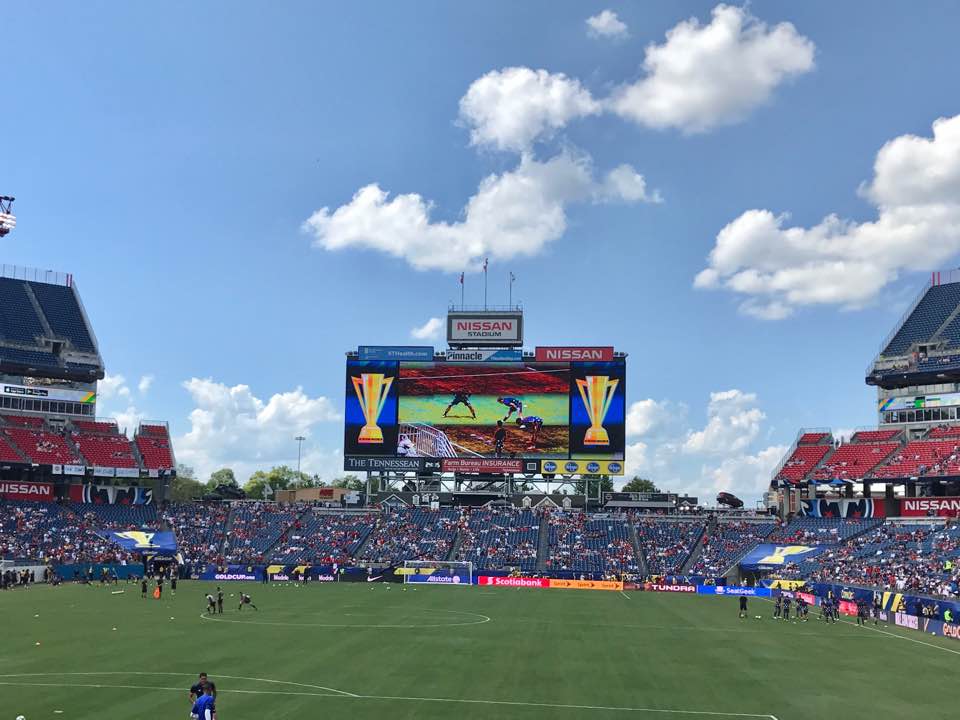
The view of Nissan Stadium in Nashville from the American
Outlaws' section prior to the U.S. v. Panama match. (photo by me)

5.  The U.S. Men's B Team is Not Germany's B Team. Or C Team. No surprise there, of course, but the performance against Panama was dross. Fortunately, the players know it and Bruce Arena knows it. While Arena chose to use the Gold Cup as a testing ground for players who are on the fringe of the potential 2018 World Cup roster, they were out-of-sorts defensively and particularly in the midfield. Which leads to the final observation ...

6.  Shut Up About Michael Bradley Already. After every U.S. match of any significance, the trolls crawl from their parents' basements to complain about how Bradley gives away the ball too much, doesn't play high enough, doesn't play back enough, blah, blah, blah. If the match against Mexico at the Azteca and a Bradley-less midfield against Panama don't convince you of Bradley's quality and the absolute necessity that he be a starting midfielder for the U.S. as long as he wants to strap on his boots and don the shirt, nothing will.

While Kellyn Acosta was good in the warm-up match against Ghana and threw himself around a bit against Panama, the other two center mids against Panama, Dax McCarty and Joe Corona, were abysmal. Here's hoping Arena gives someone (anyone) else a shot against Martinique. But only with the caveat that they will back-up, or at best play alongside, Bradley.

Wednesday, June 1, 2016

Glimmers of Hope

So what are we to think about the U.S. Men's National soccer team headed into the Copa America (or Copa Centenario, if you prefer)?

Consecutive wins against South American opponents in the past week? Good.

Those wins coming against traditional CONMEBOL minnows Ecuador and Bolivia? Not so good.

Four straight wins and a 6-1 record so far in 2016? Good.

The loss being in World Cup qualifying to Guatemala in a dismal 2-0 performance? Not good at all.

The introduction of new, exciting players like Darlington Nagbe, Christian Pulisic, and Steve Burnbaum? Good.

Continuing to rely on old, and old guard, players like Jermaine Jones and Kyle Beckerman, particularly in the demanding role of center midfielder? Not very good.

Obviously the upcoming Copa America will give us more information on where the national team is, and where it might be going, in World Cup qualifying and, hopefully, the 2018 World Cup itself. The recent wins have certainly quelled, for now, the anti-Klinsmann drumbeat that reached a crescendo after losses to Jamaica in the Gold Cup and Mexico in the play-in for the Confederations Cup last year.

While they are far from a guarantee for success in the upcoming Copa America, which will be against stiffer competition in a more meaningful setting, the Americans' luck appears to be turning after a dismal 2015. And not just on the field.

The U.S.'s opportunity to participate in the Copa, and indeed the entire tournament, was cast into doubt by the indictment or arrest of many top CONMEBOL and CONCACAF officials last summer and additional indictments for Traffic Sports, a major player in organizing (and skimming graft from) both the Gold Cup and Copa America. The importance of the tournament as preparation for the next World Cup cannot be understated, particularly after the ignominious denial of the chance to play in the Confederations Cup, participation in which was long touted by Klinsmann as essential to success in Russia, until it wasn't.

But whether through sheer will to actually celebrate the 100th anniversary of the competition, or the unappealing prospect of losing millions of dollars of revenue from the target-rich U.S. soccer market, the tournament will go on (although perhaps without Argentina).

While Klinsmann has talked about bringing new or younger players along slowly (hence not starting Nagbe or Pulisic against either Ecuador or Bolivia), this tournament seems the ideal opportunity to start determining whether they will be able to withstand the pressure of top flight competition in CONCACAF World Cup qualifying, particularly once it moves to the final stage (known as The Hex because of its six teams, the top three of which will qualify for the World Cup, and the fourth place team of which will advance to a playoff against the fifth place team from Asia).

The back line seems set with John Brooks and Geoff Cameron (assuming he's healthy) in the center of defense and Fabian Johnson and DeAndre Yedlin on the wings. Bobby Wood, Gyasi Zardes, and Clint Dempsey appear ready to play up front in some combination (particularly with the surprise exclusion of Jordan Morris from the squad) with Pulisic likely to come off the bench and Chris Wondolowski available to poach a last minute goal in a pinch. 


Pulisic celebrates his goal against Bolivia, which made him the
youngest goalscorer for the U.S. Men in the modern era.
(photo from www.dailymail.co.uk)

That leaves three players to man the midfield (although Zardes could play wing or Dempsey as a withdrawn forward or attacking midfielder at the top of a diamond). Michael Bradley is a shoo-in, of course. Alejandro Bedoya was, for my money, perhaps the Yanks' best player against Bolivia and seems unlikely to be left out of the starting 11 (as long as Klinsmann doesn't insist that he play in the back).

There has to be some bite, which Jones normally provides. Klinsmann could go with two defensive mids with Jones and Beckerman, but that seems unlikely, particularly given Beckerman's lack of mobility. Equally unlikely is abandoning the defense altogether and playing both Nagbe and Bedoya along with Bradley.

While Jones is an acceptable choice this summer, it's hard to see him as capable of being one in Russia. I'd like to see Klinsmann try Bradley at the bottom of a diamond with Nagbe and Bedoya the linking midfielders and Dempsey at the tip. But that's unlikely to happen since Klinsmann has insisted for more than two years now that Bradley's best position is up the field leading the attack, and for the most part Bradley has proved him right.

Another option would be to recognize that Dempsey may be too old by the time 2018 comes around and put Bradley at the top, with Nagbe and Bedoya behind, Cameron in the defensive/deep-lying mid position, and Burnbaum or Matt Besler in the center of defense with Brooks.

Given the heat that Klinsmann took last year over the team's performance it's understandable that he is reluctant to sacrifice results for experimentation in the Copa. But, in the long-term, that may be exactly what this team needs. Regardless, it's nice to talk about the options available to him, which seemed in very short supply last fall.

Friday, January 10, 2014

FIFA's Hypocrisy Knows No Bounds - Part I

For years, FIFA Emir Sepp Blatter hounded MLS about changing its season to coincide with that of the European leagues. And, according to fairly recent reports, he may have been close to winning the argument. That should have changed, though, this past week with two separate developments regarding soccer and when it is played.

While the pretense of the advice was that the U.S. pro season should coincide with that of England, Spain, Germany, etc., it always struck me that Blatter's position on the issue was either incredibly naive (not caring that MLS can not now, and will not for years, if ever, be able to compete directly with the NFL) or, more likely, incredibly arrogant (Sepp thinks that if our pros play at the same time of year as Europe's they will be better players, so we should think that too).

Blatter didn't care that many MLS teams shared stadiums with NFL franchises or college football teams that made playing from August to May logistically impossible. Or that fans, forced to make the choice, would opt for football over soccer.  Or that the thought of playing soccer in Boston or New York City or Chicago or Denver or Toronto or Montreal in December and January and February is absurd (evidently, the NFL missed that memo too). Just his saying "play August to May" should have been all the reason we needed to make it so.

What soccer in March can look like in Denver.
(photo from USA Today)

Never mind that the Swedes aren't stupid enough to play in the Scandinavian winter, or that Brazilian clubs play May to December. Or that the Russians, who apparently caved in to Blatter's pressure, have experienced all sorts of issues in converting their season from March to December to August to May (hmm, maybe that's why they were awarded the 2018 World Cup? in a way, that would be a refreshing change from the usual monetary bribes).

The first development that should eliminate any consideration of kowtowing to the Blatter Rule on soccer seasons was a slip by FIFA Secretary General Jerome Valcke during an interview on a French radio station. Valcke admitted that it is likely that the 2022 World Cup (to be held in Qatar, remember?) will take place in December 2022 and January 2023.

Right smack dab in the middle of the domestic professional season Blatter has championed in most of Europe, forced on Russia, and has tried to foist off on the U.S. But in the Qatari winter, when temperatures will average a pleasant 25C rather than the brutal 50C weather in June and July, when the World Cup has been held in late May, June, and or July every time since its inception in 1930. Every time.

So much for tradition and concerns about domestic soccer. Not to mention the support of UEFA, which is thoroughly annoyed at the suggestion that the tournament will take place during both domestic competitions and its lucrative Champions and Europa League seasons, risking injury to its best players at the same time. Or of Fox and Telemundo which ponied up more than double the amount paid by ESPN to broadcast the South African and Brazilian World Cup to win the bid for the rights to the 2018 and 2022 Cups and now face the prospect of trying to convince advertisers that their money is better spent on soccer during the same months as the college football conference championship games, bowls, and playoffs and the NFL playoffs and Super Bowl.

While the ensuing denials, partial withdrawals, and outrage that followed Valcke's interview reveal FIFA at its Keystone Cops best, the real point is this: Blatter's demands that the U.S. change its domestic season were as baseless and dictatorial as most other decisions he has handed down during his reign.  

No matter how corrupt the selection of Qatar has proven to be (and it was astonishingly, brazenly corrupt, even for FIFA), no matter how stupid the idea of playing soccer in the Middle Eastern desert in June and July was, no matter how absurd the suggestion that the outdoor stadiums could be air conditioned for players' and fans' safety (yeah, that was b.s. too), the 2022 (well, and 2023) World Cup will be played there and then, the domestic season which he championed for years be damned. Which is pretty much what it will be.

Unless …