Showing posts with label Sunil Gulati. Show all posts

Thursday, December 29, 2016

U.S. Women's Soccer CBA Negotations Take an Interesting Turn

We awoke this morning to the news that the U.S. Women's National Team has parted ways with its chief negotiator, Rich Nichols, three days before its collective bargaining agreement with the U.S. Soccer Federation is set to expire.

Why and why now are relevant questions unanswered by the Women's Player's Association in its terse announcement, which merely says that Nichols will "no longer serve" as counsel to the Association, says that it is "focused on" productive conversations with U.S. Soccer regarding "our future" and looks forward to the upcoming NWSL season and an international women's tournament next March.

That immediate future will apparently proceed under the current CBA, which expires Saturday. Neither side has given the required 60-day notice of termination of that agreement,  after which either a work stoppage or a lock-out would be permitted.

Nichols has been a ferocious advocate for the women's team in negotiations with the Federation and by all appearances was the driving force in the wage discrimination complaint of five prominent players filed with the EEOC earlier this year, the defense of the Federation's suit that sought to impose the terms of an earlier CBA which forbid the players from striking before the Olympics this year (in which the Federation succeeded), and presumably in the players' public relations onslaught regarding their demands for "equal pay."

While meddling politicians and vacuous media outlets have taken up the women's team's call, as I and others have explained in the past, equal pay in the context of national soccer teams is not as simple as paying everyone the same salary or bonus or even paying equal amounts to the teams as a whole. And the EEOC complaint could, in fact, simply lead to further pay disparities in the women's professional game or the death of the women's professional league in the U.S. 

It seems likely that during negotiations (or perhaps because of the absence of negotiations) regarding a new CBA the players reached the conclusion that Nichol's approach was counterproductive to striking a bargain. Nichols has certainly raised the bar for the next counsel in terms of his zealous advocacy of the women's professional game, but perhaps a skillful negotiator and someone more willing to compromise is needed to bring the two sides together.

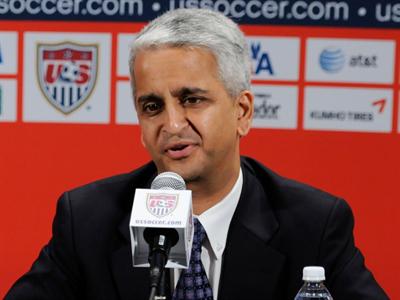
Certainly there's been nothing said publicly to-date by the Federation or its President Sunil Gulati to suggest that the Federation is not interested in trying to reach an agreement that does not compensate the national team players at a rate commensurate with their male counterparts, keeping in mind the revenue that each team has generated on a historical basis and U.S. Soccer's financial support for the NWSL.

Oh, but wait. There is one women's national team member who has cried foul, complaining that the Federation is "putting pressure" on the women to strike a deal. Anyone care to guess who that player might be?

Equal rights champion Hope Solo at her arraignment on
domestic violence charges (photo from washingtonpost.com)

That's right, Hope Solo. In a blog post yesterday Solo expounded on her self-proclaimed role as a champion for equal pay and takes a shot at the Federation and Gulati for "putting pressure on the players" and "trying to divide and conquer us."

To which I say: go figure. One side of a negotiation is trying to use leverage against the other? Say it ain't so, Solo! I suppose the EEOC complaint and the players' implicit threat of a strike prior to the Olympics (which caused the Federation's ultimately successful lawsuit) were not leverage, or attempts by the players to put pressure on the Federation to strike a deal?

Posturing aside, one has to wonder if the timing of Solo's post isn't an indication that she is not on-board with her fellow team members and litigants regarding Nichol's approach and was her (indirect) protest against his dismissal. In other words, Hope is the true champion of women's rights and the others are not. Certainly wouldn't be the first time that she willingly distanced herself from the common good.

Tuesday, May 13, 2014

Two Not So Fitting Farewells - Part One

You could take two recent decisions involving the U.S. Men's and Women's national teams as good signs. As indications that we are big time now, that we make heartless decisions based on what we think is best for our programs, nothing more and nothing less.

Or you could see it as the passing of an era, from a time when our national soccer teams, perhaps to a fault, recognized past service or gave longer leash to a coach because it was the right thing, even if it wasn't necessarily in the best interests of the team (Briana Scurry starting in the 2007 World Cup semifinals instead of Hope Solo comes to mind, but perhaps then-coach Greg Ryan would disagree, since the fallout from that determination cost him his job).

The first decision involved the "shocking" dismissal last month of Women's head coach Tom Sermanni. Unlike Pia Sundhage's last game, there was no celebration after Sermanni's last match as coach, in which the U.S. beat China 3-0. In fact, other than Sunil Gulati and perhaps handful of others, no one knew that it was Sermanni's last match.

That victory came on the heels of a disappointing performance by the squad in the Algrave Cup, an annual women's tournament held in Portugal. The U.S. drew with eventual runners-up Japan in their first group match before losing to Sweden 1-0 and to Denmark by a shocking 5-3 score. Sweden is now coached by Sundhage, adding insult to the injury of a seventh place finish.

Sermanni coaching during the match vs. Japan at the Algrave
Cup. The team's performance at the tournament was at least a
part of his undoing. (photo from soccerblog.dallasnews.com)

While the team's performance in Portugal was admittedly underwhelming, it did not seem to be sufficient justification for a change. The termination came as a shock to Sermanni who is universally beloved by his players and seemingly deserved better, or, at the least, some notice that a change was being considered.

In the aftermath of the firing, pundits offered varying theories on the reasons for and the timing of Sermanni's departure. With CONCACAF Wold Cup qualifying set to take place in October for the 2015 Women's World Cup to be held in Canada, time is short for another coach to impose his or her vision on the team.

Gulati denied that a player revolt provoked Sermanni's dismissal, but it's hard to believe that the veterans of the squad were happy with Sermanni's habit of thrusting players new to the national team into starting spots (and, in particular, leaving Abby Wambach on the bench for the entire match against Japan and for all but five minutes against Denmark). Gulati did admit in his press conference that he gained information from "people in and around the team" that played a role in the decision, along with an assessment of "where the team's going and heading," and the performance in Portugal.

It's inconceivable that the decision was made with anything other than the best of intentions - clearly, Gulati and others in the U.S. Soccer brain trust thought the team was headed in the wrong direction (or, more likely, in no particular direction). With a qualification tournament upcoming that was nearly the team's undoing four years ago (remember the loss to Mexico? the play-off matches against Italy?) surely part of what played into Sermanni's firing was that if a change had to be made, it had to be made soon.

So, Sermanni wasn't the answer. Fair enough. But who is? The anticipation was that a new coach would be named by early May, but it's nearly the middle of the month and still no new coach. The list of candidates, frankly, isn't that inspiring (although Sundhage's former assistant, Tony Gustavsson, is an intriguing option). And time is growing short.

One thing is certain: if we are in a new, cold world of soccer with our women's national team, the choice this time had better be the right one. Or heads other than just the next coach's ought to roll.

Tuesday, May 7, 2013

"I'm Kind of a Big Deal"


"Ron: I don't know how to put this, but I'm kind of a big deal.
Veronica:  Really.
Ron: People know me.
Veronica: Well, I'm very happy for you.
Ron: Um, I'm very important. I have many leather-bound books,
and my apartment smells of rich mahogany."


Far be it from me to suggest that Sunil Gulati would use the same terms to identify himself, and every indication is that he wouldn't, but the fact is he's kind of a big deal. That was emphasized late last month when he was elected by representatives of CONCACAF to serve on FIFA's Executive Committee.

Call me naive if you will, but I truly believe that Gulati has worked for the New England Revolution, MLS, the U.S. Soccer Federation, and now FIFA because he wants to advance the game in America. The unfortunate reality, however, is that he may be alone among the 25 members of the ExCom to put the game's interests above his own.

I admit, you can almost hear:
"I have many leather-bound books."
(photo from the "San Diego's #10" blog)

The tales of the excesses and arrogance of the men who run FIFA are legendary. Kickbacks, bribes, and private jets appear to be the rule, not the exception, when it comes to business as usual for the FIFA poo bahs. Some have suggested that the first question from most of Gulati's less-than-luminous predecessors upon their election was "just how many World Cup tickets do I get?"

I suspect that Gulati has bigger fish to fry. After the failed U.S. attempt to win the bid for the 2022 World Cup, Gulati didn't cry foul, as he was surely tempted to do, after many years of effort in the bid went down in flames (in particular, those from the gas wells in Qatar). Instead he shrugged his shoulders and vowed to carry on the fight for soccer in the States.

If Gulati sees his election as an attempt to remake FIFA from a fiefdom of stuffy old men in fancy suits into the actual international organizing body of the most popular sport in the world, he may have a few allies. Michel Platini, the President of UEFA (Europe's CONCACAF equivalent), is another influential member of the international soccer community who actually appears to have the best interests of the game at heart.

Can one or two or a few men change the mindset of what is essentially a huge multi-national corporation based on graft and backscratching? Time will tell. But that seems to be precisely what Gulati has in mind.

Sunday, November 25, 2012

Third Time's a Charm?

Amidst the orgy of turkey, Black Friday, and college football this past week you may have missed the announcement that, for the third time in the past 12 years, a women's professional soccer league will begin play in the U.S. this coming spring.

The WUSA was formed in the wake of the U.S. Women's National Team's triumph in the 1999 World Cup here in the U.S. Much as the formation of MLS following the men's World Cup in the States in 1994, the notion was that it was the perfect time to start a women's league with all the momentum that the sport had gained after the climatic final game, won by Brandi Chastain's famous pk.

That league folded after just three years though, drowning in debt caused, at least in part, by the signing of big name players from abroad and (based on the attendance and limited television exposure and dollars) high salaries for the players. The WUSA tried to hang on through the next year, holding a few "exhibition" matches which were essentially all-star games, but finally gave up the ghost.

Women's Professional Soccer jumped into the void for another three years, but it seemed even more doomed from the start. Feuding (and seemingly imbalanced), owners, lackluster crowds, and frankly dull play led to another three seasons, but even the most hard core fan would be hard-pressed to name more than one team, let alone more than one champion. The WPS played in 2009-2011, but in January of this year announced a hiatus and eventually disbanded.

The success of the U.S. Women's National Team this summer in London, however, led to renewed talk of another women's professional league. While the WPS had tried to associate with MLS and thus reduce facilities costs, the effort never seemed to take hold outside of, perhaps, Philadelphia. The announcement of the new league, however, came not from potential owners but from Sunil Gulati, the President of the U.S. Soccer Federation. 

Gulati, whose day job is a senior lecturer in economics at Columbia, believes he has finally developed a  "sustainable" economic model for the women's professional game in the States. The as-yet-unnamed league will work in cooperation with the U.S., Canadian, and Mexican Soccer Federations in paying the salaries of many of the players in the league. U.S. Soccer will also finance the administrative costs of the league, presumably while trying to ensure that costs are held in some close approximation to the revenues generated by attendance, television rights, and collateral income.

Gulati, at the press conference announcing
the formation of the new women's league.

The new league will also likely follow more closely the MLS model by limiting, at least initially, the number of foreign players allocated to each club ("foreign" meaning in this context non-American, Canadian, or Mexican) and to begin play in smaller venues to enhance fan participation and camaraderie.

While it remains to be seen whether a women's professional league is sustainable in the U.S., Gulati's plan seems to have the kernels of the model that could work. But what else would you expect from an Economics professor who has been called "the single most important person in the development of soccer in this country"? 

Tuesday, September 25, 2012

A Fitting Farewell

Pia Sundhage's final match as the U.S. Women's soccer coach had all the right elements to encapsulate her nearly five years in charge. An early deficit, some dodgy defending, lots of goals, and in the end, a victory as the Americans beat Australia 6-2.

It's easy to forget that when Sundhage took over the team it was in complete disarray. The women had finished third in the World Cup in 2007, a result with which most countries (Canada comes to mind) would be ecstatic, but which was disappointing for the Americans in part because it constituted the second straight World Cup that they had failed to win, but mostly because of the way it had happened.

Then-coach Greg Ryan benched keeper Hope Solo in favor of long-time starter Brianna Scurry for the semi-final match against Brazil, which the U.S. promptly and embarrassingly lost 4-0. After the game, Solo publicly blasted Ryan for the decision (where have we heard that since?), splitting the team into two camps.

Alex Morgan, one of the fast, skilled young players
that Sundhage included in the U.S. Women's National team.

While the team regrouped to defeat Norway in the consolation game, the damage had been done. Ryan was dismissed and U.S. Soccer President Sunil Gulati eventually named Sundhage, the first non-American to hold the job, in his place.

Nine months later, the U.S. Women won the Gold Medal at the Beijing Olympics. Sundhage found a winning formula, based primarily on Abby Wambach and Solo, and stuck with it.

While the play wasn't always pretty, and there were some rough stretches (particularly during World Cup qualifying, when the U.S. lost to Mexico and had to defeat Italy in home-and-home matches to squeak into the Finals) the team began to play exciting, attractive soccer. Sure, there were more bumps along the way - especially the World Cup Final against Japan when the Americans twice surrendered leads and their slow defenders (yes, Hope, slow defenders) were exposed.

But two matches in particular, the World Cup quarterfinal against Brazil in 2011 and the Olympic semifinal against Canada this summer, were two of the most compelling soccer matches, men's or women's, I've ever watched. And Sundhage should also be credited for bringing youth into the team, Megan Rapinoe, Alex Morgan, and Sydney Leroux being the best examples of quality players who blossomed under Sundhage's leadership.

Perhaps most importantly, Sundhage clearly enjoys coaching and imparts that joy to her players. Undoubtedly she worked them hard. But she has a whimsical side that occasionally causes her to dance or break into song.


Whoever replaces Sundhage will have big shoes to fill, and will inherit a team with high expectations for the next World Cup, to be held in Canada in 2015. He or she may well bring the Cup back across the border. But I doubt that whoever it is will do so with as much panache as Sundhage brought to our team.

Thursday, June 30, 2011

Not All That Great

That is, the state of American soccer isn't all that great.

The men were pounded by Mexico and the women looked less than convincing in their win against North Korea, which apparently would have been a loss had the Koreans not suffered tragic misfortune in the days leading up to the World Cup.

The men had a dream start to their Gold Cup final against Mexico, scoring twice in the first half hour of the match to take a 2-0 lead.  The next hour, however, was basically an evisceration of the Yanks' defense as Mexico showed off all of its attacking talent and at the same time exposed the weakness and lack of depth of the American backline.

An overwhelmingly pro-Mexico crowd and the delivery of the post-match honors primarily in Spanish rankled both American supporters and some of their players, but were just salt in the wounds for a disappointing performance in the tournament as a whole and particularly in the final. While their defensive deficiencies can be explained by some extent to the early substitution of right back Steve Cherundolo, it's hard to believe that his presence would have made much of a difference, with central defenders Carlos Bocanegra and Clarence Goodson looking slow and Cherundolo's replacement Jonathan Bornstein completely out of his element.

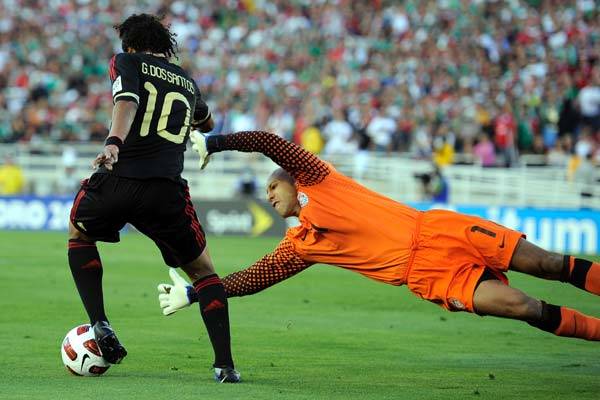
 Giovani Dos Santos jukes Tim Howard just before scoring
the goal of the Tournament, sealing Mexico's 4-2 win

Post-match commentary has been critical of coach Bob Bradley, suggesting that it is time for him to go so that a new man may be in place and fully in charge before World cup qualifying begins. Given that Bradley received a new four year contract shortly after the last World Cup, a replacement seems unlikely, although U.S. Soccer President Sunil Gulati seemed somewhat equivocal regarding his confidence in Bradley immediately following the Mexico match.

I think Bradley is in a damned if he does and damned if he doesn't situation -- criticized for being predictable, he actually tried some new things at the Gold Cup that worked (featuring Freddy Adu, then starting him, with considerable success, in the final; installing Eric Lichaj at left back) and some that didn't (mostly, naming Bornstein to the squad in the first place). The biggest thing that Bradley seems to have in his favor is that contract, and the fact that by all appearances U.S. Soccer attempted to find a big profile successor after the 2010 World Cup without success.

The women started their World Cup with a 2-0 over North Korea. The North Koreans were very young (10 players on their roster are under 20) and were technically skilled and the more consistently dangerous team in the first half, which ended 0-0. The Americans ramped up their attack in the second half and won 2-0.

Lauren Cheney (12) celebrates her crucial first goal against North Korea.

After the match, perhaps keeping in mind the humiliation to which the North Korean men's squad was subjected after their 2010 World Cup, the Korean coach explained the "real" reason why his team lost. Lightning. That's right, Kim-Kwang-min claimed that his keeper and his defenders (or strikers, depending on the translation) were victims of a lightning strike in training leading up to the match, leading to their substandard performance in the second half.

While the U.S. women probably won't have to hope that the Colombian women, their next opponents, suffered a similar fate in order to beat them, they will still have to show improvement, or hope for divine intervention, before facing Sweden (to whom they lost 2-1 in January) in the final match of group play, which will likely determine which team will be the number one seed in the group entering the knockout phase of the tournament.