Showing posts with label Women's World Cup. Show all posts

Sunday, February 8, 2015

Rudderless

rud·der·less
ˈrədərləs/
adjective
adjective: rudderless
  1. lacking a rudder.
    • lacking a clear sense of one's aims or principles.
      "today's leadership is rudderless"

Rudderless.

That's the one word that kept creeping into my mind, over and over again, as I watched another U.S. National Soccer team, this time the women, be outclassed and outworked.

Yes, we lost 2-0 to a very good French national team that has beaten Germany and Brazil in the past few months.

Yes, the U.S. was without some of its key players as Megan Rapinoe, Christine Rampone, Hope Solo, and Sydney Leroux didn't dress for the match and the first three didn't even make the trip for the friendlies with France and England.

Yes, the rest of the world is catching us along with the other members of the formerly exclusive club of countries that can contend for the women's World Cup.

All the more reason to need, to have to rely on and have confidence in, your coach. And in my opinion the game against the French demonstrated that the team appears to be a rudderless ship.

When, just seven months ago, U.S. Soccer decided to unceremoniously dump national team coach Tom Sermanni I wrote that the candidates to replace him were uninspiring and that, if the powers-that-be had concluded that they had made the wrong decision in hiring Sermanni, they did not have the luxury of making a second mistake in choosing his replacement with the World Cup a year away. 

One of those candidates, Jill Ellis, was chosen as the temporary and then permanent replacement for Sermanni. Ellis was born in England and her father John was a soccer coach as well. After playing for William & Mary, Ellis embarked on a coaching career in college that culminated at UCLA, where the program made eight NCAA Final Fours in her 12 years as coach. She then moved to U.S. Soccer on a full-time basis in 2011. Ellis was the temporary head coach for the team when Pia Sundhage departed in 2012 as well.

Ellis may be a fine coach. She may have the ear of her players. She may be a good organizer. She may be a good practice coach.

But she's never won anything. 

A couple of Nordic Cups, whatever that is. But no NCAA titles (in eight visits). No U-20 World Cups (the team that she coached in 2010 didn't make the semi-finals). 

When it mattered, when it came time to play the game that was the difference between finishing second or third or fourth best or hoisting the trophy in triumph, her teams always came up short. And, while sports are a perfect venue for second chances and new opportunities, nothing that has occurred since Ellis took permanent control of arguably the most prominent women's national sports team in the World indicates that things will be different this time around.

Strategically, the handling of the team, and its goalkeeper/diva Hope Solo in particular, has been troubling. While Ellis was quoted in the New York Times yesterday as saying "for every player, you have to have a Plan B" there was clearly no Plan B for the U.S. at the position that has always been one of the biggest strengths of its men's and women's teams (keeper, not diva). Julie Foudy pointed out as much in ESPNW the day before Ellis' comment was published, and I submit that I did the same over two years ago.

Tactically, the Americans were always "on the back foot," as Ian Darke likes to say, against the French. Second best in effort and ideas. Reduced by bad passes in the mid-field to booting it forward and hoping for the best. Unable, even, to take advantage of a huge potential break when the referee gifted them a penalty for a foul that both wasn't a foul and wasn't in the penalty box, only for Abby Wambach to hit a weak penalty kick that was easily saved. The midfield chased the game, with Lauren Holiday practically invisible unless she was passing to the team in the blue shirts (and, in case you didn't watch, the U.S. wore white).

I understand, and often state, that too much shouldn't be read into friendly matches. But this was one that the U.S. was apparently pointing to. Yes, Ellis wants to review her options in game situations for the World Cup. And it was encouraging to see Alex Morgan put in a full 90 minutes in her return from injury.

Morgan's presence (although not necessarily her play) was one
of the few bright spots against France. (photo from ussoccer.com)

But the lack of ideas and skill and just plain work (excepting the always solid Carli Lloyd and Tobin Heath) transcend the issue of whether this was "just a friendly." Foudy made the comment shortly after Wambach entered the game that you could sense a lift in the other U.S. players' emotions when she was on the field. But neither they, nor Ellis, should have to rely on a simple tactical change to inject energy or ingenuity into the game. And, even if it works, you can only go to that particular well so many times before it becomes routine and by definition unremarkable.

The U.S. plays England in that next friendly on Friday. After that comes the Algarve Cup, the tournament that was presumably Sermanni's undoing when the U.S. finished seventh out of eight teams a year ago. We'd better hope that Ellis has figured some things out between now and then. Because, much like Solo, I doubt that there's a "Plan B" when it comes to who will coach our national team at the World Cup in June.

Sunday, January 25, 2015

Good is Dumb

"So Lone Starr, you see that evil will always triumph, because good is dumb."

So says Dark Helmet to Lone Starr in the movie Spaceballs after he's tricked him for the umpteenth time.

But it could just as easily be FIFA czar Sepp Blatter speaking to Abby Wambach or Megan Rapinoe or Marta.  Because this week came the news that evil had indeed triumphed once again over good as the 84 women soccer players who had filed a complaint with the Human Rights Tribunal of Ontario over FIFA's insistence that this year's Women's World Cup be played exclusively on artificial turf had abandoned their lawsuit.

Basically, FIFA broke all the rules when it comes to conducting litigation, yet, in the end, it won. Again.

It refused to mediate with the players after being ordered to by the Tribunal. It refused to even meet with the players' counsel. It was accused of, and may well have, coerced the national teams of the players who filed the complaint into discriminating against those who participated in the lawsuit.

But in the end its tactics of stalling, blackmailing, and just bald-faced lying about turf and soccer and inequality among the sexes wore down the women and won the day for evil.

"I am hopeful that the players' willingness to contest the unequal playing fields -
and the tremendous pubic support we received during the effort - marks the start
of even greater activism to ensure fair treatment when it comes to women's sports."
Abby Wambach (photo from foxsports.com)

So much for the thought that the rule of law would prevail where reason, negotiation, investigation, and public ridicule had failed. The players' lawsuit, however well-founded, however compelling, again failed to bring FIFA to a public accounting. We were dumb to think that this time the result would be different.

Usually, when I write a post like this one, I try to include links to other articles and posts to demonstrate that I'm not just making this stuff up. But when it comes to FIFA, I've decided that's pointless. It makes stuff up all the time, doesn't play by the rules, and still wins. Every time.

Ultimately, the players say that they abandoned their complaint because they, unlike FIFA, were "putting soccer first" and realized that the lawsuit, at this late date, could have no positive effect. And they were correct. It became obvious that FIFA would have abandoned the tournament altogether rather than admit that a court of law has authority over it, and rather than making the simple accommodation that it had made before for men's World Cups by installing temporary grass fields.

No, it is clear that only one thing motivates FIFA, that it will bow to only one master not ensconced in its palaces in Geneva.

Money.

Lots of it.

Perhaps, completely apart from the plight of its women players, the tide may be turning. Not for the women in 2015, but for the men in 2018 or 2022.

This week came news that three "second-tier" sponsors of the 2014 Men's World Cup were not renewing their sponsorships for the next two World Cups. Presumably because of the rampant corruption that marked the bidding processes that allowed Russia and Qatar to steal the right to host the next two World Cups.

FIFA insists that this is business as usual and that there are other suitors lined up to replace Castrol, Johnson & Johnson, and Continental. Perhaps.

But we can only hope that this is the dawn of a new era. Clearly FIFA will continue to operate above the law as long as the bottom line is satisfied. But maybe, just maybe, there won't be new shills ponying up millions to replace those that have finally had enough.

A fat lot of good that will do the women who play on fake grass this summer in Canada, knowing that their male counterparts will not be required to do the same in Russia in 2018 or Qatar in 2022.

Monday, October 27, 2014

Plastic Grass and Level Playing Fields

While the U.S. Women's National team has qualified for the 2015 World Cup (and, if you remember, that was not a given four years ago), the question remains: on what surface will its members be playing?

You may have heard that FIFA, in its imperial wisdom, has sanctioned next summer's Women's World Cup in Canada to be held at six venues, all of which have artificial turf. Unlike in 1994, when U.S. Soccer was required to lay natural turf fields over the artificial surfaces of the Pontiac Silverdome and The Meadowlands (which, admittedly, were vastly inferior AstroTurf as opposed to today's FieldTurf), FIFA has not required the Canadian Soccer Association to alter the turf of the host stadia for the 2015 tournament to comply with what has been a consistent FIFA requirement: that World Cup matches take place only on natural grass.

In responding to concerns over requiring women to play on plastic grass next summer, FIFA czar Sepp Blatter has declared that "artificial pitches are the future." Well, for women anyway. While many clubs in the Russian professional leagues have fake grass due to the extreme winters, there hasn't been even the faintest whisper that any of the venues for the 2018 men's World Cup will be played on artificial turf. The same for Qatar and its 110F summers, which are seemingly not conducive to growing grass (it's a desert!) and the pitches for the 2022 tournament.

Blatter has also responded by cranking up the FIFA propaganda machine, with its Head of Women's Competitions Tatjana Haenni declaring that "we play on artificial turf and there is no Plan B" for the Canadian games and by directing that a Roger Goodell-esque "interview" be performed with "independent consultant Prof Eric Harrison" in which the virtues of plastic pitches are touted and the merits of installing temporary real grass fields are poo-pooed. 

The reaction of women players to FIFA' double-standard has been emphatic and increasingly militant. It appears that, left out of the inscrutable process that is decision-making in FIFA, they've decided that they've got nothing to lose by actually fighting back. Megan Rapinoe, never one to mince words, summed up her reaction to FIFA's inaction in response to unofficial entreaties from women asking to play on real grass like their male counterparts, this way: "Maybe you're not having a thousand times more injuries [on turf], but there's an aspect to the purity of the game and the quality of the game that is played on grass that is different on turf. They can say what they want, but it's all bullshit to me."

Tell it like it is Megan (photo from espn.com)

Instead of just engaging in what would likely be a losing war of words, the women decided to take action. Earlier this month they filed an application before the Human Rights Tribunal of Ontario seeking a ruling that FIFA and the CSA be ordered to provide "proper, lawful playing surfaces [i.e., grass turf] for FIFA Women's World Cup Canada 2015."

The complaint contains a damning laundry list of past discrimination against women by FIFA and the CSA as well as an extensive analysis of the dangers and game-altering properties of fake grass. Amusingly, the players' counsel turns FIFA's words on itself, quoting from an article in the March 14, 2014 FIFA magazine "The Weekly" in which an English journalist examined the use of plastic pitches by four MLS teams and stated that "non-grass pitches are widely regarded as deeply problematic."

While in their complaint the players do refer to numerous studies that establish a possible link to increased lower extremity injuries to turf fields and the certainty that minor injuries (contusions and abrasions) occur with greater frequency on fake grass, the primary emphasis in the complaint is simply that FIFA and the CSA are clearly comfortable with requiring women to play on inferior surfaces as opposed to their male counterparts. This strikes me as a smart strategy -- arguing fundamental fairness is much less complicated than quibbling over whether or how much the risk of substantial injury is increased when playing on turf instead of grass.

In support of their assertion that there is a clear mandate that men's games be played on real grass, the players quote CSA officials who have declared in the past that play on turf for male World Cup qualifying matches is a "dealbreaker" and that the surface that that men's team plays on "has to be grass." They also cite FIFA's past and on-going requirement that World Cup matches take place on real grass, mentioning the Silverdome, The Meadowlands, and the future World Cups to be held in Russia and Qatar (seriously, Qatar). 

The players also note that FIFA "invited" female players to express whether they had a preference to play on grass or turf (the vast majority responded in favor of the former) and then promptly ignored their input. Finally, the players seek an expedited ruling on their application to allow FIFA and the CSA sufficient time to comply with the Tribunal's anticipated ruling before the games begin next June.

Having had Canadian courts described recently to me as "California on steroids" as far as their proclivity to find for litigants asserting discrimination, I find it difficult to believe that the Tribunal will find against the players. This seems rather clear-cut gender discrimination.

While undoubtedly FIFA and the CSA will oppose the players' application, it's difficult to conjure up many good arguments that they will have in response. The usual recourse followed by FIFA, to ignore or obfuscate issues, is not going to work this time around. The response that "there's no Plan B" won't either. And certainly, if it reads the same handwriting on the wall, it is not in either organization's interests to attempt to delay the proceedings since it will only make identifying alternative stadia or planning to overlay existing turf fields well in advance of the competition more problematic. 

My guess is that there are two different sets of conversations taking place in bowels of FIFA and the CSA right now: one in which FIFA, the CSA, and their lawyers are trying to figure out how to respond to the application without looking like bigger misogynists than it already depicts them to be; and the second between FIFA and the CSA to figure out who is going to foot the bill for the temporary surfaces. 

If we've learned anything about Blatter, it's that his only true concern is FIFA's bottom line. It would be completely consistent for him to be less concerned at this point with defending the "pitch of the future" and more worried about how he can strong-arm the CSA into paying for the renovations while holding on to every penny of proceeds that he can from the tournament.

Will the women play on grass next summer? There's a very good chance they will. Will it be FIFA that pays for the same playing surface that it demands for its male players? There's a better chance that the 2022 World Cup will be held in the middle of a desert in July.
Footnote: The only World Cup match I have seen in person was at the Silverdome in 1994. The U.S. men played Switzerland to a 1-1 draw thanks to a fantastic free kick by Eric Wynalda. What I remember most about the game was it was the most miserably hot I have ever been for an extended period of time (well, until I spent three days in a field in Southern Tennessee in July). The Silverdome wasn't air conditioned and since it was a true domed stadium, they had to keep it ridiculously humid to try to keep the grass alive, without sun, for as long as possible. The first step into the arena was like walking into a sauna.

Tuesday, May 13, 2014

Two Not So Fitting Farewells - Part One

You could take two recent decisions involving the U.S. Men's and Women's national teams as good signs. As indications that we are big time now, that we make heartless decisions based on what we think is best for our programs, nothing more and nothing less.

Or you could see it as the passing of an era, from a time when our national soccer teams, perhaps to a fault, recognized past service or gave longer leash to a coach because it was the right thing, even if it wasn't necessarily in the best interests of the team (Briana Scurry starting in the 2007 World Cup semifinals instead of Hope Solo comes to mind, but perhaps then-coach Greg Ryan would disagree, since the fallout from that determination cost him his job).

The first decision involved the "shocking" dismissal last month of Women's head coach Tom Sermanni. Unlike Pia Sundhage's last game, there was no celebration after Sermanni's last match as coach, in which the U.S. beat China 3-0. In fact, other than Sunil Gulati and perhaps handful of others, no one knew that it was Sermanni's last match.

That victory came on the heels of a disappointing performance by the squad in the Algrave Cup, an annual women's tournament held in Portugal. The U.S. drew with eventual runners-up Japan in their first group match before losing to Sweden 1-0 and to Denmark by a shocking 5-3 score. Sweden is now coached by Sundhage, adding insult to the injury of a seventh place finish.

Sermanni coaching during the match vs. Japan at the Algrave
Cup. The team's performance at the tournament was at least a
part of his undoing. (photo from soccerblog.dallasnews.com)

While the team's performance in Portugal was admittedly underwhelming, it did not seem to be sufficient justification for a change. The termination came as a shock to Sermanni who is universally beloved by his players and seemingly deserved better, or, at the least, some notice that a change was being considered.

In the aftermath of the firing, pundits offered varying theories on the reasons for and the timing of Sermanni's departure. With CONCACAF Wold Cup qualifying set to take place in October for the 2015 Women's World Cup to be held in Canada, time is short for another coach to impose his or her vision on the team.

Gulati denied that a player revolt provoked Sermanni's dismissal, but it's hard to believe that the veterans of the squad were happy with Sermanni's habit of thrusting players new to the national team into starting spots (and, in particular, leaving Abby Wambach on the bench for the entire match against Japan and for all but five minutes against Denmark). Gulati did admit in his press conference that he gained information from "people in and around the team" that played a role in the decision, along with an assessment of "where the team's going and heading," and the performance in Portugal.

It's inconceivable that the decision was made with anything other than the best of intentions - clearly, Gulati and others in the U.S. Soccer brain trust thought the team was headed in the wrong direction (or, more likely, in no particular direction). With a qualification tournament upcoming that was nearly the team's undoing four years ago (remember the loss to Mexico? the play-off matches against Italy?) surely part of what played into Sermanni's firing was that if a change had to be made, it had to be made soon.

So, Sermanni wasn't the answer. Fair enough. But who is? The anticipation was that a new coach would be named by early May, but it's nearly the middle of the month and still no new coach. The list of candidates, frankly, isn't that inspiring (although Sundhage's former assistant, Tony Gustavsson, is an intriguing option). And time is growing short.

One thing is certain: if we are in a new, cold world of soccer with our women's national team, the choice this time had better be the right one. Or heads other than just the next coach's ought to roll.

Monday, December 23, 2013

The Water's Fine

U.S. Soccer ran an on-line "tournament bracket" asking fans to choose their "best moment" of the first 100 years of soccer in the States.

While admittedly the results were overly-weighted to recent events (the Men's team's third place finish in the 1930 World Cup - it's best ever - only made the third round), the fans seemingly tended to voting for "best moments" (as the competition suggested) rather than team achievements.

I voted in most of the rounds, but it wasn't until after I cast my vote in the finals that I realized that both finalist moments were ones about which I had previously written posts.

In fact, they were posts with a similar theme, and were similarly … well, gushy about soccer in general and the men's and women's teams in particular.

The winner? Abby Wambach's goal at the death in the 2011 Women's World Cup quarterfinal against Brazil to send the match into overtime. It was that goal that I waxed poetic about in a post that was based on the theme that began with the other finalist, which was ...

Landon Donovan's goal, also at the death, against Algeria in the 2010 Men's World Cup which sent the U.S. into the round of 16, and soccer fans across the States into a frenzy not seen before for any soccer match of any kind. That post, too, was based on the wisdom of Delmar in Oh Brother Where Art Thou? and his invitation to partake of the waters of salvation.

Did Wambach and Donovan redeem soccer in the U.S.? Well, in retrospect, perhaps not completely. After all, the men lost their next game to Ghana in 2010 and the women lost in the World Cup final to Japan later in that tournament.

Wambach's perfect header.


But they certainly excited more people than just me about our national teams and soccer in general. And arguably set the stage for the women's 2012 Olympic triumph and the men's resurgence under Jurgen Klinsmann. I can still remember going crazy in my family room, with my son and a co-worker who had ditched work to watch the game.  It was kind of like this:


And their reemergence in the poll allows me to say, one more time, "C'mon in, the water's fine."

Sunday, July 17, 2011

Team of Destiny, Meet Team of Destiny

Okay, so I really don't feel much like writing a post about the U.S. vs. Japan match. Or anything else, for that matter.

As an objective observer/soccer fan you have to be more than a little happy for a plucky Japanese team that had more of a never-say-die attitude than the Americans, who had made that their trademark in this World Cup. And that whole tsunami thing undoubtedly makes this a "feel good" story not only in Japan but worldwide.

Except here. Japan didn't win this one; we gave it away.  I wanted to pummel Ian Darke when he kept wondering if the U.S. would rue its repeated missed opportunities in the first 30 minutes of the match, but that was mostly because I suspected he was right (and for God's sake will someone please buy Julie Foudy a calculator?).

Still, those misses shouldn't have mattered. You have to be able to defend a one goal lead in the last ten minutes of any match. And particularly a World Cup Final against a team that had, for 80 minutes, displayed a remarkable lack of finishing ability and had failed to pose a single legitimate offensive threat.

It was the first of the two Japanese goals that was particularly heinous. Horrible, desperate defending when it wasn't necessary or called for. Usually you speak of offensive players who "choke" but it certainly appeared that it was the U.S. defenders who did exactly that, gifting Miyama an opportunity she didn't deserve but, to her credit, she put away.

Not the celebration U.S. fans were hoping to see,
particularly in the 116th minute with the lead.

When Sawa scored the second, with only four minutes to play in extra time, it seemed to seal the deal. It wasn't the U.S. that would be the improbable winner in this match. The shootout was awful to watch and, surely, worse to actually participate in.

So we're left with a lot of good memories and renewed attention, at least temporarily, to soccer in general and women's soccer in particular in this country. But oh, what could have been, if only we had decided to clear the ball upfield instead of treating it like a pinball in our own six-yard box.

And, if nothing else, this match proved exactly what makes soccer unique among all sports: one team can dominate another and still lose. That is indeed what makes soccer so maddening, and so irresistible at the same time.

The next Women's World Cup is in Canada. Anyone else in?

Monday, July 11, 2011

C'mon In Girls, the Water's Fine

Yeah, yeah, you've read this before. Or something close to it anyway.

The difference is fans of women's soccer in the United States don't need an introduction to the sport or to World Cup thrills.

But just as a year ago Landon Donovan and the U.S. men gave us 90 minutes of tension and then jubilation, so too Abby Wambach and the U.S. women (and a less-than-helpful Australian referee) gave us 122 minutes of nail-biting thrills against Brazil in the Women's World Cup yesterday and then tacked on a penalty shootout for good measure.

Megan Rapinoe and Abby Wambach celebrate Wambach's goal
(and Rapinoe's cross that set it up) at the death against Brazil.

Yesterday's match was the re-invigoration of soccer in our country that we so needed. Instead of its earliest ever exit from the World Cup, Wambach and her resilient, never-say-die teammates gave us a match for the ages and a lesson that makes us all feel a little bit better about the sport in our country. And maybe ourselves.

There's still a long way to go, no doubt about that. The Americans have to beat the surprising French in the semifinal and, if they get past Les Blues, either a team that has already bested them in this tournament (Pia Sundhage's native Sweden), or a Japan team that knocked out the favorites Germany in the quarterfinals.

While you have to like their chances, regardless of what happens in the semifinals and final, this game will likely be remembered as the match of the 2011 Women's World Cup, or perhaps any women's World Cup. Just as Donovan's goal, while ultimately not leading to a World Cup (or even a spot in the quarterfinals), was an example of grit and determination, so to the women's victory demonstrated guts, and heart, and most of all belief in the value of team.

Wambach's perfect header.

At the very least, the women made a believer out of their coach. "I come from Sweden," said Sundhage after the match, "and this American attitude, pulling everything together and bringing out the best performance in each other, that is contagious. I am very, very proud, and I'm very, very happy to be the coach of the U.S. team."  

The U.S. women faced a daunting task when the match began against a squad with the five-time defending world player of the year in Marta and several other teammates with, honestly, more flair than that possessed by any American player. An early own goal by Brazil seemed at the time a gift (the only one the Yanks received all evening), but may have caused them to play more tentatively as a result.

It would be easy to dwell on the negatives of the next two hours of soccer that followed that first goal.  Horrible refereeing decision upon bad. Cynical play and play-acting by the Brazilians. Even, surprisingly, at times clueless commentary by the usually fine Ian Darke and Julie Fouty (90 plus 15 plus 15 equals 120, not 115 y'all). More globally, whether it's good that the women's game appears to be evolving into the same bad-tempered, cynical affair that marks the men's game. Or whether our apparent malaise regarding women's soccer is indicative of a misogynistic turn that my favorite soccer blogger, Fake Sigi, thinks our nation has taken in the last 12 years.

But we'll leave all that for another day (if ever). Now is the time to just revel. In the accomplishments of a team of resolute women who ignored at best horrible misfortune and at worst a stacking of the deck against them. In a team that stuck to the task at hand and believed, when all seemed lost, that they would persevere.

Or, as Wambach said after the match: "I think that is a perfect example of what this country is about. What the history of this team has always been. We never give up. We literally went to the last second it seems."

The reference in the title to this post is to the Donovan goal a year ago, and to Delmar's invitation to join the nation of believers in O Brother Where Art Thou? But perhaps a better observation from Delmar for yesterday's game, and our reaction to it, comes after Delmar thinks that he has discovered that his fellow escapee Pete in an altered state. "Them syreens did this to Pete." says Delmar. "They loved him up and turned him into a toad."

What's the state of U.S. soccer? For at least one day, it's about as good as it can get, thanks to the sirens of our national team. Color us grey and cover us with warts for all we care.

Wednesday, July 6, 2011

Can You Demand Support?

The recent National Team matches between the U.S. Men's soccer team and Mexico and the Women's team and Sweden have had me pondering the nature of support of national teams.
Ask anyone who is a fan raised in a football culture and they will tell you club comes before country. In America, however, it's a little different. Unless you're 15 years old or younger, you were born at a time when there was no major professional league in the country. So for my generation, and the one that preceded me, the national team was the team of first allegiance. Maybe that's why I have trouble understanding Americans who root for other countries against "their" nation in any competition.
My Grandfather emigrated from Sweden in his early adulthood and I am extremely proud of my Scandinavian heritage, as well as his accomplishments and assimilation into American life. But I would never think of rooting for Sweden to beat the U.S. Sweden is what I claim as my nation of origin, my heritage. The United States is my country.
The Swedish national team badge.
So while the Swedes made the American women look very ordinary in their World Cup match Wednesday, I felt no elation. Frustration, yes. But the team I was rooting for wore white and the badge of U.S. soccer and they were and are my team.


As noted in my previous post, that is not the case with Hispanic fans who root on Mexico against their adopted homeland, America. While I am far from those who insist on making English the official language of the United States, and have established a track record of non-jingoism, I am troubled by the fact that the American men are the "away" team when they play Mexico almost anywhere within the contiguous 48 states.
The rationalization of one Mexican national team supporter at the Gold Cup final was this: "I love this country, it has given me everything that I have, and I'm proud to be part of it," said Victor Sanchez, a 37-year-old Monrovia resident wearing a Mexico jersey. "But yet, I didn't have a choice to come here, I was born in Mexico, and that is where my heart will always be."
I'm sorry Victor, but, unless you were forced across the border at gun point, yes, in fact, you did have a choice. You chose to come to the land of opportunity over your native land, much as my Grandfather did. And now you turn your back on it.
There are several solutions to this situation. The most obvious is to cultivate a large enough following of the U.S. national team that supporters that they will purchase tickets instead of the Mexican fans. 
The second is to hold to matches in areas that are not traditional "strongholds" of Mexican national team support (i.e., Los Angeles). The most memorable soccer match I have ever attended was in Columbus, Ohio. In February. 


U.S. Soccer finally decided to turn the tables on our neighbors to the South, who generally make us play in the smog-filled thin air of Mexico City for our national team matches against them, and set our first qualifying match for the 2002 World Cup in Columbus. Mother Nature, with a wink and a nod, complied with the plan and served up weather that was 29F at kick-off, with the wind chill in the teens.


The Mexican team never had a chance, emerging shivering from its locker room only minutes before kick-off only to find the Americans already on the field, most memorably for me Tony Sanneh in shirt sleeves. Even with Brian McBride, local Columbus Crew hero and the Americans' top striker, forced out early with a golf ball sized knot on his face, the Yanks dominated and won 2-0.


The third solution is the one that the democrat (little "d") in me whispers in my ear while I curse the pro-Mexican crowds is to make those fans feel a little more American. Maybe, it says, it was easier for your Grandpa and his son and his son's son because they had fair hair and blue eyes. Maybe, if we spent a little less time building walls (real and metaphorical) to keep immigrants out they would feel a little more American.


Pia Sundhage, the U.S. women's national team coach, is Swedish. I seriously doubt that anyone will accuse her of throwing the game against Sweden (although why Megan Rapinoe played for 72 minutes is completely beyond me). Would the same be true if Bob Bradley was of Mexican heritage?


Regardless of why, or what the short-term solution may be, the bottom line is that you can't dictate allegiance. It has to be earned. So, at least for the short run, Victor and his many companions will continue to support their country of origin over their country of opportunity. And I (and Tim Howard) will just have to learn to deal with it. After all Tim, that match in Columbus? It's forever known in Mexico as La Guerra Fria ("The Cold War"). Sounds way cooler in Spanish.

Thursday, June 30, 2011

Not All That Great

That is, the state of American soccer isn't all that great.

The men were pounded by Mexico and the women looked less than convincing in their win against North Korea, which apparently would have been a loss had the Koreans not suffered tragic misfortune in the days leading up to the World Cup.

The men had a dream start to their Gold Cup final against Mexico, scoring twice in the first half hour of the match to take a 2-0 lead.  The next hour, however, was basically an evisceration of the Yanks' defense as Mexico showed off all of its attacking talent and at the same time exposed the weakness and lack of depth of the American backline.

An overwhelmingly pro-Mexico crowd and the delivery of the post-match honors primarily in Spanish rankled both American supporters and some of their players, but were just salt in the wounds for a disappointing performance in the tournament as a whole and particularly in the final. While their defensive deficiencies can be explained by some extent to the early substitution of right back Steve Cherundolo, it's hard to believe that his presence would have made much of a difference, with central defenders Carlos Bocanegra and Clarence Goodson looking slow and Cherundolo's replacement Jonathan Bornstein completely out of his element.

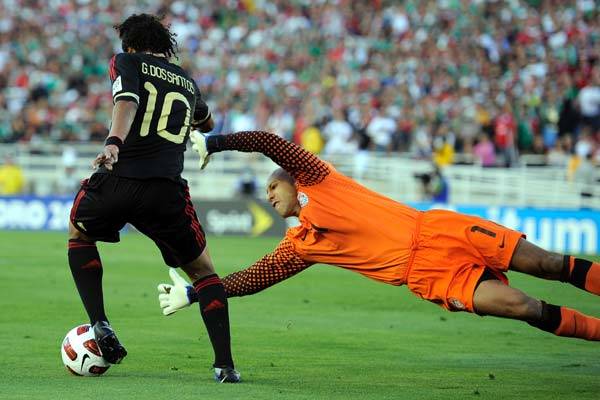
 Giovani Dos Santos jukes Tim Howard just before scoring
the goal of the Tournament, sealing Mexico's 4-2 win

Post-match commentary has been critical of coach Bob Bradley, suggesting that it is time for him to go so that a new man may be in place and fully in charge before World cup qualifying begins. Given that Bradley received a new four year contract shortly after the last World Cup, a replacement seems unlikely, although U.S. Soccer President Sunil Gulati seemed somewhat equivocal regarding his confidence in Bradley immediately following the Mexico match.

I think Bradley is in a damned if he does and damned if he doesn't situation -- criticized for being predictable, he actually tried some new things at the Gold Cup that worked (featuring Freddy Adu, then starting him, with considerable success, in the final; installing Eric Lichaj at left back) and some that didn't (mostly, naming Bornstein to the squad in the first place). The biggest thing that Bradley seems to have in his favor is that contract, and the fact that by all appearances U.S. Soccer attempted to find a big profile successor after the 2010 World Cup without success.

The women started their World Cup with a 2-0 over North Korea. The North Koreans were very young (10 players on their roster are under 20) and were technically skilled and the more consistently dangerous team in the first half, which ended 0-0. The Americans ramped up their attack in the second half and won 2-0.

Lauren Cheney (12) celebrates her crucial first goal against North Korea.

After the match, perhaps keeping in mind the humiliation to which the North Korean men's squad was subjected after their 2010 World Cup, the Korean coach explained the "real" reason why his team lost. Lightning. That's right, Kim-Kwang-min claimed that his keeper and his defenders (or strikers, depending on the translation) were victims of a lightning strike in training leading up to the match, leading to their substandard performance in the second half.

While the U.S. women probably won't have to hope that the Colombian women, their next opponents, suffered a similar fate in order to beat them, they will still have to show improvement, or hope for divine intervention, before facing Sweden (to whom they lost 2-1 in January) in the final match of group play, which will likely determine which team will be the number one seed in the group entering the knockout phase of the tournament.

Wednesday, June 22, 2011

What Exactly Is The State of U.S. Soccer?

With the United States men's national team in the midst of the Gold Cup and the women's team preparing for their World Cup which begins in Germany later this month, I've been thinking about where were are as a soccer nation and whether things are improving or not.

The men have not looked particularly good so far despite making it to the final after beating Panama 1-0 in the semis. The best news is probably that the U.S. was not in the same bracket as Mexico and will only have to play Los Tricolores once, in the final. Panama had beaten the U.S. 2-1 in group play in this tournament so the semi-final win was a measure of redemption or revenge for a team that had never before lost in group play in the Gold Cup.

The way that Mexico is playing, however, second may be the best that the U.S. can hope for in this Gold Cup. Given the way the Americans both won the Gold Cup in 2007 and finished first in CONCACAF qualifying leading to the 2010 World Cup, that concession is disturbing.

Clint Dempsey celebrates his goal against Jamaica.
Mexico looks like the younger, more innovative squad right now as the Yanks struggle to assimilate new players into the established backbone of Landon Donovan, Clint Dempsey, Jozy Altidore, Michael Bradley, Steve Cherundolo, and Tim Howard. Heck, even Freddie Adu (remember him?) played a role in the only goal against Panama in the semis. 

While the men have time to sort things out before the rigors of World Cup qualifying, the U.S. women enter their World Cup next week far from the role of clear favorites that they once enjoyed. Although the women's team is currently ranked first in the world, and won the gold medal at the Beijing Olympics, they have endured a string of inconsistent results in the past year.

After dominating World Cup qualifying for the past decade, the U.S. women lost to Mexico in the CONCACAF tournament semifinal  and had to beat Italy in a two-legged play-in to even reach the World Cup. They followed that up with a series of matches earlier this year, again with some inconsistent results.

Germany seems the odds-on favorite to win the WWC, as the host and after winning the last two (the U.S. finished third in both). Brazil and the U.S. lead the second tier of contenders, with Canada, Japan, and Sweden possibilities as well.

While the U.S. women are led by an experienced group including Abby Wambach and captain Christie Rampone, there are a number of younger players on the roster that could see significant playing time and perhaps tilt the scales in the Yanks' favor. Forwards Amy Rodriguez and Alex Morgan in particular may help inject some speed and youth into an attack that has seemed relatively predictable against well-organized defenses.

There certainly isn't the hype and anticipation for this team that surrounded the 1999 edition, even before Brandi Chastain took off her shirt.

The most famous picture in women's soccer history.

There was a time, even after the men's World Cup was held in the U.S. in 1994 and MLS started in 1996, when there seemed to be as much interest, or more, in the women's national team than the men. Whether because of the retirement of magnetic personalities and players like Mia Hamm, Julie Foudy, and Christine Lilly, or the disappointing finishes in recent tournaments that seem attributable in part to too many coaching changes or questionable coaching decisions on the national team, the women no longer enjoy much of the spotlight here.

The hope is that Wambach and company can restore a little of that luster this summer in Germany. After all, there's only one national team from the U.S. (and North America, for that matter) that has won a World Cup.