Two recent events have drawn my attention to the issues of sexual orientation, soccer, and the need for a modern day Jackie Robinson, not only in soccer but in all of men's sports.
I tend to think of soccer's culture, as it has grown in this country in the past two decades, as residing primarily among the white and upper middle class. While soccer was at one time largely the bastion of immigrants here, its recent explosion is no doubt due to suburban parents and players. From my interaction with coaches, players, parents, and fans, I regard soccer followers as tolerant folk.
In doing so I forget soccer's roots as the World's game, played by the lower and lower middle class, as a means of entertainment and escape (from reality and, occasionally, from their circumstances). While I've declined in
other posts to expound on the nature of sport as a substitute for combat or the hunt, it is undeniable that, in many other parts of the world, sport in general and soccer in particular are still viewed as somewhat gladiatorial.
This attitude is reflected by the attitudes towards, or restrictions placed on, women's soccer teams in many parts of the world, particularly in predominantly
Islamic countries. While these restrictions are purportedly based on Sharia law, they are certainly reflective, I believe, of the attitudes of those nations and cultures with regard to women and their place not only in sport but in society. And certainly the same issues are being fought out in broader society in
non-Islamic nations as well.
Lest we consider the "West" more enlightened, however, recent developments in Germany and England and less recently in Brazil all indicate differently, at least where sexual orientation is concerned.
Last week, as a parting plea upon his departure as president of the German Football Association ("DFB"),
Theo Zwanziger called for gay players "to have the courage to declare themselves." Zwanziger cited German politician Klaus Wowereit, the Mayor of Berlin, as an example of how a public figure acknowledging his or her own homosexuality can contribute towards making public acceptance of various sexual orientations more likely.
In response, Philipp Lahm, the captain of the German national team, described Zwanziger's plea as unrealistic. "Football is like being the gladiators in the old times," Lahm was quoted as saying. "The politicians can come out these days, for sure, but they don't have to play in front of 60,000 people every week."
Zwanziger, describing Lahm as a tolerant person, said that he wouldn't criticize Lahm for his views. But while they may be realistic, they certainly aren't brave.
Also last week,
news came that Blackburn Rovers were contemplating a bid for a Brazilian midfielder named Richarlyson. A midfielder and defender who has had a successful club career and won two caps for his national team, Richarlyson would seem to be the type of player in whom the big clubs of Europe would have an interest.
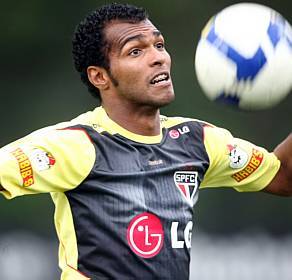 |
| Richarlyson |
But for the fact that he was publicly identified as gay, he might well have been. Richarlyson's outing (if it can be called that -- he has apparently neither admitted nor denied publicly that he is gay) occurred when the coach of a rival team
"accidentally" identified Richarlyson as the player in Brazil's top division who was
rumored to be gay.
It got worse for Richarlyson when, after suing the coach for defamation, the presiding judge
dismissed the lawsuit, reportedly on the grounds that soccer is a "virile masculine sport and not a homosexual one." The judge went so far as to suggest that because of his assumed sexual orientation "Richarlyson should be forever banished by FIFA and never be allowed to play football again".
The decision was appealed and Richarlyson's lawyers were quoted as saying that they would sue the judge as well but, although these incidents occurred in 2007, there is nothing on the internet (at least in English) to indicate that the judge was disciplined or a civil lawsuit was instituted against him. Not surprisingly, Richarlyson's professional career has not benefited from the controversy -- he transferred in 2010 from one of the biggest clubs in Brazil, Sao Paulo, and after two appearance with the national team in 2008 has not had another cap.
While I understand Lahm's position that a professional player would risk derision from fans and players if he were to come out, I can't help but think of the parallels between gay athletes today and those who fifty years ago broke the color barrier in professional sports in this country. The notion that the first "big name" professional athlete to declare his homosexuality would face more vitriol than Jackie Robinson or
Emlen Tunnell is, I believe, false.
It will no doubt take a player with the courage of his convictions, a thick skin, and athletic talent to be the first to break the orientation barrier, just as it did for football and baseball here. But once that barrier is broken, the benefits to other gay players, and ultimately to society, are immense.
Sports allow, even require, fans in particular and citizens in general to reevaluate their attitudes and prejudices towards certain groups. While the differences between the races are hardly resolved here, the fact that we have had in the past two years a national championship football team from the Deep South with a black quarterback and, in the past four, a black president, have to be accounted for, at least in part, by pioneer athletes who endured the threats and chants of those who were opposed to them solely because of the color of their skin a half century ago.
In the same way I believe that the first internationally recognized soccer player who steps up the the microphone and declares his sexuality will lead to the second, then the third, then many more. And he will no doubt have to endure years, perhaps a lifetime, of bigoted songs from the terraces (perhaps even those of his own club), physical threats, and the cold shoulder from some teammates. But the volume and ferocity of those chants and threats will lessen over time, and lessen with each additional player who comes out.
And when they do, when some day an admittedly gay player captains a World Cup squad or a Champions' League finalist, then everyone will have to acknowledge, on one level or another, that homosexual soccer players (or baseball players, or football players) can be just as skilled, just as committed, just as much a member of the team, as any heterosexual player.
Soccer needs its Jackie Robinson. He's out there somewhere. It's time for him to step forward.
 |
| We're waiting. |


